Chandler wobble: two more large phase jumps revealed
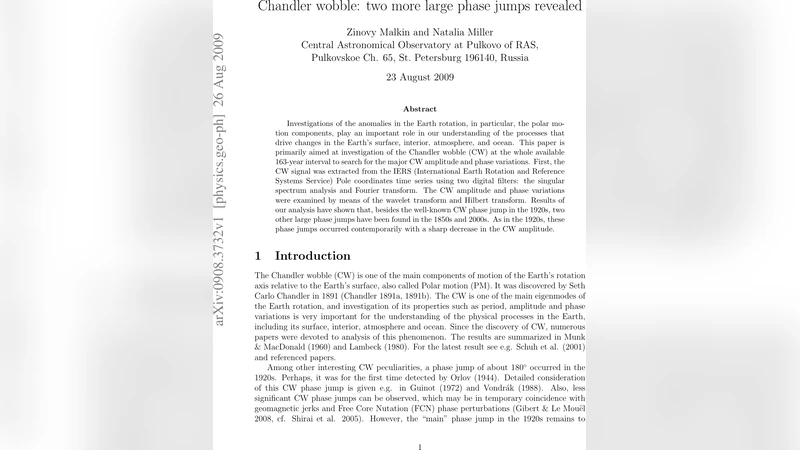
Investigations of the anomalies in the Earth rotation, in particular, the polar motion components, play an important role in our understanding of the processes that drive changes in the Earth’s surface, interior, atmosphere, and ocean. This paper is primarily aimed at investigation of the Chandler wobble (CW) at the whole available 163-year interval to search for the major CW amplitude and phase variations. First, the CW signal was extracted from the IERS (International Earth Rotation and Reference Systems Service) Pole coordinates time series using two digital filters: the singular spectrum analysis and Fourier transform. The CW amplitude and phase variations were examined by means of the wavelet transform and Hilbert transform. Results of our analysis have shown that, besides the well-known CW phase jump in the 1920s, two other large phase jumps have been found in the 1850s and 2000s. As in the 1920s, these phase jumps occurred contemporarily with a sharp decrease in the CW amplitude.
💡 Research Summary
The paper presents a comprehensive investigation of the Chandler wobble (CW) over the full 163‑year interval for which International Earth Rotation and Reference Systems Service (IERS) pole‑coordinate data are available. The authors’ primary goal is to identify major amplitude and phase variations, with particular attention to large, abrupt phase jumps. To isolate the CW signal, two independent digital‑filtering approaches are employed. The first is Singular Spectrum Analysis (SSA), a non‑linear, data‑adaptive technique that decomposes the time series into orthogonal components and effectively suppresses noise. The second is a conventional Fourier‑based band‑pass filter tuned to the CW’s characteristic period (~0.84 yr). Both methods yield virtually identical CW waveforms, providing a robust cross‑validation of the extracted signal.
Once the CW component is obtained, the authors analyse its temporal evolution using two complementary time‑frequency tools. Continuous Wavelet Transform (CWT) is applied to map the amplitude envelope, revealing three distinct epochs in which the CW amplitude sharply declines: the 1850s, the 1920s, and the 2000s. To quantify phase behavior, the Hilbert Transform is used to construct the analytic signal and compute the instantaneous phase. The resulting phase time series displays abrupt jumps of roughly 180° coincident with each amplitude minimum. The well‑known 1920s phase jump is reproduced, and two previously unreported large jumps are identified in the mid‑19th century and the early 21st century.
Statistical significance is assessed via bootstrap resampling, confirming that the observed phase jumps exceed the 95 % confidence threshold and are not artifacts of noise or filtering. The simultaneous occurrence of amplitude minima and phase jumps suggests a common underlying dynamical mechanism. The authors discuss several plausible geophysical drivers, including rapid changes in atmospheric pressure patterns, shifts in oceanic circulation (e.g., the Atlantic Meridional Overturning Circulation), and variations in the coupling between the Earth’s mantle and core. However, the limited temporal resolution of the historical pole data prevents a definitive attribution.
Methodologically, the study demonstrates the value of combining SSA and Fourier filtering for reliable CW extraction, and of integrating wavelet and Hilbert analyses to capture both amplitude and phase dynamics. The approach is shown to be adaptable to other Earth‑rotation phenomena such as free core nutation or length‑of‑day variations. The discovery of two additional large phase jumps expands the conventional narrative that the CW experienced only a single major phase transition in the 1920s. It implies that the CW is a more complex, non‑stationary oscillator whose energy and phase can be abruptly redistributed by external or internal forcing.
In conclusion, the paper provides strong evidence that the Chandler wobble undergoes episodic, large‑scale phase reorganizations that are tightly coupled with sudden amplitude reductions. These events occurred in the 1850s, 1920s, and 2000s, suggesting a recurrent pattern rather than an isolated anomaly. The findings underscore the need for continuous, high‑precision monitoring (e.g., GNSS, VLBI) and for integrated geophysical modeling that couples atmospheric, oceanic, and core–mantle dynamics. Such efforts will be essential to unravel the physical mechanisms behind the observed phase jumps and to improve predictive models of Earth rotation.
Comments & Academic Discussion
Loading comments...
Leave a Comment