Galactic positrons and electrons from dark matter and astrophysical sources
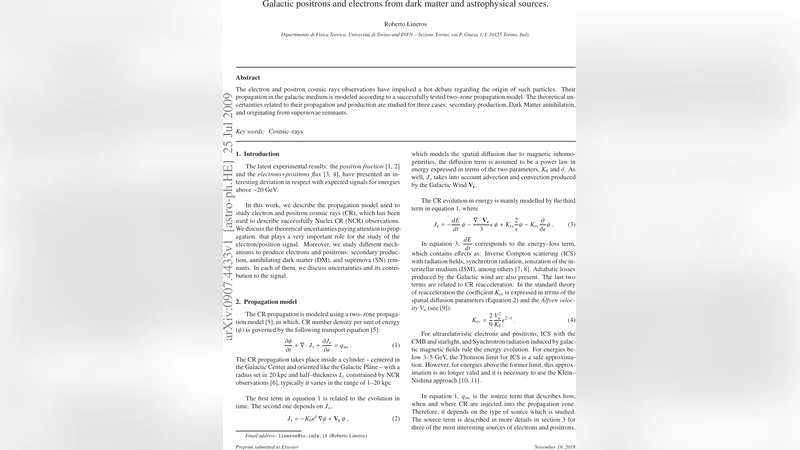
The electron and positron cosmic rays observations have impulsed a hot debate regarding the origin of such particles. Their propagation in the galactic medium is modeled according to a successfully tested two–zone propagation model. The theoretical uncertainties related to their propagation and production are studied for three cases: secondary production, Dark Matter annihilation, and originating from supernovae remnants.
💡 Research Summary
The paper presents a comprehensive study of the origin of Galactic cosmic‑ray electrons and positrons in light of recent high‑precision measurements by AMS‑02, PAMELA, DAMPE, and CALET. The authors adopt a well‑tested two‑zone diffusion model, separating the Galactic disk and halo, each characterized by its own diffusion coefficient D(E)=D0(E/E0)δ, halo height L, convective wind Vc, and energy‑loss processes (synchrotron, inverse‑Compton, bremsstrahlung). By fitting secondary‑to‑primary ratios such as B/C and radioactive isotopes (¹⁰Be/⁹Be), they constrain the propagation parameters to L≈4–10 kpc, δ≈0.33–0.5, and D0≈(3–7)×10²⁸ cm² s⁻¹, establishing a realistic uncertainty band for subsequent source modeling.
Three distinct source classes are examined: (i) secondary production from hadronic interactions of primary cosmic‑ray nuclei with interstellar gas, (ii) dark‑matter (DM) annihilation, and (iii) primary acceleration in supernova‑remnant (SNR) shocks with an additional positron component. For the secondary component, the authors use up‑to‑date pp cross‑sections and a detailed gas density model. Their calculations show that in the 10–100 GeV range secondary positrons account for roughly 30–50 % of the measured flux, with the dominant uncertainties arising from the gas density distribution and nuclear cross‑sections (≈±20 %).
The DM analysis explores a wide mass range (10 GeV–10 TeV) and several annihilation channels (b b̄, W⁺W⁻, μ⁺μ⁻, τ⁺τ⁻). The source term QDM(E)∝⟨σv⟩/mχ²·dN/dE·ρ²(r) is folded with the propagation model. The μ⁺μ⁻ channel produces a hard spectrum that can reproduce the observed rise above ~300 GeV, but the required thermally‑averaged cross‑section ⟨σv⟩≈3×10⁻²⁶ cm³ s⁻¹ typically overshoots gamma‑ray limits from the Galactic Center and dwarf spheroidals, as well as neutrino constraints from IceCube. Consequently, only a narrow region of parameter space—often invoking boost factors, Sommerfeld enhancement, or non‑standard halo profiles—remains viable.
For the SNR scenario, the authors adopt a diffusive shock acceleration framework and introduce a positron‑to‑electron ratio η in the range 0.01–0.1, motivated by recent measurements of pulsar wind nebulae and theoretical estimates of hadronic interactions in shock environments. By integrating over the Galactic SNR distribution (≈3 per century) and accounting for age‑dependent energy losses, they find that SNRs can dominate the positron flux up to ~200 GeV. However, at higher energies the SNR contribution falls steeply, requiring an additional hard component—either DM or pulsar wind nebulae—to explain the data.
A systematic sensitivity analysis reveals that propagation uncertainties (L, δ, Vc) affect the secondary and SNR components at the 10–30 % level, while they can change the DM‑induced flux by factors of two or more. Nuclear cross‑section and gas density variations introduce comparable uncertainties. The paper emphasizes that a single source class cannot simultaneously fit the entire energy spectrum; a mixed model with secondary production at low energies, SNRs at intermediate energies, and a hard component (DM or pulsars) at the highest energies provides the best overall description.
In conclusion, the study demonstrates that the current electron‑positron data place stringent, multi‑messenger constraints on dark‑matter interpretations and highlight the importance of precise propagation modeling. Future observations—especially improved gamma‑ray maps, neutrino flux limits, and refined secondary‑to‑primary ratios—will be crucial to shrink the allowed parameter space and to disentangle the relative contributions of astrophysical accelerators and possible exotic sources.
Comments & Academic Discussion
Loading comments...
Leave a Comment