Mapping the evolution of scientific fields
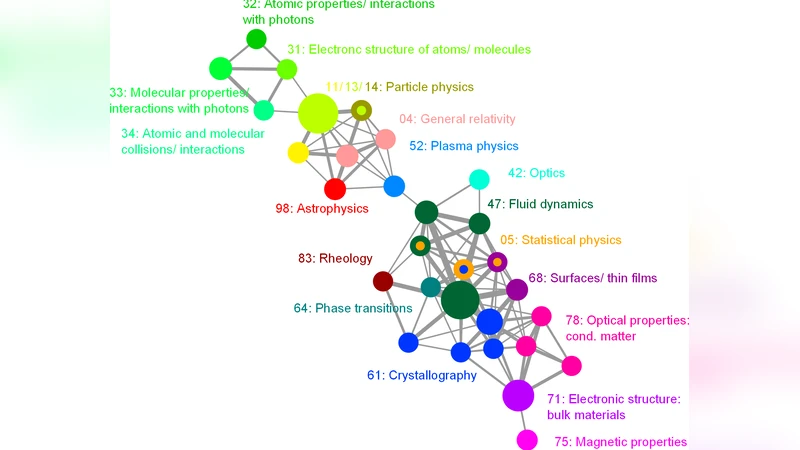
Despite the apparent cross-disciplinary interactions among scientific fields, a formal description of their evolution is lacking. Here we describe a novel approach to study the dynamics and evolution of scientific fields using a network-based analysis. We build an idea network consisting of American Physical Society Physics and Astronomy Classification Scheme (PACS) numbers as nodes representing scientific concepts. Two PACS numbers are linked if there exist publications that reference them simultaneously. We locate scientific fields using a community finding algorithm, and describe the time evolution of these fields over the course of 1985-2006. The communities we identify map to known scientific fields, and their age depends on their size and activity. We expect our approach to quantifying the evolution of ideas to be relevant for making predictions about the future of science and thus help to guide its development.
💡 Research Summary
The paper introduces a network‑based methodology for quantifying the dynamics and evolution of scientific fields. Using the American Physical Society’s Physics and Astronomy Classification Scheme (PACS) as a proxy for individual research concepts, the authors construct an “idea network” in which each PACS code is a node and an undirected, weighted edge connects two nodes whenever they co‑appear in the reference list of a single paper. The weight of an edge corresponds to the number of papers that jointly cite the two codes. To reduce noise, edges with weights below a chosen threshold are pruned.
The dataset spans all APS journal articles published between 1985 and 2006, providing a longitudinal series of yearly network snapshots. For each snapshot, the authors apply the Louvain community‑detection algorithm, which optimizes modularity to partition the network into densely interconnected subgraphs. These subgraphs are interpreted as distinct scientific fields or research topics. By tracking the composition of communities across successive years, the authors map the birth, growth, merging, splitting, and disappearance of fields over the 22‑year period.
Three quantitative descriptors are defined for each community: (1) size, measured by the number of unique PACS codes it contains; (2) activity, measured by the total (or average) number of papers associated with the community in a given year; and (3) age, defined as the elapsed time from the community’s first appearance to the current year. Statistical analysis reveals a strong positive correlation between size and activity: larger communities tend to generate more publications and persist longer, whereas small, low‑activity communities are often short‑lived. This relationship suggests that resource concentration and collaborative intensity are key determinants of a field’s longevity.
The identified communities map closely onto well‑known physics sub‑disciplines such as quantum information, statistical mechanics of nonequilibrium systems, and high‑energy particle physics. Importantly, the network also uncovers interdisciplinary clusters that are not captured by traditional classification schemes—for example, a hybrid community linking quantum optics with condensed‑matter theory, reflecting emerging cross‑fertilization among researchers. The authors validate their community assignments by comparing them with expert‑curated field taxonomies and find high concordance, demonstrating that the network approach captures the underlying intellectual structure of the discipline.
Limitations of the study are acknowledged. PACS codes are specific to physics and astronomy, so the method’s applicability to other domains (biology, social sciences, engineering) requires integration with broader classification systems such as Web of Science categories or Scopus subject areas. Moreover, the choice of edge‑weight threshold can influence community detection outcomes; a systematic sensitivity analysis is needed to ensure robustness.
Future work is outlined along two main avenues. First, extending the framework to a multi‑disciplinary corpus would enable a universal map of scientific ideas, facilitating cross‑field comparisons and the detection of global innovation hotspots. Second, coupling the temporal network data with machine‑learning predictive models could allow forecasting of emerging fields, identification of potentially declining areas, and scenario analysis for science‑policy planning. By providing a quantitative, data‑driven picture of how ideas coalesce, diverge, and evolve, the proposed methodology offers a powerful tool for researchers, funding agencies, and policymakers aiming to steer the future trajectory of science.
Comments & Academic Discussion
Loading comments...
Leave a Comment