Polynomial hierarchy, Betti numbers and a real analogue of Todas theorem
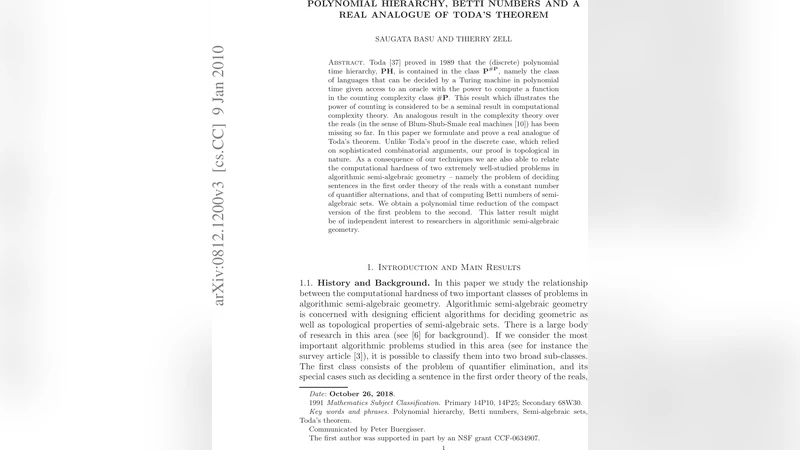
Toda proved in 1989 that the (discrete) polynomial time hierarchy, $\mathbf{PH}$, is contained in the class $\mathbf{P}^{#\mathbf{P}}$, namely the class of languages that can be decided by a Turing machine in polynomial time given access to an oracle with the power to compute a function in the counting complexity class $#\mathbf{P}$. This result which illustrates the power of counting is considered to be a seminal result in computational complexity theory. An analogous result in the complexity theory over the reals (in the sense of Blum-Shub-Smale real machines) has been missing so far. In this paper we formulate and prove a real analogue of Toda’s theorem. Unlike Toda’s proof in the discrete case, which relied on sophisticated combinatorial arguments, our proof is topological in nature. As a consequence of our techniques we are also able to relate the computational hardness of two extremely well-studied problems in algorithmic semi-algebraic geometry – namely the problem of deciding sentences in the first order theory of the reals with a constant number of quantifier alternations, and that of computing Betti numbers of semi-algebraic sets. We obtain a polynomial time reduction of the compact version of the first problem to the second. This latter result might be of independent interest to researchers in algorithmic semi-algebraic geometry.
💡 Research Summary
**
The paper establishes a real‑number analogue of Toda’s theorem, showing that the polynomial‑time hierarchy over the Blum‑Shub‑Smale (BSS) model of computation, denoted PHℝ, is contained in the class P^{#Pℝ}. In the classical discrete setting, Toda’s theorem (1989) proved PH ⊆ P^{#P} by means of intricate combinatorial arguments that exploit integer counting. Over the reals, however, inputs are continuous and quantifier alternations correspond to geometric constraints on semi‑algebraic sets, so a purely counting‑based approach does not transfer directly.
The authors replace counting with a topological invariant: the Betti numbers of semi‑algebraic (more precisely, complement‑of‑algebraic) sets. A Betti number counts the number of independent i‑dimensional holes, and can be expressed as the rank of homology groups of a suitable chain complex. By constructing a “compactification” transformation that maps any PHℝ formula into a complement‑of‑algebraic set whose Betti numbers encode the truth value of the original formula, they obtain a reduction from logical decision to topological computation. The transformation works as follows: each quantified block is replaced by a bounded interval, the order of quantifiers is reversed, and the resulting system of polynomial inequalities defines a compact semi‑algebraic set. Using classical results such as the Mayer‑Vietoris sequence, inclusion‑exclusion for Euler characteristics, and the Masur–Smale theorem on the stability of Betti numbers under quantifier elimination, they prove that the Betti numbers are invariant under this reversal and therefore faithfully reflect the original logical outcome.
Given an oracle that can compute #Pℝ functions (i.e., count the number of real solutions of a system of polynomial equations), one can also compute Betti numbers in polynomial time, because the latter can be expressed as alternating sums of solution counts of auxiliary systems. Consequently, any language in PHℝ can be decided by a polynomial‑time BSS machine equipped with a #Pℝ oracle, establishing PHℝ ⊆ P^{#Pℝ}. This constitutes the real‑number version of Toda’s theorem.
Beyond the main inclusion, the paper investigates the relationship between two well‑studied problems in algorithmic semi‑algebraic geometry: (1) deciding sentences of the first‑order theory of the reals with a constant number of quantifier alternations (the “constant‑alternation” fragment of PHℝ), and (2) computing the Betti numbers of semi‑algebraic sets. By applying the compactification reduction, the authors give a polynomial‑time many‑one reduction from the former to the latter. In other words, if one can compute Betti numbers efficiently, one can also decide any constant‑alternation real sentence efficiently. This reduction not only clarifies the relative hardness of these problems but also suggests that Betti‑number computation is at least as hard as the most difficult decision problems in the constant‑alternation fragment.
The paper also discusses algorithmic implications. Existing algorithms for Betti numbers run in time exponential in the number of variables or the degree of the defining polynomials. The topological viewpoint introduced here hints at the possibility of designing algorithms whose complexity is polynomial in the size of the input, provided a #Pℝ oracle is available. Moreover, the authors outline several avenues for future work: extending the framework to non‑compact semi‑algebraic sets, investigating other topological invariants (e.g., persistent homology) in the context of complexity classes, and exploring analogous results for the complex BSS model or quantum BSS machines.
In summary, the paper delivers a conceptually new proof of a real‑analogue of Toda’s theorem, grounded in algebraic topology rather than combinatorial counting, and leverages this proof to bridge decision problems in the real first‑order theory with the computational topology of semi‑algebraic sets. This connection enriches both fields, offering new tools for complexity theorists and new hardness results for researchers in algorithmic semi‑algebraic geometry.
Comments & Academic Discussion
Loading comments...
Leave a Comment