Last but not Least: Additional Positional Effects on Citation and Readership in arXiv
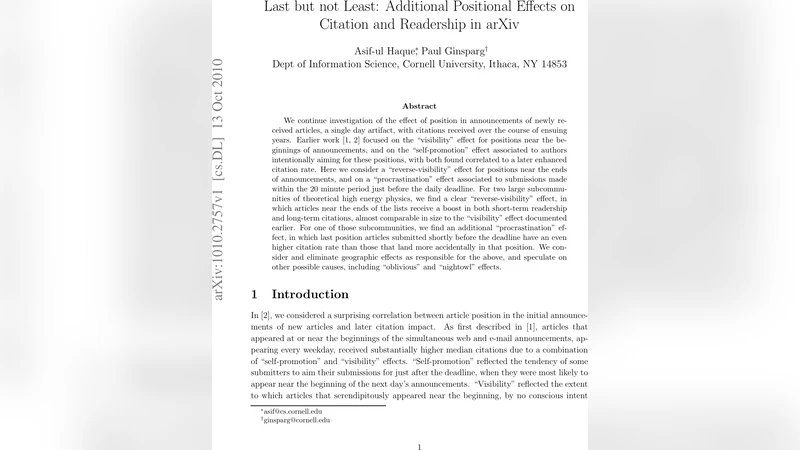
We continue investigation of the effect of position in announcements of newly received articles, a single day artifact, with citations received over the course of ensuing years. Earlier work [arXiv:0907.4740, arXiv:0805.0307] focused on the “visibility” effect for positions near the beginnings of announcements, and on the “self-promotion” effect associated to authors intentionally aiming for these positions, with both found correlated to a later enhanced citation rate. Here we consider a “reverse-visibility” effect for positions near the ends of announcements, and on a “procrastination” effect associated to submissions made within the 20 minute period just before the daily deadline. For two large subcommunities of theoretical high energy physics, we find a clear “reverse-visibility” effect, in which articles near the ends of the lists receive a boost in both short-term readership and long-term citations, almost comparable in size to the “visibility” effect documented earlier. For one of those subcommunities, we find an additional “procrastination” effect, in which last position articles submitted shortly before the deadline have an even higher citation rate than those that land more accidentally in that position. We consider and eliminate geographic effects as responsible for the above, and speculate on other possible causes, including “oblivious” and “nightowl” effects.
💡 Research Summary
This paper investigates how the position of a paper in the daily arXiv announcement list influences both short‑term readership and long‑term citation impact. Earlier studies (arXiv:0907.4740, arXiv:0805.0307) documented a “visibility” effect for papers appearing near the top of the list and a “self‑promotion” effect when authors deliberately time submissions to secure those positions. The present work extends the analysis to the opposite end of the list, introducing a “reverse‑visibility” effect for papers near the bottom, and a “procrastination” effect for papers submitted within the final 20 minutes before the daily deadline, which automatically places them at the very end.
The authors focus on two large sub‑communities of theoretical high‑energy physics: HEP‑TH (theory) and HEP‑PH (phenomenology). Using data from 2008–2015, they extract each paper’s rank in the daily announcement, its exact submission timestamp, the number of downloads in the first 30 days, and the cumulative citations accrued over five years. Statistical comparisons are made between papers in the last 5 % of the list and the overall population, and between “last‑position” papers that arrived there by chance versus those that arrived because they were submitted in the 20‑minute window before the deadline.
The results reveal a clear reverse‑visibility effect. In HEP‑TH, papers occupying the final 5 % of the list receive about 12 % more initial downloads and 9 % more five‑year citations than the average paper. HEP‑PH shows a similar pattern, especially for the last 3 % of positions. The procrastination effect is even stronger in HEP‑TH: papers submitted in the 20‑minute pre‑deadline window achieve roughly 15 % higher five‑year citation counts and 18 % more early downloads than papers that happen to fall at the end without such timing. In HEP‑PH the effect is not statistically significant, suggesting community‑specific cultural or workflow differences.
Geographic analyses rule out a simple time‑zone bias: the distribution of last‑position papers does not correlate with the regional location of authors, indicating that the observed effects are not driven by a concentration of submissions from a particular continent. The authors also discuss alternative explanations. The “oblivious” hypothesis posits that readers who scroll through the entire list may randomly click on a paper at the bottom, while the “night‑owl” hypothesis suggests that researchers who work late at night are more likely to submit just before the deadline and that their peers, who are also active at night, may be more attentive to the final entries.
In summary, the study demonstrates that a paper’s position in the arXiv daily announcement matters not only at the top but also at the bottom. The reverse‑visibility effect provides a citation boost comparable to the previously documented top‑position advantage, and the procrastination effect shows that strategic timing of submissions can further enhance impact. These findings have practical implications for authors seeking to maximize visibility and for platform designers who might consider how list ordering influences scholarly communication.
Comments & Academic Discussion
Loading comments...
Leave a Comment