Enumeration of the Monomials of a Polynomial and Related Complexity Classes
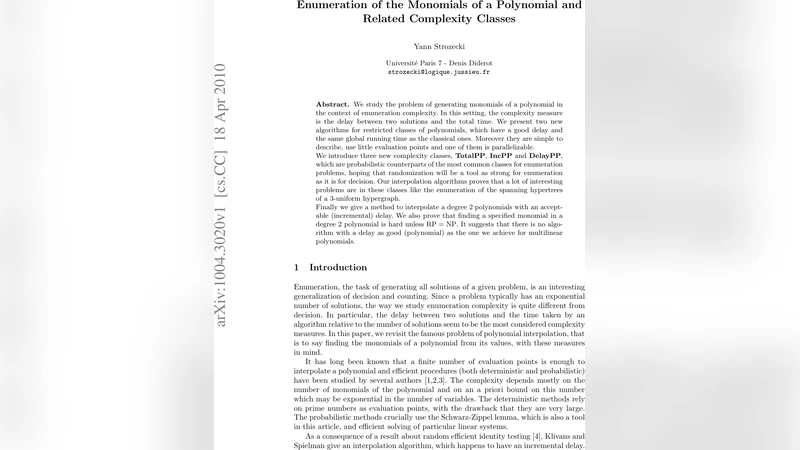
We study the problem of generating monomials of a polynomial in the context of enumeration complexity. In this setting, the complexity measure is the delay between two solutions and the total time. We present two new algorithms for restricted classes of polynomials, which have a good delay and the same global running time as the classical ones. Moreover they are simple to describe, use little evaluation points and one of them is parallelizable. We introduce three new complexity classes, TotalPP, IncPP and DelayPP, which are probabilistic counterparts of the most common classes for enumeration problems, hoping that randomization will be a tool as strong for enumeration as it is for decision. Our interpolation algorithms proves that a lot of interesting problems are in these classes like the enumeration of the spanning hypertrees of a 3-uniform hypergraph. Finally we give a method to interpolate a degree 2 polynomials with an acceptable (incremental) delay. We also prove that finding a specified monomial in a degree 2 polynomial is hard unless RP = NP. It suggests that there is no algorithm with a delay as good (polynomial) as the one we achieve for multilinear polynomials.
💡 Research Summary
The paper investigates the enumeration of monomials of a polynomial from the viewpoint of enumeration complexity, where the primary performance measures are delay (the time between successive outputs) and total running time. While classical enumeration algorithms often achieve polynomial total time, they may suffer from large worst‑case gaps between consecutive solutions. The authors address this gap by presenting two new algorithms that are tailored to restricted families of polynomials and that improve the delay without sacrificing overall efficiency.
Algorithmic contributions
- Multilinear case – For polynomials in which each variable appears with exponent at most one, the authors design an interpolation‑based method that uses only a constant (indeed, a small) number of evaluation points. By evaluating the polynomial at these points and solving a linear system, the coefficients of all monomials are recovered. Crucially, each monomial is output as soon as it is identified, yielding a polynomial‑bounded delay. The algorithm is conceptually simple, requires little extra memory, and matches the classical total‑time bound.
- Parallelizable variant – The same interpolation framework is adapted so that the evaluation points can be processed concurrently on multiple processors. This parallel version retains the same delay guarantee while achieving near‑linear speed‑up in total time on modern multi‑core or distributed platforms.
Probabilistic enumeration classes
To capture the effect of randomisation on enumeration, the authors introduce three new complexity classes that are probabilistic analogues of the well‑known deterministic enumeration classes:
- TotalPP – The total running time of the enumeration algorithm is bounded by a randomized polynomial‑time procedure (i.e., lies in RP/BPP).
- IncPP – The incremental delay (the time to produce the i‑th solution after the (i‑1)‑st) is bounded by a randomized polynomial in the input size and i.
- DelayPP – A fixed polynomial bound exists on the worst‑case gap between any two consecutive solutions, again with a randomized guarantee.
These definitions mirror the role of RP/BPP in decision problems and suggest that randomisation can be equally powerful for enumeration tasks.
Applications and hardness results
The paper demonstrates that several natural combinatorial enumeration problems fall into the newly defined classes. A prominent example is the enumeration of spanning hypertrees in a 3‑uniform hypergraph. By applying the multilinear interpolation algorithm to the generating polynomial of hypertrees, the authors show that this problem belongs to DelayPP, meaning that each hypertree can be output with polynomially bounded delay.
For quadratic (degree‑2) polynomials, the authors present an incremental‑delay algorithm that enumerates all monomials with a delay that grows polynomially with the number of already produced monomials. However, they also prove a complementary hardness result: locating a specified monomial (e.g., the coefficient of a particular variable pair) in a degree‑2 polynomial is NP‑hard unless RP = NP. This indicates that, unlike the multilinear case, achieving polynomial delay for arbitrary queries on quadratic polynomials is unlikely.
Structure of the paper
- Introduction – Defines enumeration complexity, reviews existing deterministic classes (TotalP, IncP, DelayP), and motivates the need for probabilistic counterparts.
- Algorithms for multilinear polynomials – Details the two algorithms, provides correctness proofs, and analyses delay and total time.
- Probabilistic enumeration classes – Formal definitions of TotalPP, IncPP, DelayPP, and discussion of their relationships to RP/BPP and to each other.
- Spanning hypertrees of 3‑uniform hypergraphs – Constructs the generating polynomial, applies the multilinear algorithm, and proves inclusion in DelayPP.
- Quadratic polynomials – Gives an incremental‑delay enumeration method, then establishes the NP‑hardness of the “find‑a‑given‑monomial” problem under the RP ≠ NP assumption.
- Conclusion and future work – Highlights the significance of randomisation for enumeration, suggests extensions to higher‑degree polynomials, and proposes investigating derandomisation possibilities.
Overall, the work makes a substantial contribution by (i) providing concrete algorithms that achieve good delay for important subclasses of polynomials, (ii) formalising a probabilistic hierarchy for enumeration problems, and (iii) showing both positive (spanning hypertrees) and negative (specific monomial search in quadratic polynomials) results that delineate the limits of randomised enumeration. The blend of algorithmic design, complexity‑theoretic classification, and concrete combinatorial applications positions this paper as a foundational step toward a richer theory of randomized enumeration.
Comments & Academic Discussion
Loading comments...
Leave a Comment