Rigorous confidence bounds for MCMC under a geometric drift condition
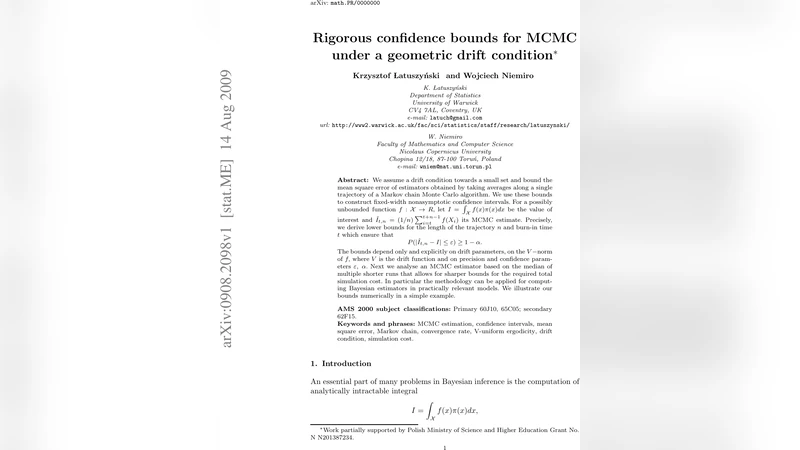
We assume a drift condition towards a small set and bound the mean square error of estimators obtained by taking averages along a single trajectory of a Markov chain Monte Carlo algorithm. We use these bounds to construct fixed-width nonasymptotic confidence intervals. For a possibly unbounded function $f:\stany \to R,$ let $I=\int_{\stany} f(x) \pi(x) dx$ be the value of interest and $\hat{I}{t,n}=(1/n)\sum{i=t}^{t+n-1}f(X_i)$ its MCMC estimate. Precisely, we derive lower bounds for the length of the trajectory $n$ and burn-in time $t$ which ensure that $$P(|\hat{I}_{t,n}-I|\leq \varepsilon)\geq 1-\alpha.$$ The bounds depend only and explicitly on drift parameters, on the $V-$norm of $f,$ where $V$ is the drift function and on precision and confidence parameters $\varepsilon, \alpha.$ Next we analyse an MCMC estimator based on the median of multiple shorter runs that allows for sharper bounds for the required total simulation cost. In particular the methodology can be applied for computing Bayesian estimators in practically relevant models. We illustrate our bounds numerically in a simple example.
💡 Research Summary
The paper addresses a fundamental practical problem in Markov chain Monte Carlo (MCMC) simulation: how to choose a burn‑in period and a trajectory length that guarantee a prescribed accuracy and confidence without relying on asymptotic approximations. The authors work under a geometric drift condition toward a small set, a standard assumption that ensures geometric ergodicity in a weighted V‑norm. Concretely, there exists a function V ≥ 1, a contraction factor λ ∈ (0,1) and a constant b such that the one‑step kernel P satisfies PV(x) ≤ λ V(x) + b 1_C(x) for a measurable “small” set C. This condition allows the authors to control the dependence structure of the chain through explicit constants that appear in subsequent error bounds.
The central technical contribution is an explicit, non‑asymptotic bound on the mean‑square error (MSE) of the usual time‑average estimator
\
Comments & Academic Discussion
Loading comments...
Leave a Comment