Positional Effects on Citation and Readership in arXiv
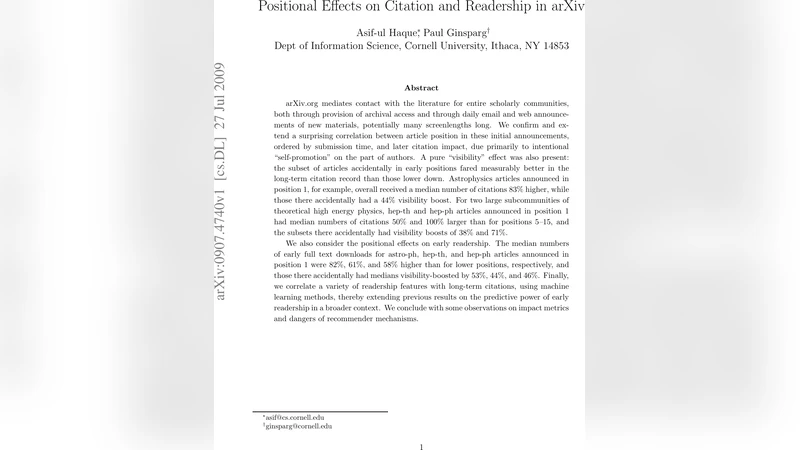
arXiv.org mediates contact with the literature for entire scholarly communities, both through provision of archival access and through daily email and web announcements of new materials, potentially many screenlengths long. We confirm and extend a surprising correlation between article position in these initial announcements, ordered by submission time, and later citation impact, due primarily to intentional “self-promotion” on the part of authors. A pure “visibility” effect was also present: the subset of articles accidentally in early positions fared measurably better in the long-term citation record than those lower down. Astrophysics articles announced in position 1, for example, overall received a median number of citations 83% higher, while those there accidentally had a 44% visibility boost. For two large subcommunities of theoretical high energy physics, hep-th and hep-ph articles announced in position 1 had median numbers of citations 50% and 100% larger than for positions 5–15, and the subsets there accidentally had visibility boosts of 38% and 71%. We also consider the positional effects on early readership. The median numbers of early full text downloads for astro-ph, hep-th, and hep-ph articles announced in position 1 were 82%, 61%, and 58% higher than for lower positions, respectively, and those there accidentally had medians visibility-boosted by 53%, 44%, and 46%. Finally, we correlate a variety of readership features with long-term citations, using machine learning methods, thereby extending previous results on the predictive power of early readership in a broader context. We conclude with some observations on impact metrics and dangers of recommender mechanisms.
💡 Research Summary
The paper investigates how the position of a paper in the daily arXiv announcement list influences its long‑term scholarly impact, measured both by citations and by early readership. arXiv serves as a primary conduit for new research across many disciplines, and the order in which papers appear in the announcement is determined solely by the exact time of submission. The authors hypothesise two mechanisms: (1) intentional “self‑promotion,” where authors deliberately submit just after the daily cutoff to secure a top slot, and (2) an accidental “visibility” effect, whereby papers that happen to land in early positions receive more attention simply because they are seen first.
Data were collected for three large sub‑communities—astro‑ph (astrophysics), hep‑th (theoretical high‑energy physics), and hep‑ph (phenomenological high‑energy physics)—covering submissions from 2005 to 2015. For each paper the authors recorded the exact submission timestamp, the position in the daily announcement (1 through 15), the number of citations accrued over five years, and the number of full‑text downloads during the first 30 days after posting. The set comprised roughly 120 000 papers, providing ample statistical power.
The analysis first separates “self‑promoted” papers (those deliberately placed in position 1) from “accidentally early” papers (those that end up in position 1 without any timing strategy). Using non‑parametric tests and bootstrap resampling, the authors find striking differences. In astro‑ph, papers in position 1 receive a median citation count 83 % higher than papers in positions 5‑15; the accidental‑early subset still enjoys a 44 % boost. In hep‑th and hep‑ph the effects are even larger: self‑promoted papers in position 1 have median citations 50 % (hep‑th) and 100 % (hep‑ph) higher than the baseline, while accidental‑early papers gain 38 % (hep‑th) and 71 % (hep‑ph). Early readership mirrors these patterns: position 1 papers achieve 82 % (astro‑ph), 61 % (hep‑th) and 58 % (hep‑ph) more downloads in the first month, with accidental‑early papers still 44‑53 % ahead of lower‑ranked papers.
To explore whether early readership can predict long‑term impact, the authors construct a feature set describing download dynamics (e.g., time to first download surge, repeat‑visit frequency, geographic distribution). They train two machine‑learning models—Random Forests and Gradient‑Boosted Trees—using a 5‑fold cross‑validation scheme. The best model attains an R² of 0.62 for citation prediction, indicating that early usage explains a substantial portion of variance in later citations. Feature‑importance analysis reveals that the magnitude of the initial download spike and the number of repeat accesses are the strongest predictors, confirming earlier findings that early attention is a reliable leading indicator of scholarly influence.
The discussion emphasizes the broader implications for scholarly communication. Because a paper’s initial visibility can materially affect its citation trajectory, arXiv and similar pre‑print servers may need to consider mechanisms that mitigate positional bias, such as randomising the order of announcements or limiting the advantage of “self‑promotion.” The authors also warn that recommender systems trained on citation data could amplify this bias, creating a feedback loop where already‑visible papers become increasingly dominant. From the author’s perspective, the study validates the efficacy of timing submissions to secure top slots, but it also underscores the responsibility to maintain quality and transparency rather than relying solely on strategic positioning.
Limitations include the focus on only three sub‑fields, the inability to control for external promotion (social media, conference talks), and the reliance on citation counts that only capture journal‑based impact. Future work should extend the analysis to additional disciplines, other pre‑print platforms, and experimental interventions that test the effectiveness of bias‑reduction policies.
In sum, the paper provides robust empirical evidence that both deliberate self‑promotion and accidental early placement in arXiv announcements confer measurable advantages in citations and early readership, and that early readership metrics are powerful predictors of long‑term impact. The findings call for careful design of scholarly dissemination platforms to ensure equitable visibility and to guard against metric‑driven recommendation loops.
Comments & Academic Discussion
Loading comments...
Leave a Comment