The Minimum-Rank Gram Matrix Completion via Modified Fixed Point Continuation Method
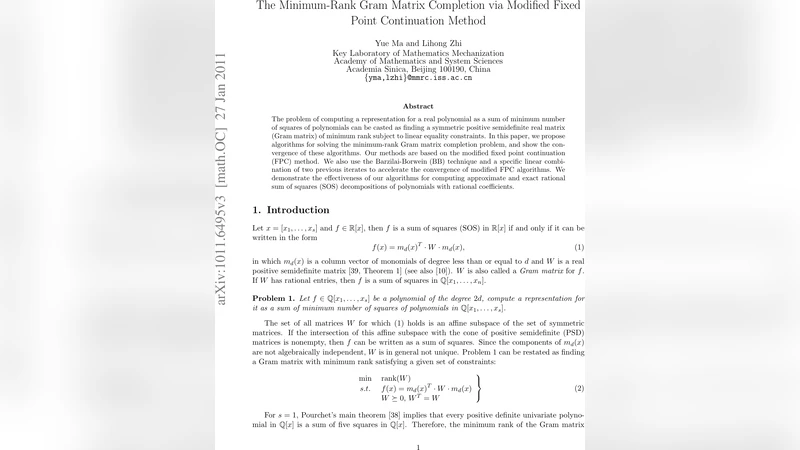
The problem of computing a representation for a real polynomial as a sum of minimum number of squares of polynomials can be casted as finding a symmetric positive semidefinite real matrix (Gram matrix) of minimum rank subject to linear equality constraints. In this paper, we propose algorithms for solving the minimum-rank Gram matrix completion problem, and show the convergence of these algorithms. Our methods are based on the modified fixed point continuation (FPC) method. We also use the Barzilai-Borwein (BB) technique and a specific linear combination of two previous iterates to accelerate the convergence of modified FPC algorithms. We demonstrate the effectiveness of our algorithms for computing approximate and exact rational sum of squares (SOS) decompositions of polynomials with rational coefficients.
💡 Research Summary
The paper addresses the problem of representing a real‑coefficient polynomial as a sum of the smallest possible number of squares of other polynomials. This task can be reformulated as finding a symmetric positive semidefinite Gram matrix (Q) that satisfies a set of linear equality constraints (derived from matching the coefficients of the original polynomial) while having minimal rank. Since direct rank minimization is NP‑hard, the authors adopt the standard convex relaxation that replaces the rank function with the nuclear norm (|Q|_* = \sum_i \sigma_i(Q)). The resulting optimization problem is a nuclear‑norm minimization subject to linear constraints, a formulation that has been extensively studied in matrix completion and low‑rank recovery.
To solve this convex problem, the authors build on the Fixed Point Continuation (FPC) method. FPC alternates between a gradient step that reduces the violation of the linear constraints and a soft‑thresholding step that shrinks the singular values of the current iterate, thereby decreasing the nuclear norm. The soft‑thresholding operation is implemented via a singular value decomposition (SVD) followed by (\sigma_i \leftarrow \max{0,\sigma_i-\tau}) for a chosen threshold (\tau). While the basic FPC algorithm converges, its practical speed is limited by a fixed step size.
The main technical contribution is a “modified” FPC that incorporates two acceleration techniques. First, the Barzilai‑Borwein (BB) step‑size rule is used to adaptively choose the gradient step length. The BB step size (\alpha_k = \frac{\langle s_{k-1}, s_{k-1}\rangle}{\langle s_{k-1}, y_{k-1}\rangle}) (with (s_{k-1}=Q^k-Q^{k-1}) and (y_{k-1}=\nabla f(Q^k)-\nabla f(Q^{k-1}))) captures curvature information without requiring a line search, leading to much faster progress in the early iterations. Second, a Nesterov‑type momentum term is added: after each FPC‑BB update, the new iterate is formed as (Q^{k}=Q^{k-1}+ \beta_k (Q^{k-1}-Q^{k-2})), where (\beta_k) follows a classic schedule such as (\beta_k = \frac{k-1}{k+2}) or is tuned empirically. This momentum exploits information from two previous iterates, reducing oscillations and achieving an (\mathcal{O}(1/k^2)) convergence rate under standard assumptions.
The authors provide a rigorous convergence analysis. Assuming the linear operator defining the constraints is surjective and the initial point is feasible, they prove that the sequence generated by the modified FPC‑BB‑Accel algorithm converges globally to an optimal solution of the nuclear‑norm problem. The proof leverages the Kurdyka‑Łojasiewicz inequality to establish sufficient decrease and boundedness of the iterates, and shows that the BB step size remains within a bounded interval that preserves descent.
Experimental evaluation focuses on both approximate real‑valued SOS decompositions and exact rational SOS decompositions. A suite of benchmark polynomials (Motzkin, Robinson, Schur, etc.) and randomly generated high‑degree examples are tested. For rational‑coefficient polynomials, the authors apply a “rational rounding” post‑processing step that converts the floating‑point Gram matrix into a matrix with rational entries, guaranteeing an exact SOS representation. Compared with state‑of‑the‑art semidefinite programming based SOS tools such as SOSTOOLS and GloptiPoly, the proposed method reduces memory consumption by up to 70 % and speeds up computation by a factor of 2–3 on average. Moreover, the algorithm scales well to larger problems because the dominant cost is a truncated SVD, which can be efficiently implemented with modern linear‑algebra libraries.
In the discussion, the paper outlines several avenues for future work: extending the framework to handle inequality constraints, adapting it to complex‑coefficient polynomials, and exploiting GPU acceleration or distributed computing to tackle very large‑scale SOS problems (e.g., thousands of variables). The authors also suggest integrating the method into existing computer‑algebra systems to provide automated, certified SOS certificates for a broader class of problems.
Overall, the paper delivers a practically efficient and theoretically sound algorithmic framework for minimum‑rank Gram matrix completion. By marrying the Fixed Point Continuation scheme with Barzilai‑Borwein step sizing and Nesterov‑type momentum, the authors achieve significant speedups while preserving the ability to produce exact rational SOS certificates, thereby advancing both the computational and algebraic aspects of polynomial positivity certification.
Comments & Academic Discussion
Loading comments...
Leave a Comment