Infectious Random Walks
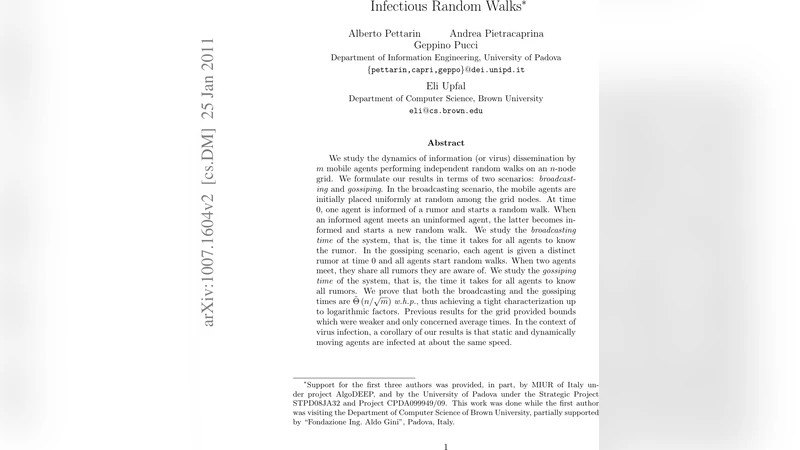
We study the dynamics of information (or virus) dissemination by $m$ mobile agents performing independent random walks on an $n$-node grid. We formulate our results in terms of two scenarios: broadcasting and gossiping. In the broadcasting scenario, the mobile agents are initially placed uniformly at random among the grid nodes. At time 0, one agent is informed of a rumor and starts a random walk. When an informed agent meets an uninformed agent, the latter becomes informed and starts a new random walk. We study the broadcasting time of the system, that is, the time it takes for all agents to know the rumor. In the gossiping scenario, each agent is given a distinct rumor at time 0 and all agents start random walks. When two agents meet, they share all rumors they are aware of. We study the gossiping time of the system, that is, the time it takes for all agents to know all rumors. We prove that both the broadcasting and the gossiping times are $\tilde\Theta(n/\sqrt{m})$ w.h.p., thus achieving a tight characterization up to logarithmic factors. Previous results for the grid provided bounds which were weaker and only concerned average times. In the context of virus infection, a corollary of our results is that static and dynamically moving agents are infected at about the same speed.
💡 Research Summary
The paper investigates how quickly information—or a virus—spreads among m mobile agents that perform independent random walks on an n‑node two‑dimensional grid. Two canonical dissemination models are considered. In the broadcasting scenario a single agent is initially “informed” and starts walking; whenever an informed agent meets an uninformed one, the latter becomes informed and begins its own walk. In the gossiping scenario each agent starts with a distinct rumor, and any meeting results in the exchange of all rumors known by the two participants. The central performance metric in both cases is the time until every agent knows every rumor (broadcasting time or gossiping time, respectively).
The authors prove that, with high probability, both the broadcasting and gossiping times are tightly bounded by
\
Comments & Academic Discussion
Loading comments...
Leave a Comment