The Category Theoretic Solution of Recursive Program Schemes
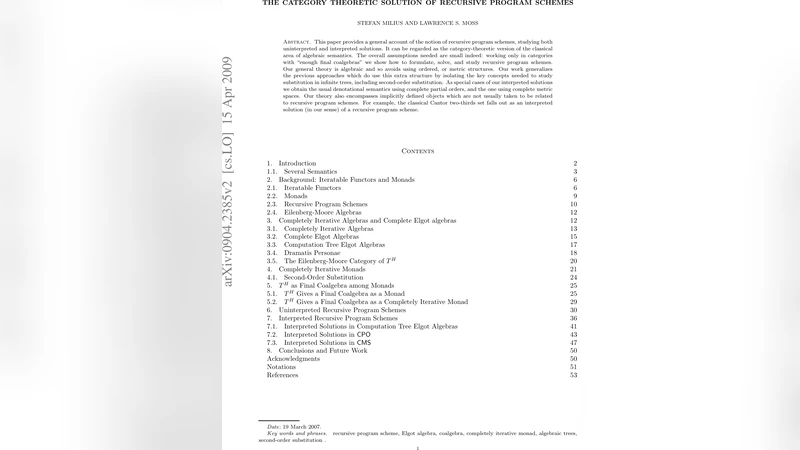
This paper provides a general account of the notion of recursive program schemes, studying both uninterpreted and interpreted solutions. It can be regarded as the category-theoretic version of the classical area of algebraic semantics. The overall assumptions needed are small indeed: working only in categories with “enough final coalgebras” we show how to formulate, solve, and study recursive program schemes. Our general theory is algebraic and so avoids using ordered, or metric structures. Our work generalizes the previous approaches which do use this extra structure by isolating the key concepts needed to study substitution in infinite trees, including second-order substitution. As special cases of our interpreted solutions we obtain the usual denotational semantics using complete partial orders, and the one using complete metric spaces. Our theory also encompasses implicitly defined objects which are not usually taken to be related to recursive program schemes. For example, the classical Cantor two-thirds set falls out as an interpreted solution (in our sense) of a recursive program scheme.
💡 Research Summary
The paper presents a fully categorical framework for solving recursive program schemes (RPS) that requires only the existence of sufficient final coalgebras in the underlying category. By working in such a minimal setting, the authors avoid any reliance on additional order‑theoretic or metric structures that have traditionally underpinned algebraic semantics. The core idea is to treat an RPS as a pair consisting of a signature Σ (a collection of operation symbols with arities) and a set of equations E that can be represented as a Σ‑algebra homomorphism e : FΣX → FΣX, where FΣ denotes the free Σ‑algebra on a set of variables X.
Two categorical constructions are brought together: the initial algebra FΣ, which captures finite syntax trees, and the final coalgebra Z for Σ‑coalgebras, which captures potentially infinite unfolding trees. The “double structure” formed by these objects enables the definition of an uninterpreted solution as a fixed point λ : Z → Z that satisfies λ = ζ ∘ Σλ ∘ ê, where ζ is the coalgebra structure on Z and ê is the coalgebraic lifting of e. Existence of such a λ follows from the universal property of the final coalgebra, without any guardedness or continuity assumptions.
For interpreted solutions, a concrete object A in the category (for example a cpo or a complete metric space) together with an interpretation of the signature ⟦·⟧ : Σ → End(A) is chosen. The uninterpreted fixed point λ is then transferred to A by a second‑order substitution that is itself a natural transformation. When A carries the appropriate structure—continuity in a cpo setting or contractiveness in a metric setting—the transferred fixed point becomes a genuine semantic solution, reproducing the classical domain‑theoretic and metric‑space semantics as special cases.
A striking illustration is the Cantor two‑thirds set. By encoding the classic self‑similarity equations as an RPS, the categorical construction yields the Cantor set as a fixed point in the final coalgebra, showing that even fractal objects can be viewed as interpreted solutions of recursive schemes.
The paper also isolates the notion of second‑order substitution, extending ordinary variable‑by‑term substitution to the replacement of operation symbols by other operation symbols, all expressed categorically as natural transformations. This provides a uniform treatment of substitution that works uniformly across syntax, semantics, and infinite tree unfolding.
In summary, the authors develop an algebraic, coalgebraic, and categorical theory of recursive program schemes that subsumes traditional denotational approaches, eliminates the need for extra order or metric assumptions, and opens the door to new applications such as implicit definitions of fractals and other self‑referential structures. The work suggests further extensions to higher‑order schemes, heterogeneous signatures, and concrete implementations based on coalgebraic interpreters.
Comments & Academic Discussion
Loading comments...
Leave a Comment