We describe a three-dimensional geometry that exhibits a repulsive Casimir force using ordinary metallic materials, as computed via an exact numerical method (no uncontrolled approximations). The geometry consists of a zippelike, glide-symmetric structure formed of interleaved metal brackets attached to parallel plates. Depending on the separation, the perpendicular force between the plates/brackets varies from attractive (large separations) to repulsive (intermediate distances) and back to attractive (close separations), with one point of stable equilibrium in the perpendicular direction. This geometry was motivated by a simple intuition of attractive interactions between surfaces, and so we also consider how a rough proximity force approximation of pairwise attractions compares to the exact calculations.
Deep Dive into Repulsive, nonmonotonic Casimir forces in a glide-symmetric geometry.
We describe a three-dimensional geometry that exhibits a repulsive Casimir force using ordinary metallic materials, as computed via an exact numerical method (no uncontrolled approximations). The geometry consists of a zippelike, glide-symmetric structure formed of interleaved metal brackets attached to parallel plates. Depending on the separation, the perpendicular force between the plates/brackets varies from attractive (large separations) to repulsive (intermediate distances) and back to attractive (close separations), with one point of stable equilibrium in the perpendicular direction. This geometry was motivated by a simple intuition of attractive interactions between surfaces, and so we also consider how a rough proximity force approximation of pairwise attractions compares to the exact calculations.
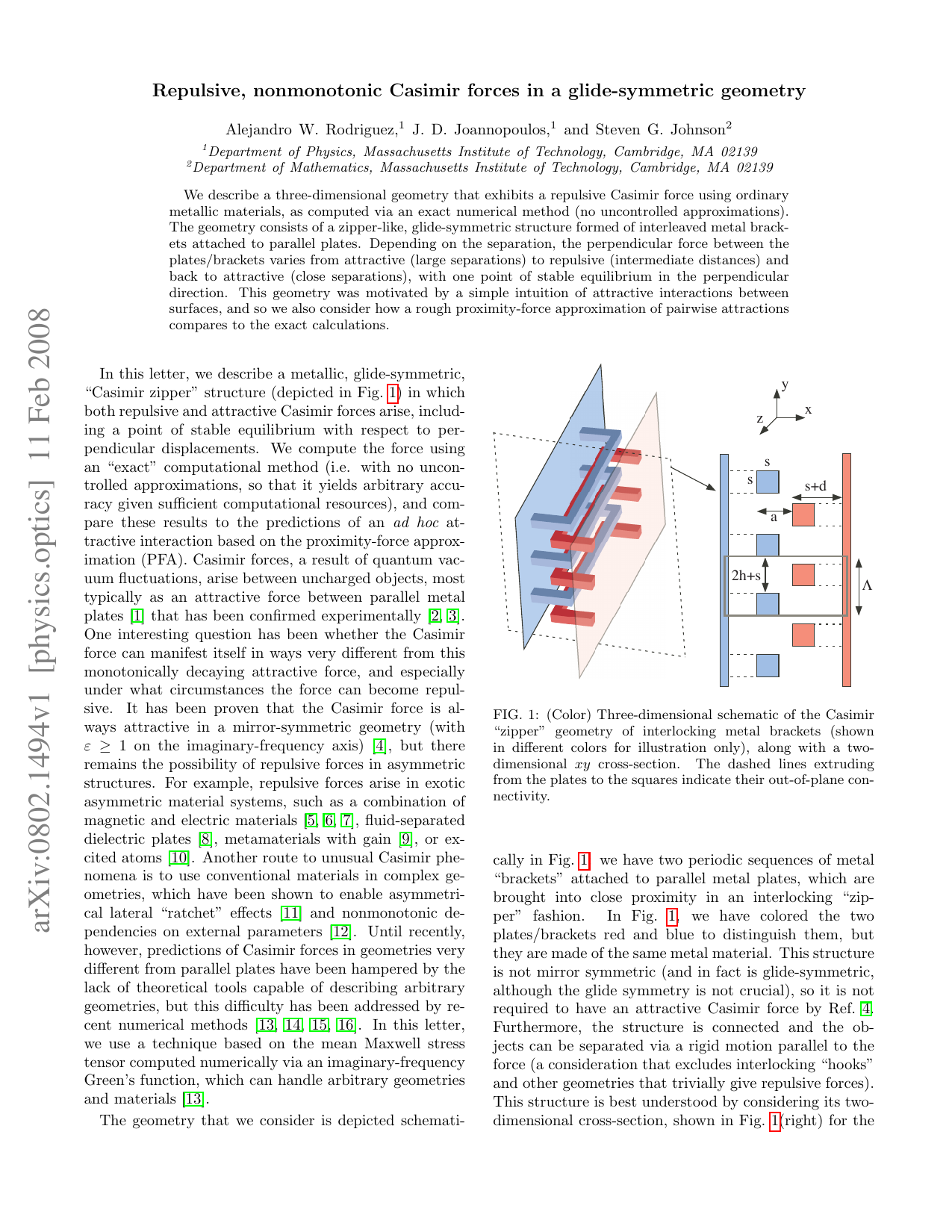
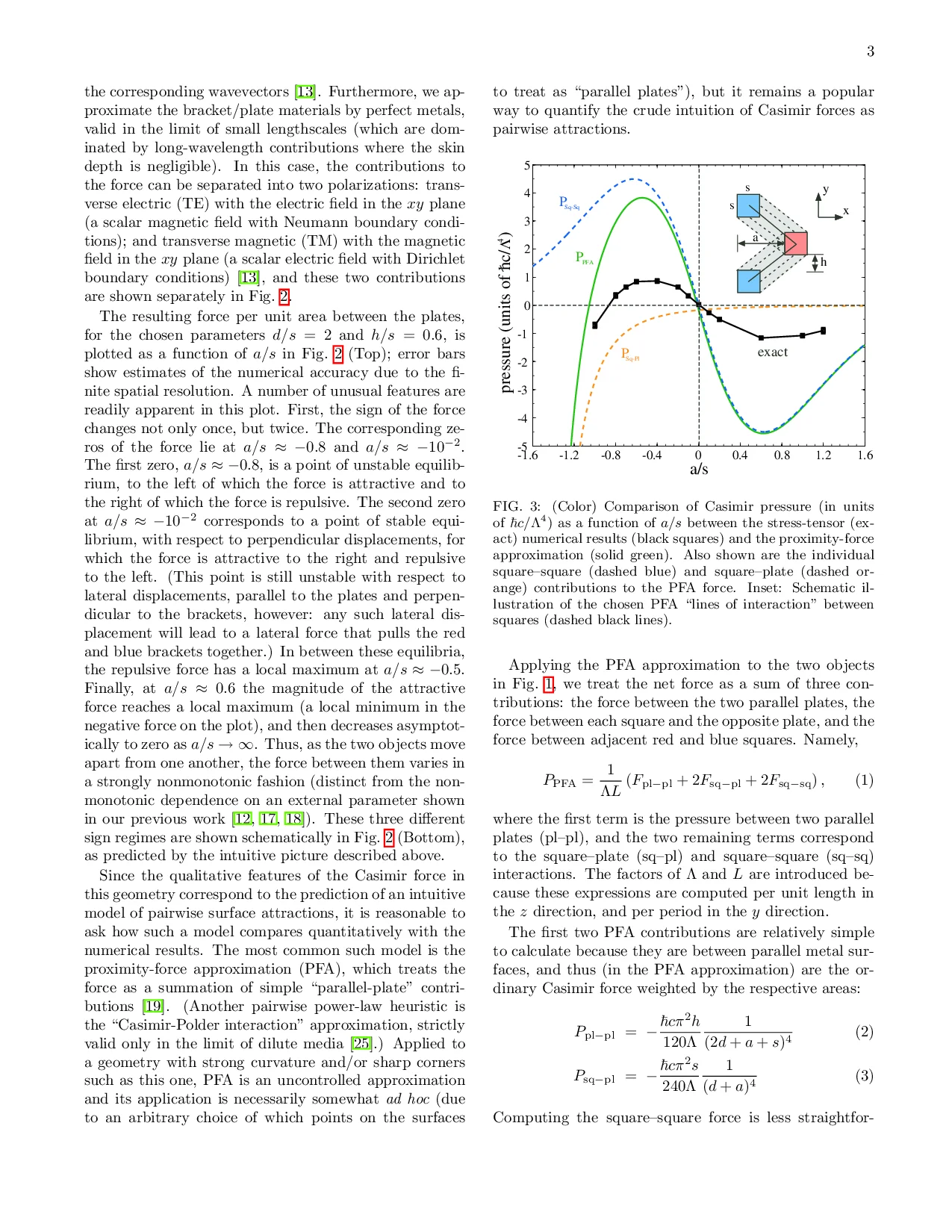
In this letter, we describe a metallic, glide-symmetric, "Casimir zipper" structure (depicted in Fig. 1) in which both repulsive and attractive Casimir forces arise, including a point of stable equilibrium with respect to perpendicular displacements. We compute the force using an "exact" computational method (i.e. with no uncontrolled approximations, so that it yields arbitrary accuracy given sufficient computational resources), and compare these results to the predictions of an ad hoc attractive interaction based on the proximity-force approximation (PFA). Casimir forces, a result of quantum vacuum fluctuations, arise between uncharged objects, most typically as an attractive force between parallel metal plates [1] that has been confirmed experimentally [2,3]. One interesting question has been whether the Casimir force can manifest itself in ways very different from this monotonically decaying attractive force, and especially under what circumstances the force can become repulsive. It has been proven that the Casimir force is always attractive in a mirror-symmetric geometry (with ε ≥ 1 on the imaginary-frequency axis) [4], but there remains the possibility of repulsive forces in asymmetric structures. For example, repulsive forces arise in exotic asymmetric material systems, such as a combination of magnetic and electric materials [5,6,7], fluid-separated dielectric plates [8], metamaterials with gain [9], or excited atoms [10]. Another route to unusual Casimir phenomena is to use conventional materials in complex geometries, which have been shown to enable asymmetrical lateral "ratchet" effects [11] and nonmonotonic dependencies on external parameters [12]. Until recently, however, predictions of Casimir forces in geometries very different from parallel plates have been hampered by the lack of theoretical tools capable of describing arbitrary geometries, but this difficulty has been addressed by recent numerical methods [13,14,15,16]. In this letter, we use a technique based on the mean Maxwell stress tensor computed numerically via an imaginary-frequency Green's function, which can handle arbitrary geometries and materials [13].
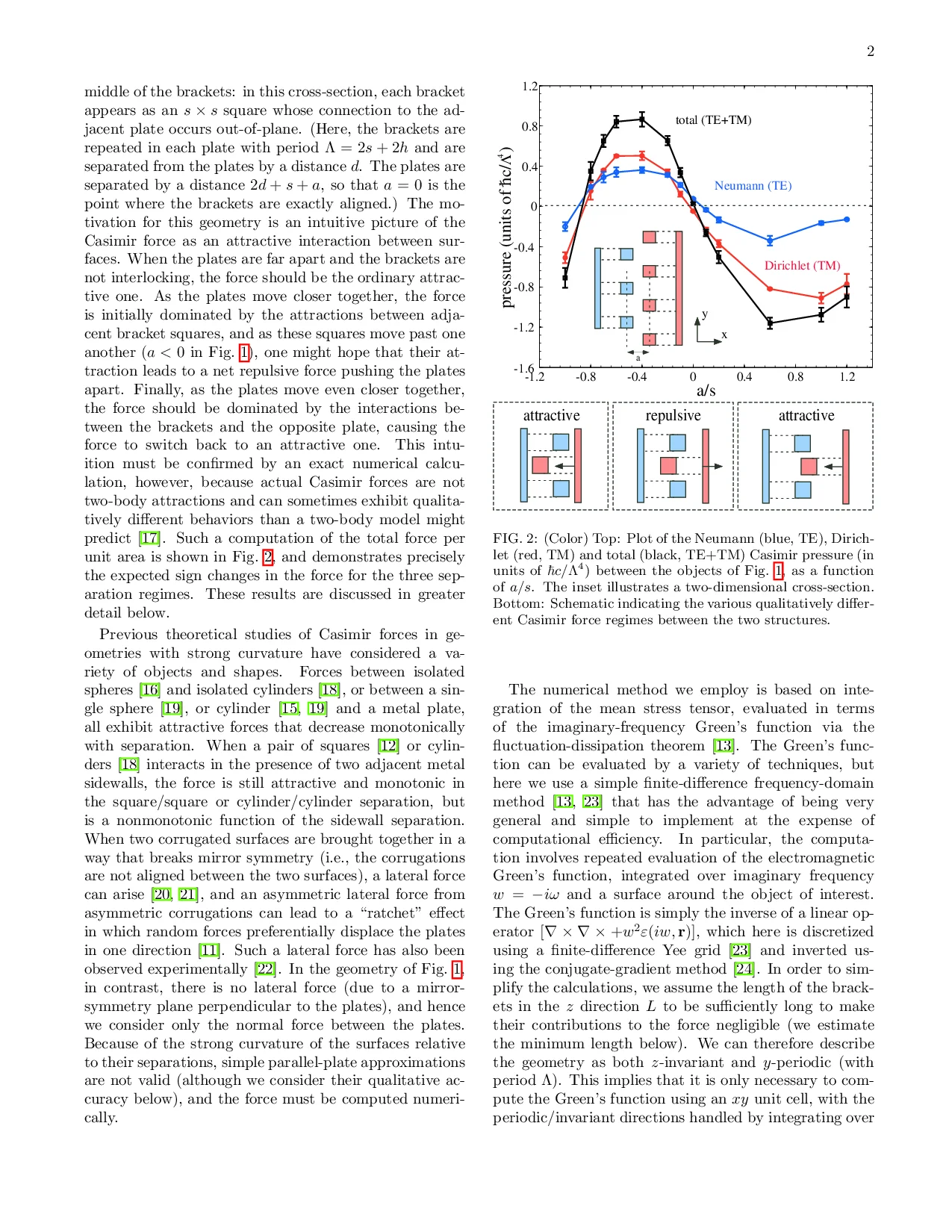
The geometry that we consider is depicted schemati- cally in Fig. 1: we have two periodic sequences of metal “brackets” attached to parallel metal plates, which are brought into close proximity in an interlocking “zipper” fashion. In Fig. 1, we have colored the two plates/brackets red and blue to distinguish them, but they are made of the same metal material. This structure is not mirror symmetric (and in fact is glide-symmetric, although the glide symmetry is not crucial), so it is not required to have an attractive Casimir force by Ref. 4. Furthermore, the structure is connected and the objects can be separated via a rigid motion parallel to the force (a consideration that excludes interlocking “hooks” and other geometries that trivially give repulsive forces). This structure is best understood by considering its twodimensional cross-section, shown in Fig. 1(right) for the middle of the brackets: in this cross-section, each bracket appears as an s × s square whose connection to the adjacent plate occurs out-of-plane. (Here, the brackets are repeated in each plate with period Λ = 2s + 2h and are separated from the plates by a distance d. The plates are separated by a distance 2d + s + a, so that a = 0 is the point where the brackets are exactly aligned.) The motivation for this geometry is an intuitive picture of the Casimir force as an attractive interaction between surfaces. When the plates are far apart and the brackets are not interlocking, the force should be the ordinary attractive one. As the plates move closer together, the force is initially dominated by the attractions between adjacent bracket squares, and as these squares move past one another (a < 0 in Fig. 1), one might hope that their attraction leads to a net repulsive force pushing the plates apart. Finally, as the plates move even closer together, the force should be dominated by the interactions between the brackets and the opposite plate, causing the force to switch back to an attractive one. This intuition must be confirmed by an exact numerical calculation, however, because actual Casimir forces are not two-body attractions and can sometimes exhibit qualitatively different behaviors than a two-body model might predict [17]. Such a computation of the total force per unit area is shown in Fig. 2, and demonstrates precisely the expected sign changes in the force for the three separation regimes. These results are discussed in greater detail below.
Previous theoretical studies of Casimir forces in geometries with strong curvature have considered a variety of objects and shapes. Forces between isolated spheres [16] and isolated cylinders [18], or between a single sphere [19], or cylinder [15,19] and a metal plate, all exhibit attractive forces that decrease monotonically with separation. When a pair of squares
…(Full text truncated)…
This content is AI-processed based on ArXiv data.