Indexing Properties of Primitive Pythagorean Triples for Cryptography Applications
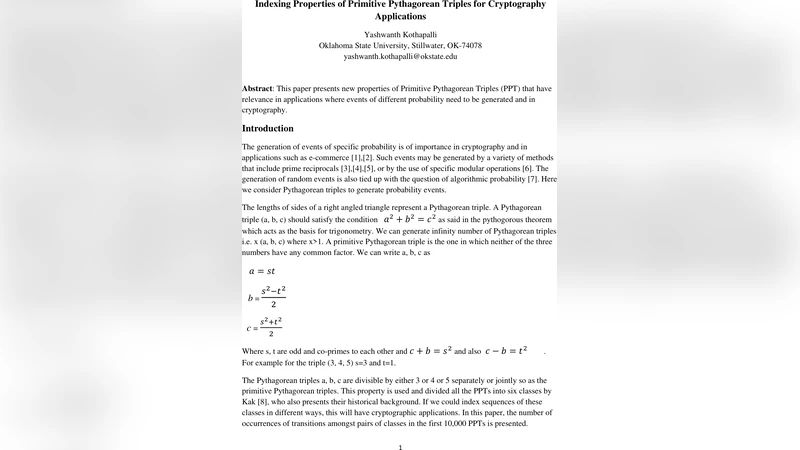
This paper presents new properties of Primitive Pythagorean Triples (PPT) that have relevance in applications where events of different probability need to be generated and in cryptography.
💡 Research Summary
**
The paper investigates how primitive Pythagorean triples (PPTs) can be organized and indexed to produce events of prescribed probabilities, with a view toward cryptographic applications. After a brief motivation that random‑event generation is important for cryptography and e‑commerce, the authors recall the classic Euclidean parametrisation of PPTs: (a=m^{2}-n^{2},; b=2mn,; c=m^{2}+n^{2}) where (m) and (n) are coprime, one even and one odd.
The core idea is to classify each PPT into one of six “classes” (A–F) according to the divisibility of its sides by 3 and 5. The six categories are defined as follows:
- Class A – (a) divisible by 3 and (c) divisible by 5.
- Class B – (a) divisible by 5 and (b) divisible by 3.
- Class C – (a) divisible by both 3 and 5.
- Class D – (b) divisible by 3 and (c) divisible by 5.
- Class E – (a) divisible by 3 and (b) divisible by 5.
- Class F – (b) divisible by both 3 and 5.
Table 1 illustrates how an odd integer can be expressed as a sum of two coprime numbers, how that pair yields a PPT, and which class the resulting triple belongs to. The authors then list the first 34 PPTs in order of increasing hypotenuse, annotate each with its class, and extract the class‑sequence “ABCDEB…”.
To explore statistical regularities, the authors compute the frequencies of transitions between classes for the first 10 000 PPTs. Table 2 records, for each ordered pair (e.g., A→B), the total number of occurrences (X) and the index of the first occurrence (y). For example, A→B occurs 997 times, first appearing at the 10‑th triple. The table demonstrates that the transition distribution depends heavily on the ordering of the triples.
Four “properties” of the PPT‑class mapping are claimed:
- For any prime (p), the number of coprime pairs ((r,s)) with (r+s=p) is ((p-1)/2); each such pair generates a distinct PPT, so a prime yields ((p-1)/2) PPTs.
- Every odd multiple of 15 belongs to class C.
- Primes ending in 3 or 7 (except 3) follow a fixed cyclic class pattern “DEBFADFCFDAFBED”.
- Primes ending in 1 or 5 (except 5) follow a different cyclic pattern “FABDEFDCDFEDBAF”.
The authors argue that by sliding a window of length (i) over the class sequence, one can obtain (i)-tuples of classes. They show experimentally that for (i=6) there are 28 distinct 6‑tuples before repetitions set in, and they plot the number of unique tuples versus (i).
The paper’s most concrete contribution is a set of five indexing schemes that reorder the PPT list according to different functions of the triple’s components:
- Increasing (a) – all 36 ordered class‑pairs appear within a sequence of length 300.
- Increasing (b) – length 4037.
- Increasing (c-b) – length 132.
- Increasing (c-a) – length 504.
- Increasing (b-a) – length 147.
In each case the authors provide the first few symbols of the resulting class‑sequence. They claim that the “(c)‑ordered” list (case 1) is the most efficient because it covers every possible ordered pair of classes in the smallest number of steps.
The discussion concludes that if two parties share a secret indexing rule (e.g., “order by (c) and take the 57‑th triple”), the corresponding PPT can serve as a shared secret key. The authors therefore suggest that PPT class transitions constitute a novel source of pseudo‑randomness suitable for cryptographic protocols.
Critical assessment – The paper introduces an interesting combinatorial viewpoint on PPTs, but several shortcomings limit its impact. The proofs of the four properties are informal; Property 1, for instance, merely invokes the definition of a prime without rigorously showing that every decomposition (r+s=p) yields coprime (r) and (s). The statistical tables are presented without accompanying probabilistic models, making it difficult to evaluate how “random” the class transitions truly are. Moreover, the cryptographic claim that a PPT can act as a secret key is not substantiated with a concrete protocol, security analysis, or comparison to existing key‑exchange mechanisms. No discussion of key‑space size, collision probability, or resistance to known attacks is provided. Finally, the manuscript suffers from typographical errors, inconsistent notation, and a lack of clear definitions (e.g., the symbols used for “(c)‑ordered” are garbled).
In summary, the work offers a novel classification of PPTs and demonstrates that different orderings produce varied class‑transition patterns, which could be harnessed for generating non‑uniform probability events. However, to move from a mathematical curiosity to a practical cryptographic primitive, the authors would need to supply rigorous proofs, a formal security model, and concrete algorithmic constructions.
Comments & Academic Discussion
Loading comments...
Leave a Comment