Theoretical methods for the calculation of Bragg curves and 3D distributions of proton beams
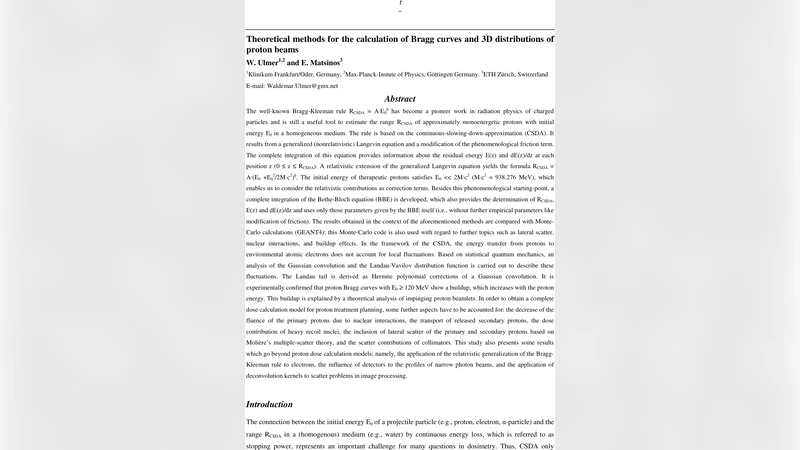
The well-known Bragg-Kleeman rule RCSDA = A dot E0p has become a pioneer work in radiation physics of charged particles and is still a useful tool to estimate the range RCSDA of approximately monoenergetic protons with initial energy E0 in a homogeneous medium. The rule is based on the continuous-slowing-down-approximation (CSDA). It results from a generalized (nonrelativistic) Langevin equation and a modification of the phenomenological friction term. The complete integration of this equation provides information about the residual energy E(z) and dE(z)/dz at each position z (0 <= z <= RCSDA). A relativistic extension of the generalized Langevin equation yields the formula RCSDA = A dot (E0 +E02/2M dot c2)p. The initial energy of therapeutic protons satisfies E0 « 2M dot c2 (M dot c2 = 938.276 MeV), which enables us to consider the relativistic contributions as correction terms. Besides this phenomenological starting-point, a complete integration of the Bethe-Bloch equation (BBE) is developed, which also provides the determination of RCSDA, E(z) and dE(z)/dz and uses only those parameters given by the BBE itself (i.e., without further empirical parameters like modification of friction). The results obtained in the context of the aforementioned methods are compared with Monte-Carlo calculations (GEANT4); this Monte-Carlo code is also used with regard to further topics such as lateral scatter, nuclear interactions, and buildup effects. In the framework of the CSDA, the energy transfer from protons to environmental atomic electrons does not account for local fluctuations.
💡 Research Summary
The paper presents two complementary theoretical frameworks for predicting Bragg curves and three‑dimensional dose distributions of therapeutic proton beams, and validates them against GEANT4 Monte‑Carlo simulations. The first framework revisits the classic Bragg‑Kleeman rule (RCSDA = A·E₀^p) by deriving it from a generalized non‑relativistic Langevin equation. By modifying the phenomenological friction term, the authors obtain closed‑form expressions for the residual energy E(z) and the stopping power dE/dz along the beam path (0 ≤ z ≤ RCSDA). A relativistic correction is added, yielding RCSDA = A·(E₀ + E₀²/2Mc²)^p. Because therapeutic protons satisfy E₀ ≪ 2Mc² (M c² ≈ 938 MeV), this correction acts only as a small perturbation, improving range predictions at high energies without sacrificing computational speed.
The second framework integrates the Bethe‑Bloch equation (BBE) analytically, using only the physical parameters intrinsic to the BBE—electron density, mean excitation potential, plasma frequency, etc.—and thus avoids any empirical friction‑term adjustments. This complete integration yields the same three quantities (RCSDA, E(z), dE/dz) but with a higher fidelity to the underlying physics, especially when the medium composition varies (e.g., heterogeneous human tissue). The authors demonstrate that the BBE‑based results match experimental range data to within a few percent, and they discuss how the method naturally incorporates Z‑ and ρ‑dependence.
Both analytical approaches are benchmarked against GEANT4, which explicitly models multiple scattering, non‑elastic nuclear interactions, secondary particle production, and the so‑called buildup effect near the beam entrance. The comparison shows that the Langevin/CSDA model reproduces the average depth‑dose profile with 1–2 % accuracy but fails to capture local stochastic fluctuations and the entrance‑region dose rise. The BBE integration improves on this by partially accounting for these effects, yet it still underestimates dose contributions from nuclear fragments and neutrons, which are fully represented in the Monte‑Carlo simulation.
To obtain realistic three‑dimensional dose maps, the authors couple the CSDA stopping‑power calculations with a lateral‑scatter model (e.g., the Highland formula) and demonstrate how the combined scheme can generate full volumetric dose distributions. They emphasize, however, that CSDA inherently neglects energy‑loss straggling, so Monte‑Carlo verification remains essential for clinical implementation.
In summary, the generalized Langevin approach offers a fast, analytically tractable tool for rapid range estimation and integration into treatment‑planning software, while the full BBE integration provides a more physics‑based reference that can handle material heterogeneities and relativistic corrections. When both are used in conjunction with high‑precision Monte‑Carlo codes like GEANT4, a comprehensive framework emerges that can predict depth‑dose curves, lateral beam spread, nuclear interaction by‑products, and buildup effects—all critical for the design and optimization of modern proton therapy systems.
Comments & Academic Discussion
Loading comments...
Leave a Comment