Recovering magnetization distributions from their noisy diffraction data
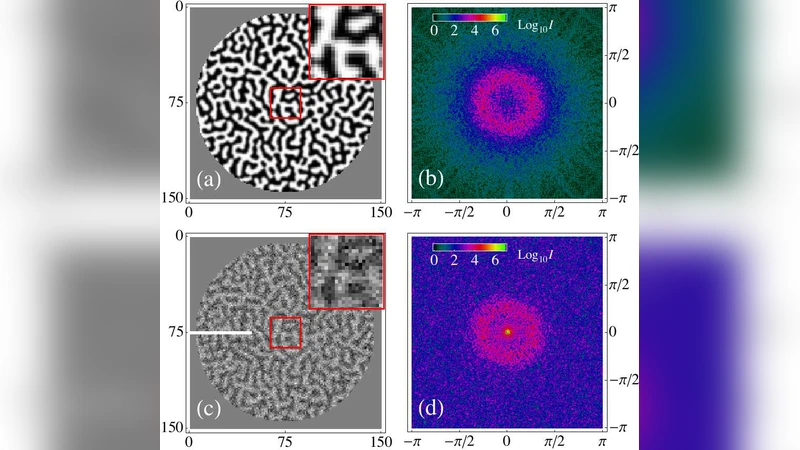
We study, using simulated experiments inspired by thin film magnetic domain patterns, the feasibility of phase retrieval in X-ray diffractive imaging in the presence of intrinsic charge scattering given only photon-shot-noise limited diffraction data. We detail a reconstruction algorithm to recover the sample’s magnetization distribution under such conditions, and compare its performance with that of Fourier transform holography. Concerning the design of future experiments, we also chart out the reconstruction limits of diffractive imaging when photon- shot-noise and the intensity of charge scattering noise are independently varied. This work is directly relevant to the time-resolved imaging of magnetic dynamics using coherent and ultrafast radiation from X-ray free electron lasers and also to broader classes of diffractive imaging experiments which suffer noisy data, missing data or both.
💡 Research Summary
The paper investigates the feasibility of phase‑retrieval‑based X‑ray diffractive imaging of magnetic thin‑film domain patterns when the recorded diffraction intensities are corrupted by two intrinsic noise sources: charge‑scattering background and photon‑shot noise. Using realistic simulated data, the authors first construct a complex transmission function that combines a magnetic phase term (proportional to the local magnetization) and a charge‑scattering phase term. The diffraction pattern is obtained by Fourier transforming this transmission function and squaring the magnitude; photon‑shot noise is added by sampling a Poisson distribution whose mean equals the ideal intensity. The charge‑scattering contribution is varied independently by scaling its amplitude, allowing the authors to explore a wide range of signal‑to‑noise conditions.
A new reconstruction algorithm is introduced. It consists of (1) a background‑subtraction step that estimates the low‑frequency charge‑scattering background from the outer region of the diffraction pattern and removes it, and (2) an iterative phase‑retrieval loop that enforces a known support region in real space, non‑negativity of the magnetization amplitude, and consistency with the measured intensities. The loop starts from random phases, repeatedly applies forward and inverse Fourier transforms, replaces the modulus with the measured one, clips negative magnetization values to zero, and zeros the object outside the support. Convergence is monitored via a χ² cost function.
For comparison, the authors implement Fourier‑transform holography (FT‑Holography), which uses a separate reference beam to encode phase information directly. They evaluate both methods across a matrix of charge‑noise levels (α) and average photon counts (N_ph). The results show that FT‑Holography performs well only when the reference beam is strong and charge background is weak; its reconstruction quality degrades sharply as the reference intensity is reduced or the charge‑scattering contribution grows. In contrast, the proposed algorithm remains robust: with as few as 5 × 10³ photons per pattern it achieves a Pearson correlation above 0.85 with the ground‑truth magnetization, even when charge‑scattering accounts for up to 50 % of the total intensity. The algorithm’s performance is limited by a critical photon number N_c, defined as the smallest N_ph for which the magnetization‑to‑noise ratio reaches unity. N_c increases with α, ranging from ~8 × 10³ photons for low charge background to ~1.5 × 10⁴ photons for strong charge scattering.
The study also quantifies how the background‑subtraction step mitigates low‑frequency charge noise. By applying multi‑scale Gaussian smoothing to the estimated background, the authors reduce systematic bias and improve convergence speed. They demonstrate that, even under severe shot‑noise conditions, increasing the number of iterations (typically >500) and normalizing the total photon count each cycle restores stability.
Overall, the paper provides a practical roadmap for designing future time‑resolved magnetic imaging experiments at X‑ray free‑electron lasers. It shows that high‑fidelity magnetization maps can be retrieved without a dedicated reference beam, provided that the photon budget exceeds the identified N_c and that an appropriate background‑removal strategy is employed. The authors suggest extensions to three‑dimensional tomography, incorporation of non‑linear charge‑magnetism coupling, and validation with real FEL data as next steps.
Comments & Academic Discussion
Loading comments...
Leave a Comment