The Hecke Bicategory
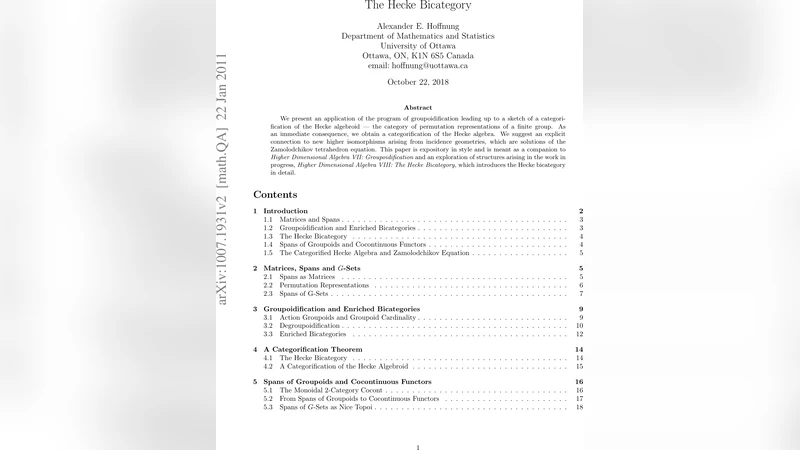
We present an application of the program of groupoidification leading up to a sketch of a categorification of the Hecke algebroid — the category of permutation representations of a finite group. As an immediate consequence, we obtain a categorification of the Hecke algebra. We suggest an explicit connection to new higher isomorphisms arising from incidence geometries, which are solutions of the Zamolodchikov tetrahedron equation. This paper is expository in style and is meant as a companion to Higher Dimensional Algebra VII: Groupoidification and an exploration of structures arising in the work in progress, Higher Dimensional Algebra VIII: The Hecke Bicategory, which introduces the Hecke bicategory in detail.
💡 Research Summary
The paper presents a systematic categorification of the Hecke algebroid— the category of permutation representations of a finite group—by employing the program of groupoidification. The authors begin by recalling that the Hecke algebroid can be identified with the category whose objects are finite G‑sets (where G is a finite group) and whose morphisms are G‑equivariant maps, equipped with a monoidal product given by the Cartesian product with the diagonal G‑action. This classical algebraic structure underlies the Hecke algebra after decategorification.
The central construction is the Hecke bicategory. Its objects are finite G‑sets. A 1‑morphism from X to Y is a span of G‑sets \
Comments & Academic Discussion
Loading comments...
Leave a Comment