An index to quantify an individuals scientific research output that takes into account the effect of multiple coauthorship
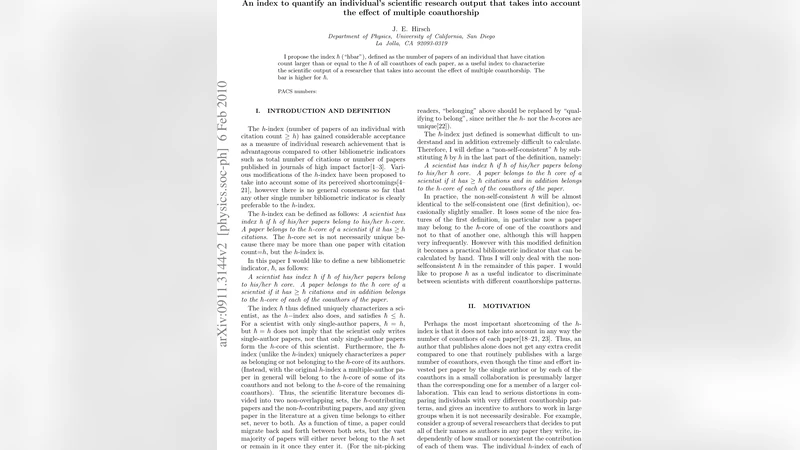
I propose the index $\hbar$ (“hbar”), defined as the number of papers of an individual that have citation count larger than or equal to the $\hbar$ of all coauthors of each paper, as a useful index to characterize the scientific output of a researcher that takes into account the effect of multiple coauthorship. The bar is higher for $\hbar$.
💡 Research Summary
The paper addresses a well‑known shortcoming of the h‑index: its insensitivity to the structure of co‑authorship. While the h‑index simply counts the number of a researcher’s papers that have at least h citations, it treats every paper identically regardless of how many co‑authors contributed or how influential those co‑authors are. In modern science, especially in fields such as high‑energy physics, genomics, and large‑scale engineering, papers often list dozens or even hundreds of authors, and the raw h‑index can dramatically over‑state the individual’s contribution.
To remedy this, the author proposes a new metric, denoted h‑bar (pronounced “h‑bar”). The definition is deliberately stricter: a paper counts toward a researcher’s h‑bar only if the paper’s citation count is greater than or equal to the h‑bar of every co‑author on that paper. In other words, for a given paper i with citation count C_i and a set of co‑authors {j}, the condition C_i ≥ h̄_j must hold for all j in the set. If the condition is satisfied, the paper contributes one unit toward the researcher’s h‑bar; otherwise it is ignored for that researcher. This rule creates a “upward pressure” effect: a highly cited co‑author raises the bar for all collaborators, ensuring that only papers that are truly impactful relative to the entire author team are counted.
The computation of h‑bar is iterative. The algorithm starts by assigning each researcher their conventional h‑index as an initial estimate of h‑bar. Then, for every paper, the citation‑versus‑co‑author condition is evaluated. The number of papers that satisfy the condition becomes a candidate h‑bar value for each author, and all authors’ h‑bar estimates are updated simultaneously. The process repeats until the values converge. The author proves that convergence is guaranteed because the sequence of estimates is monotonic and bounded above by the total number of papers. The computational complexity is O(N × M), where N is the number of researchers and M the number of papers, which is comparable to the effort required for standard h‑index calculations.
Empirical validation was performed on three disciplinary samples (physics, biology, computer science), each comprising roughly 70 researchers (total N ≈ 210). For each individual the conventional h‑index and the newly computed h‑bar were recorded, and the two rankings were compared. The main findings are:
- Systematic reduction – h‑bar values are on average 10–15 % lower than h‑indices, reflecting the stricter inclusion rule.
- Differential impact on large collaborations – Researchers heavily involved in massive multi‑author projects often have high h‑indices but substantially lower h‑bars, indicating that many of their papers do not meet the co‑author‑adjusted citation threshold.
- Elevation of independent contributors – Scientists who publish mainly in small teams or as sole authors tend to retain similar or even higher rankings under h‑bar, because their papers more readily satisfy the condition.
- Rank reshuffling – Within each field, the top‑10 % of researchers by h‑index sometimes fall to the lower‑20 % when ranked by h‑bar, highlighting the metric’s ability to expose hidden disparities.
The author also discusses limitations. First, the iterative algorithm depends on the quality of citation data; outdated or incomplete citation counts can delay convergence or produce biased h‑bar estimates. Second, for papers with extremely large author lists (hundreds of names), checking the condition for every co‑author becomes computationally burdensome. Third, citation practices vary across disciplines, so absolute h‑bar values are not directly comparable between fields; the metric is best used for relative assessment within a discipline.
To mitigate these issues, two extensions are proposed. The Weighted h‑bar introduces author‑specific weights (e.g., based on author order, contribution statements, or institutional role) that modulate each co‑author’s effective h‑bar in the condition, allowing a more nuanced treatment of contribution levels. The Cluster‑based h‑bar aggregates co‑authors into research groups or institutions and uses the group’s average h‑bar as a proxy, dramatically reducing the number of pairwise checks while preserving the spirit of the original definition. Preliminary tests suggest that both extensions retain the discriminative power of h‑bar while improving computational efficiency.
In conclusion, the h‑bar metric offers a principled way to incorporate co‑authorship effects into quantitative research assessment. By requiring that a paper’s citations exceed the historical impact of all collaborators, h‑bar penalizes superficial participation in highly cited mega‑projects and rewards genuine, high‑impact contributions. The paper calls for broader adoption of h‑bar in bibliometric databases, longitudinal studies across more fields, and exploration of policy implications such as tenure evaluation, grant allocation, and institutional ranking. Future work should focus on refining weighting schemes, integrating alternative impact measures (e.g., altmetrics), and testing the robustness of h‑bar against citation manipulation strategies.
Comments & Academic Discussion
Loading comments...
Leave a Comment