Report on the current state of the French DMLs
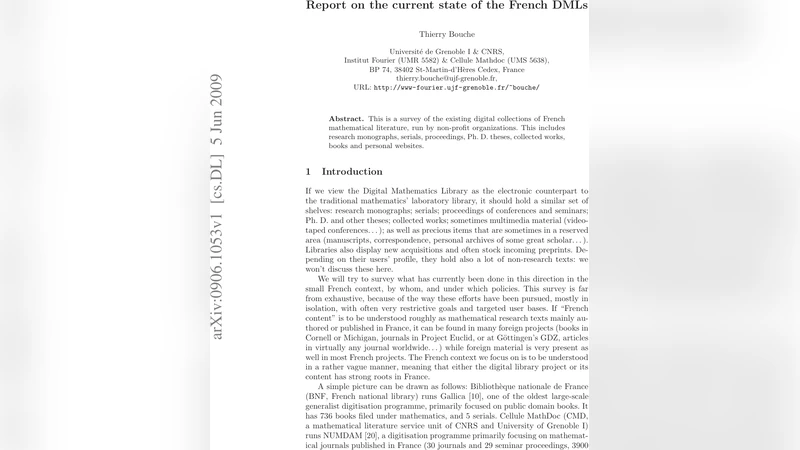
This is a survey of the existing digital collections of French mathematical literature, run by non-profit organizations. This includes research monographs, serials, proceedings, Ph. D. theses, collected works, books and personal websites.
💡 Research Summary
The paper presents a comprehensive survey of French digital mathematics libraries (DMLs) that are operated by non‑profit entities. It begins with a historical overview, noting that the digitisation effort in France started in the late 1990s with the creation of NUMDAM, which initially focused on converting the major French mathematical journals into electronic form. Over the years, NUMDAM expanded its scope to include conference proceedings, doctoral theses, collected works, and even personal scholarly websites.
The authors then examine the technical architectures of the main collections. NUMDAM uses a hybrid of Dublin Core and its own extended metadata schema, exposing an OAI‑PMH interface for automated harvesting. Gallica, the digital library of the Bibliothèque nationale de France, adopts the International Image Interoperability Framework (IIIF) to deliver high‑resolution image viewers and implements OCR to enable full‑text search across its historic monographs and modern articles. MathDoc, a collaborative project involving universities and research institutes, focuses on theses and conference papers, applying a Creative Commons BY‑SA license to promote reuse. Individual scholar‑run sites typically rely on version‑control platforms such as GitHub, publishing notes in Markdown or LaTeX and using open‑source tools for long‑term preservation.
A central finding is the lack of metadata harmonisation across these repositories. Each DML employs a different schema, which hampers interoperability with international services such as Crossref, MathSciNet, and Zentralblatt MATH. The paper highlights that many older journals are encumbered by complex copyright situations; manual rights‑clearance processes slow down digitisation and limit open access. To address these issues, the authors propose the development of a unified metadata framework and automated rights‑management tools.
Financial sustainability is another major concern. The majority of French DMLs rely on government subsidies, university contributions, or society membership fees. This funding model is fragile, especially for long‑term system maintenance, software upgrades, and staffing. The authors recommend leveraging open‑source preservation infrastructures and forging partnerships with pan‑European initiatives such as Europeana and DARIAH to distribute costs and increase resilience.
User experience is evaluated as well. While each DML offers a web interface, search capabilities are often limited to the individual collection, and there is no integrated portal that aggregates results across all French DMLs. Mobile‑friendly viewers are scarce, reducing accessibility for researchers on the go. The paper suggests building a unified search API and a responsive, multi‑collection portal to improve discoverability and usability.
Finally, the authors outline a strategic roadmap. In the short term, they aim to standardise metadata and automate copyright clearance. The medium‑term goals include launching an integrated search platform and expanding open‑access policies. The long‑term vision is to connect French DMLs with a European digital mathematics network, thereby enhancing international visibility and ensuring the sustainable provision of high‑quality digital mathematical resources for the global research community.