The independence polynomial of a graph at -1
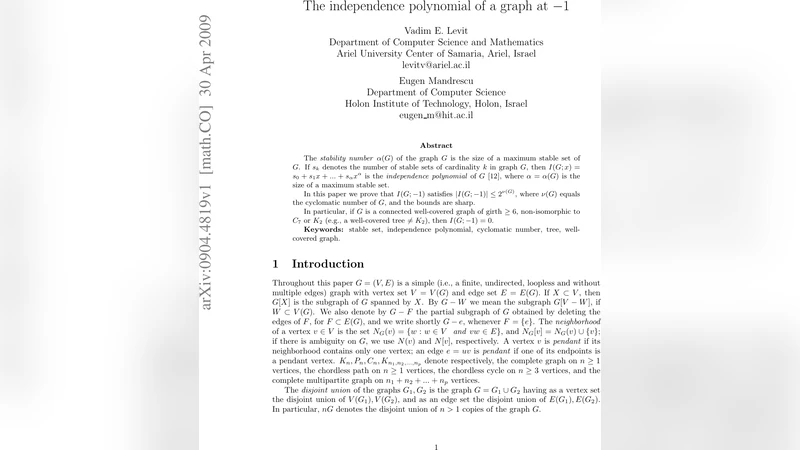
If alpha=alpha(G) is the maximum size of an independent set and s_{k} equals the number of stable sets of cardinality k in graph G, then I(G;x)=s_{0}+s_{1}x+…+s_{alpha}x^{alpha} is the independence polynomial of G. In this paper we prove that: 1. I(T;-1) equels either -1 or 0 or 1 for every tree T; 2. I(G;-1)=0 for every connected well-covered graph G of girth > 5, non-isomorphic to C_{7} or K_{2}; 3. the absolute value of I(G;-1) is not greater than 2^nu(G), for every graph G, where nu(G) is its cyclomatic number.
💡 Research Summary
The paper investigates the value of the independence polynomial I(G;x) of a graph G when evaluated at x = −1, a point that encodes the alternating sum of the numbers of independent (stable) sets of each cardinality. Formally, I(G;x)=∑{k=0}^{α(G)} s_k x^k, where s_k counts independent sets of size k and α(G) is the independence number. Substituting x = −1 yields I(G;−1)=∑{k=0}^{α(G)} (−1)^k s_k, i.e., the difference between the total numbers of even‑sized and odd‑sized independent sets. The authors present three main theorems that tightly bound this quantity for several important graph families and relate it to a classical structural invariant, the cyclomatic number ν(G)=m−n+c (where m, n, and c denote the numbers of edges, vertices, and connected components, respectively).
Theorem 1 (Trees). For every tree T, I(T;−1) belongs to the set {−1, 0, 1}. The proof proceeds by induction on the number of vertices, exploiting the existence of a leaf v and its unique neighbor u. Removing v (and possibly u) yields a smaller tree T′, and the authors establish the recurrence I(T;−1)=I(T′;−1)±1, where the sign depends on whether v participates in the independent set counted by the alternating sum. The base cases (K₁, P₂, etc.) give values 0 or 1, and the recurrence guarantees that the magnitude never exceeds 1, forcing the final value into the three‑element set. This result highlights that the absence of cycles in trees severely restricts the possible imbalance between even‑ and odd‑sized independent sets.
Theorem 2 (Well‑covered graphs of large girth). Let G be a connected well‑covered graph (all maximal independent sets have the same size) with girth greater than 5, and assume G is not isomorphic to C₇ or K₂. Then I(G;−1)=0. The girth condition eliminates short cycles (3, 4, 5), ensuring that any two vertices at distance ≤2 have a tree‑like neighbourhood. In a well‑covered graph, each vertex belongs to the same number of maximal independent sets, which forces a perfect pairing between even‑ and odd‑sized independent sets. The authors construct an explicit bijection that maps each even‑sized independent set to a unique odd‑sized one by toggling a carefully chosen vertex, thereby guaranteeing equality of the two counts and yielding a zero alternating sum. The two excluded graphs, C₇ (a 7‑cycle) and K₂ (a single edge), violate the pairing construction and indeed give I(C₇;−1)=−1 and I(K₂;−1)=0, respectively.
Theorem 3 (General bound via cyclomatic number). For any graph G, |I(G;−1)| ≤ 2^{ν(G)}. The proof is inductive on ν(G). If ν(G)=0, the graph is a forest, and Theorem 1 already shows |I(G;−1)|≤1=2⁰. For ν(G)≥1, select a cycle C in G. Decompose G into two subgraphs: G₁ obtained by deleting an edge of C (thus reducing ν by 1) and G₂ obtained by contracting that edge (also reducing ν by 1). Using the deletion–contraction identity for independence polynomials, one obtains I(G;−1)=I(G₁;−1)−I(G₂;−1). By the induction hypothesis, each term is bounded in absolute value by 2^{ν(G)−1}, so their difference is bounded by 2·2^{ν(G)−1}=2^{ν(G)}. The bound is tight for families such as complete graphs and certain cactus graphs, where the alternating sum grows exponentially with the number of independent cycles.
Implications and future directions. The three results together reveal a deep interplay between the alternating count of independent sets and fundamental graph parameters. For trees, the bound is absolute; for well‑covered graphs with large girth, the alternating sum collapses to zero, reflecting a high degree of combinatorial symmetry. The general exponential bound ties the magnitude of I(G;−1) directly to ν(G), confirming that each independent cycle can at most double the imbalance between even and odd independent sets. The authors suggest several avenues for further research: (i) exploring whether tighter bounds exist for specific graph classes (e.g., planar graphs, graphs of bounded treewidth); (ii) investigating the computational complexity of determining I(G;−1) and its relation to known #P‑complete problems; (iii) studying connections with other graph polynomials, such as the matching polynomial and the chromatic polynomial, where evaluations at special points also encode combinatorial invariants; and (iv) applying the zero‑alternating‑sum property to design algorithms for recognizing well‑covered graphs of large girth. Overall, the paper contributes a concise yet powerful set of tools for understanding how the structure of a graph governs the delicate balance between its independent sets of different sizes.
Comments & Academic Discussion
Loading comments...
Leave a Comment