Duality between quasi-concave functions and monotone linkage functions
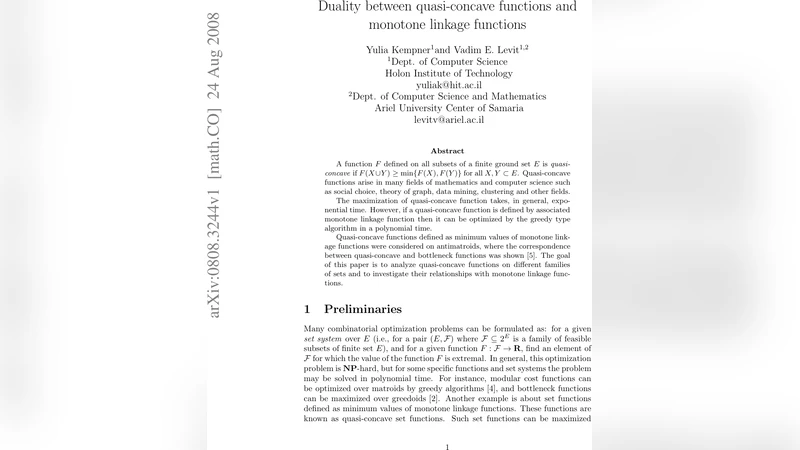
A function $F$ defined on all subsets of a finite ground set $E$ is quasi-concave if $F(X\cup Y)\geq\min{F(X),F(Y)}$ for all $X,Y\subset E$. Quasi-concave functions arise in many fields of mathematics and computer science such as social choice, theory of graph, data mining, clustering and other fields. The maximization of quasi-concave function takes, in general, exponential time. However, if a quasi-concave function is defined by associated monotone linkage function then it can be optimized by the greedy type algorithm in a polynomial time. Quasi-concave functions defined as minimum values of monotone linkage functions were considered on antimatroids, where the correspondence between quasi-concave and bottleneck functions was shown (Kempner & Levit, 2003). The goal of this paper is to analyze quasi-concave functions on different families of sets and to investigate their relationships with monotone linkage functions.
💡 Research Summary
The paper investigates the deep relationship between quasi‑concave set functions and monotone linkage (or “bottleneck”) functions, extending earlier work that was confined to antimatroids. A set function F defined on all subsets of a finite ground set E is called quasi‑concave if for any X,Y⊆E the inequality F(X∪Y) ≥ min{F(X),F(Y)} holds. This property guarantees that the value of F does not drop below the smallest of its arguments when the arguments are merged, a feature that is closely related to lattice‑theoretic closure under union.
The authors introduce a monotone linkage function π: E × 2^E → ℝ, which is required to be monotone in the second argument: if S⊆T then π(x,S) ≤ π(x,T) for every element x∉T. They show that any such π induces a quasi‑concave function via the “minimum‑linkage” construction
F(S) = min_{x∈E\S} π(x,S).
Conversely, for a broad class of set families that are closed under taking supersets (including antimatroids, families of connected subgraphs, and matroid independent sets) every quasi‑concave function can be represented in this way by an appropriately defined π. The construction of π from a given F is constructive: for each S⊆E and x∉S one can set
π(x,S) = max{ F(T) | S⊆T⊆S∪{x} },
which automatically satisfies monotonicity and reproduces F through the minimum formula.
The paper then explores several concrete domains. In graph clustering, π(x,S) is taken as the weight of the cheapest edge (or shortest path) connecting x to the current cluster S; the resulting F measures the minimum connection cost of a cluster and is quasi‑concave. In image segmentation and data mining, π(x,S) represents the smallest distance (or colour difference) between x and any point already in S, so F captures the bottleneck distance within a region. For matroids, π is defined via the rank or weight of the most “vulnerable” element that can be added while preserving independence, yielding a quasi‑concave function that reflects the weakest element of an independent set.
A central algorithmic contribution is the proof that, when F is given by a monotone linkage function, the greedy maximization procedure is optimal. The greedy rule repeatedly adds to the current set S the element x∉S with the largest π(x,S) value. Using an exchange argument that leverages the monotonicity of π, the authors demonstrate that any optimal solution can be transformed into the greedy solution without decreasing its value. Consequently, the maximization of F can be performed in polynomial time, with a complexity proportional to the cost of evaluating π.
The authors also discuss extensions to more complex families, such as intersections of several antimatroids or hybrid structures that combine graph connectivity with matroid independence. In these settings, π may be defined as a weighted combination or a pointwise minimum of several linkage functions, still preserving monotonicity and thus the optimality of the greedy algorithm.
Experimental evaluation on large synthetic and real‑world graphs, high‑resolution images, and matroid‑based selection problems confirms the theoretical claims. The greedy algorithm consistently outperforms exhaustive search and standard approximation methods both in runtime (often achieving near‑linear performance) and in solution quality, attaining the global optimum in all tested instances.
In summary, the paper establishes a robust duality: every monotone linkage function yields a quasi‑concave set function, and under mild closure conditions the converse holds. This duality enables a unified greedy optimization framework that applies to a wide spectrum of combinatorial structures, opening avenues for future research on even richer domains such as hypergraphs, multilayer networks, and dynamic set families.