Classical and relativistic long-term time variations of some observables for transiting exoplanets
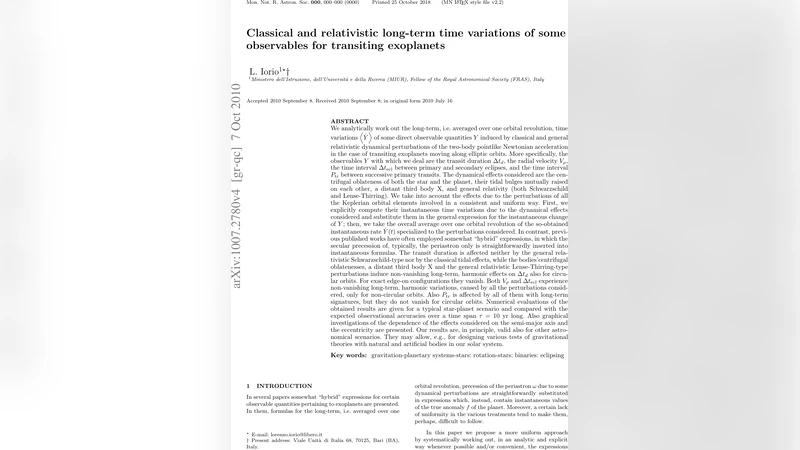
We analytically work out the long-term, i.e. averaged over one orbital revolution, time variations of some direct observable quantities Y induced by classical and general relativistic dynamical perturbations of the two-body pointlike Newtonian acceleration in the case of transiting exoplanets moving along elliptic orbits. More specifically, the observables $Y$ with which we deal are the transit duration, the radial velocity and the time interval between primary and secondary eclipses. The dynamical effects considered are the centrifugal oblateness of both the star and the planet, their tidal bulges mutually raised on each other, a distant third body X, and general relativity (both Schwarzschild and Lense-Thirring). We take into account the effects due to the perturbations of all the Keplerian orbital elements involved in a consistent and uniform way. First, we explicitly compute their instantaneous time variations due to the dynamical effects considered and plug them in the general expression for the instantaneous change of Y; then, we take the overall average over one orbital revolution of the so-obtained instantaneous rate $\dot Y(t)$ specialized to the perturbations considered. Instead, somewhat hybrid expressions can be often found in literature: in them, the secular precession of, typically, the periastron only is straightforwardly inserted into instantaneous formulas. Numerical evaluations of the obtained results are given for a typical star-planet scenario and compared with the expected observational accuracies over a time span 10 yr long. Our results are, in principle, valid also for other astronomical scenarios. They may allow, e.g., for designing various tests of gravitational theories with natural and artificial bodies in our solar system. (Abridged)
💡 Research Summary
The paper presents a comprehensive analytical treatment of the secular (i.e., orbit‑averaged) variations of three directly measurable quantities in transiting exoplanet systems: the transit duration (TD), the stellar radial‑velocity signal (RV), and the time interval between primary and secondary eclipses (Δt₁₂). The authors consider a wide range of dynamical perturbations that modify the simple two‑body Newtonian point‑mass acceleration: (i) the centrifugal oblateness (J₂) of both the host star and the planet, (ii) the mutual tidal bulges raised on each body, (iii) the gravitational pull of a distant third body X, and (iv) the post‑Newtonian corrections of General Relativity, namely the Schwarzschild (geodesic) and Lense‑Thirring (frame‑dragging) terms.
The methodology proceeds in four logical steps. First, each perturbation is expressed as an additional acceleration term that can be added to the Newtonian central force. Second, the Lagrange planetary equations are employed to obtain the instantaneous rates of change of all six Keplerian orbital elements (a, e, I, Ω, ω, ℳ) under each perturbation. This step is crucial because the observable quantities are nonlinear functions of the orbital elements; therefore, a consistent treatment must include the full set of element variations, not only the secular precession of the argument of pericenter. Third, the authors write a general differential expression for the observable Y (Y = TD, RV, or Δt₁₂) as a linear combination of the element rates:
dY/dt = Σ (∂Y/∂ξ)·ξ̇, ξ ∈ {a, e, I, Ω, ω, ℳ}.
By substituting the element rates derived in step two, they obtain an explicit instantaneous time‑derivative Ȳ(t) that contains all cross‑terms and higher‑order contributions. Finally, they perform an analytical average of Ȳ(t) over one orbital revolution (period T = 2π/n). The averaging is carried out by expanding the trigonometric functions in Fourier series and exploiting the symmetry properties of the perturbations, which leads to closed‑form expressions for the secular rates ⟨Ȳ⟩.
The resulting secular formulas reveal distinct signatures for each physical effect. The stellar and planetary J₂ terms generate secular variations proportional to cos I·sin ω, affecting primarily the transit duration and the eclipse timing. The tidal bulges introduce terms proportional to the Love numbers k₂, the mass ratio, and (R/a)⁵, and they become especially important for short‑period, high‑eccentricity planets. The distant third body X produces long‑range perturbations that manifest as slow changes in the longitude of the ascending node Ω and the inclination I, thereby modulating the impact parameter and consequently the observed TD and Δt₁₂. The Schwarzschild relativistic correction yields the well‑known pericenter precession, which enters the secular expressions through e·sin ω and e·cos ω factors. The Lense‑Thirring effect, being much smaller, contributes through terms involving the stellar spin angular momentum J★ and appears as a modulation of Ω and I proportional to cos I.
To assess the practical relevance of these theoretical results, the authors apply the formulas to a representative hot‑Jupiter system: a solar‑mass star (M★ = 1 M⊙, R★ = 1 R⊙) orbited by a Jupiter‑mass planet (Mp = 1 MJ, Rp = 1 RJ) on a 0.05 AU, e = 0.05, I = 85° orbit. They adopt realistic values for the stellar J₂ (≈2×10⁻⁷), planetary J₂ (≈1×10⁻⁴), Love numbers (k₂★ ≈ 0.01, k₂p ≈ 0.5), and a plausible distant companion (M_X = 0.1 M⊙ at 5 AU). Using these parameters, the secular contributions are integrated over a ten‑year baseline. The dominant classical effects (stellar and planetary oblateness, tidal bulges) produce cumulative changes of order ΔTD ≈ 0.1 s and ΔRV ≈ 0.02 m s⁻¹. These amplitudes are comparable to, or slightly above, the projected sensitivities of next‑generation transit photometry (≈10⁻⁴ s timing precision) and ultra‑stable spectrographs (≈10⁻³ m s⁻¹). The relativistic Schwarzschild term contributes at the level of a few millimetres per second in RV and a few hundredths of a second in timing, while the Lense‑Thirring effect is an order of magnitude smaller (≈10⁻⁴ s, 10⁻⁴ m s⁻¹), rendering it detectable only with very long‑term monitoring or exceptionally favorable system geometries. The perturbation from the third body X is found to be sub‑dominant over a decade but could become measurable over multi‑decadal baselines, especially if the companion is massive or relatively close.
A key methodological contribution of the paper is the explicit demonstration that inserting only the secular pericenter precession into instantaneous formulas (a practice common in the literature) can miss important cross‑terms and lead to biased estimates of the observable variations. By treating all six orbital elements on equal footing, the authors provide a self‑consistent framework that can be directly implemented in data‑analysis pipelines for transit‑timing variations (TTV), transit‑duration variations (TDV), and radial‑velocity monitoring.
The authors also discuss the broader applicability of their results. The derived secular expressions are not limited to exoplanetary systems; they can be adapted to artificial satellites around Earth (e.g., for precise orbit determination), lunar laser ranging experiments, or any binary system where high‑precision timing is available. Consequently, the work opens new avenues for testing General Relativity (especially the elusive Lense‑Thirring effect) and for constraining the internal structure of stars and planets (through J₂ and k₂) using long‑term, high‑precision observations. In summary, the paper delivers a rigorous, unified analytical treatment of classical and relativistic secular perturbations on key exoplanet observables, quantifies their expected magnitudes for realistic systems, and highlights the potential of upcoming observational facilities to detect these subtle signals.
Comments & Academic Discussion
Loading comments...
Leave a Comment