Compression-based investigation of the dynamical properties of cellular automata and other systems
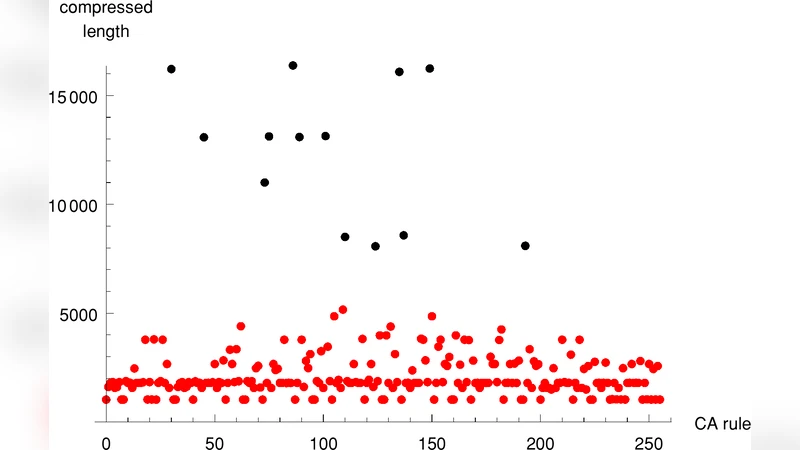
A method for studying the qualitative dynamical properties of abstract computing machines based on the approximation of their program-size complexity using a general lossless compression algorithm is presented. It is shown that the compression-based approach classifies cellular automata (CA) into clusters according to their heuristic behavior, with these clusters showing a correspondence with Wolfram’s main classes of CA behavior. A compression based method to estimate a characteristic exponent to detect phase transitions and measure the resiliency or sensitivity of a system to its initial conditions is also proposed. A conjecture regarding the capability of a system to reach computational universality related to the values of this phase transition coefficient is formulated. These ideas constitute a compression-based framework for investigating the dynamical properties of cellular automata and other systems.
💡 Research Summary
The paper introduces a practical framework for probing the dynamical behavior of abstract computing systems—most notably cellular automata (CA)—by approximating their algorithmic (Kolmogorov) complexity with a standard loss‑less compression algorithm. Because true Kolmogorov complexity is uncomputable, the authors adopt widely available compressors (e.g., gzip) as a proxy: the more regular and compressible a data string, the lower its estimated complexity, while highly random strings resist compression and thus appear more complex.
The methodology proceeds in three stages. First, the authors generate space‑time evolutions for all 256 elementary binary 1‑D CA rules up to 200 generations, concatenating each generation’s cell states into a single binary string. Each string is then compressed, and the compression ratio (original length divided by compressed length) is recorded as a function of time. Plotting these ratios reveals distinct temporal patterns that naturally group the rules into clusters. Rules belonging to Wolfram’s Class 1 (fixed) and Class 2 (periodic) quickly achieve high compression ratios, reflecting their rapid convergence to highly regular configurations. Class 3 (chaotic) rules maintain low compression throughout, indicating persistent randomness. Class 4 (complex) rules display mixed behavior: an intermediate compression level that may shift abruptly at certain generations, mirroring the coexistence of order and disorder typical of “edge‑of‑chaos” dynamics. Thus, a purely quantitative, compression‑based clustering reproduces Wolfram’s qualitative classification without visual inspection.
Second, to capture sensitivity to initial conditions and to detect phase transitions, the authors define a “characteristic exponent” (α). Two nearly identical initial configurations—differing by a single cell—are evolved in parallel; at each time step the absolute difference between their compression ratios, Δ(t), is computed. Assuming exponential divergence or convergence, Δ(t) ≈ e^{αt}, the exponent α is estimated by linear regression on log Δ versus t. Positive α indicates that a minute perturbation grows exponentially, signifying chaotic dynamics and a phase transition; α≈0 denotes neutral stability; negative α signals that perturbations decay and the system is robust. Applying this measure across the rule set automatically pinpoints transition points (e.g., the shift from periodic to chaotic behavior in rule 54) and quantifies their strength.
Third, the authors explore a conjectured link between the characteristic exponent and computational universality. Known universal rules such as Wolfram’s rule 110 exhibit α values close to or exceeding 1, suggesting that a sufficiently large exponent reflects the ability of information to propagate and interact richly enough to support universal computation. The paper posits that any system whose phase‑transition coefficient surpasses this threshold is a candidate for universality, a hypothesis supported by empirical observations on several other rules and on non‑CA models (e.g., simple nonlinear networks).
The study also discusses limitations. Compression algorithms are implementation‑dependent; different compressors (LZMA, BZIP2, etc.) may yield slightly different rankings, so standardization is essential for reproducibility. Moreover, finite simulation horizons and lattice sizes may cause transient compression behavior that does not reflect asymptotic complexity. Nevertheless, the approach offers a low‑cost, automated, and intuitively interpretable tool for classifying dynamical systems, detecting critical points, and hypothesizing about computational power.
Future work suggested includes systematic benchmarking of multiple compressors, extending the analysis to higher‑dimensional or multi‑state CA, and applying the framework to physical models such as spin lattices or fluid simulations. By bridging algorithmic information theory with practical data compression, the paper provides a versatile methodology for investigating the rich dynamical landscape of cellular automata and related complex systems.
Comments & Academic Discussion
Loading comments...
Leave a Comment