Complex networks: new trends for the analysis of brain connectivity
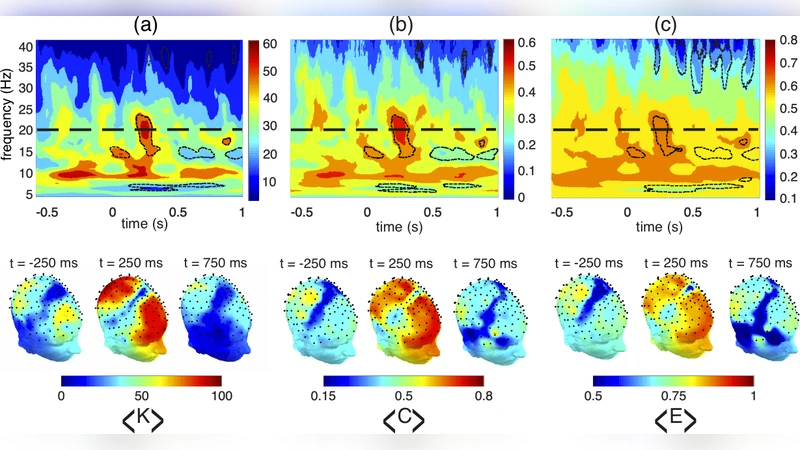
Today, the human brain can be studied as a whole. Electroencephalography, magnetoencephalography, or functional magnetic resonance imaging techniques provide functional connectivity patterns between different brain areas, and during different pathological and cognitive neuro-dynamical states. In this Tutorial we review novel complex networks approaches to unveil how brain networks can efficiently manage local processing and global integration for the transfer of information, while being at the same time capable of adapting to satisfy changing neural demands.
💡 Research Summary
The tutorial paper provides a comprehensive overview of how modern complex‑network theory can be applied to functional brain connectivity data obtained from EEG, MEG, and fMRI. It begins by describing the pipeline that transforms raw time‑series recordings into graphs: selection of connectivity metrics (Pearson correlation, phase‑locking value, mutual information, etc.), construction of weighted adjacency matrices, and subsequent binarisation or thresholding strategies such as statistical significance testing, fixed density, or minimum spanning tree approaches. The authors stress that each preprocessing decision can substantially reshape the resulting topology, and they discuss best‑practice guidelines to minimise bias.
Next, the paper introduces the core graph‑theoretic descriptors that have become standard in neuroscience. Small‑worldness, quantified by high clustering combined with short characteristic path length, captures the brain’s simultaneous capacity for local processing and global integration. Modularity analysis reveals functionally specialized modules (visual, auditory, frontoparietal, etc.) and the balance between intra‑module cohesion and inter‑module communication. Global and local efficiency provide energy‑adjusted measures of information transfer, while hub‑centric concepts such as betweenness centrality, degree distribution, and rich‑club organization identify high‑capacity nodes that support resilient communication pathways. Additional metrics—core‑periphery structure, assortativity, and path diversity—are discussed as complementary tools for characterizing hierarchical organization.
The tutorial then moves to dynamic and multilayer network frameworks, acknowledging that brain connectivity is not static. Sliding‑window techniques generate time‑resolved graphs, enabling the study of network reconfiguration during tasks, sleep, or disease progression. Multilayer models integrate different frequency bands, imaging modalities, or spatial scales into a single analytical object, allowing researchers to capture cross‑frequency coupling and modality‑specific interactions in a unified manner. These approaches reveal that the brain rapidly shifts its modular architecture to meet changing cognitive demands, a phenomenon termed “flexible integration.”
Clinical and cognitive applications are illustrated with concrete examples. In Alzheimer’s disease, reductions in small‑worldness, loss of hub connectivity, and weakened rich‑club structures correlate with memory deficits. Schizophrenia is associated with aberrant modularity—either hyper‑segregation or excessive integration—linked to impaired reality testing. Depression shows decreased global efficiency and disrupted frontolimbic rich‑club connectivity, reflecting maladaptive emotional regulation. Conversely, learning and working‑memory tasks are accompanied by transient strengthening of fronto‑hippocampal links and increased inter‑module connectivity, demonstrating the brain’s capacity for adaptive network re‑wiring.
Finally, the authors critique current limitations and outline future directions. Challenges include heterogeneous spatial and temporal resolutions across modalities, noise contamination, the arbitrariness of threshold selection, and the lack of a unified theoretical mapping between graph metrics and underlying neurophysiology. They advocate for large, open‑access datasets, individualized network fingerprinting, and the integration of machine‑learning or deep‑learning models to predict behavior or disease trajectories from network features. Moreover, they highlight the promise of truly multiscale, multilayer network analyses that simultaneously incorporate time, frequency, and structural information. Such advances are expected to improve early diagnosis, monitor therapeutic response, and guide the design of neuroengineering interventions that harness the brain’s intrinsic network dynamics.
Comments & Academic Discussion
Loading comments...
Leave a Comment