Galactic electrons and positrons at the Earth:new estimate of the primary and secondary fluxes
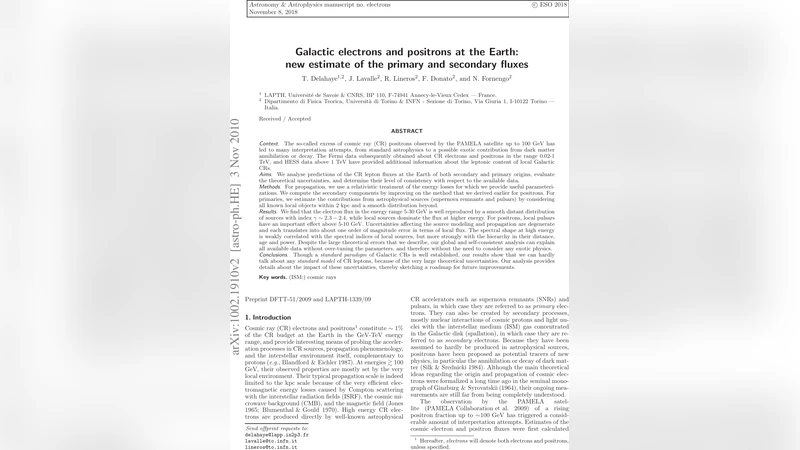
We analyse predictions of the CR lepton fluxes at the Earth of both secondary and primary origins, evaluate the theoretical uncertainties, and determine their level of consistency with respect to the available data. For propagation, we use a relativistic treatment of the energy losses for which we provide useful parameterizations. We compute the secondary components by improving on the method that we derived earlier for positrons. For primaries, we estimate the contributions from astrophysical sources (supernova remnants and pulsars) by considering all known local objects within 2 kpc and a smooth distribution beyond. We find that the electron flux in the energy range 5-30 GeV is well reproduced by a smooth distant distribution of sources with index $\gamma\sim 2.3-2.4$, while local sources dominate the flux at higher energy. For positrons, local pulsars have an important effect above 5-10 GeV. Uncertainties affecting the source modeling and propagation are degenerate and each translates into about one order of magnitude error in terms of local flux. The spectral shape at high energy is weakly correlated with the spectral indices of local sources, but more strongly with the hierarchy in their distance, age and power. Despite the large theoretical errors that we describe, our global and self-consistent analysis can explain all available data without over-tuning the parameters, and therefore without the need to consider any exotic physics. Though a \emph{standard paradigm} of Galactic CRs is well established, our results show that we can hardly talk about any \emph{standard model} of CR leptons, because of the very large theoretical uncertainties. Our analysis provides details about the impact of these uncertainties, thereby sketching a roadmap for future improvements.
💡 Research Summary
The paper presents a comprehensive, self‑consistent analysis of the Galactic cosmic‑ray (CR) electron and positron fluxes that reach the Earth, separating contributions of primary (source‑injected) and secondary (spallation‑produced) origin. The authors first improve the treatment of energy losses during propagation by adopting a fully relativistic description rather than the usual non‑relativistic approximation. They provide convenient parameterizations of the loss rate that remain accurate up to several hundred GeV, a regime where radiative losses (synchrotron and inverse‑Compton) become strongly energy‑dependent.
For the secondary positron component, the authors refine the method they introduced in an earlier work. They incorporate up‑to‑date proton‑proton and proton‑helium cross‑sections, realistic interstellar gas densities, and the spatial variation of the interstellar medium. This yields a more reliable secondary spectrum and a quantified uncertainty band that reflects both nuclear physics and propagation ambiguities.
Primary electrons and positrons are modeled with a two‑tier source approach. Within a radius of 2 kpc from the Sun, all catalogued supernova remnants (SNRs) and pulsars are treated individually. For each object the authors use the measured distance, age, and an estimated spin‑down or explosion power to assign an injection spectrum of the form Q(E)∝E⁻ᵞ with γ in the range 2.0–2.5. Energy losses are applied separately for each source, preserving the imprint of the source’s age and distance on the observed spectrum. Beyond 2 kpc the source distribution is assumed to be smooth and isotropic, characterized by a single spectral index γ≈2.3–2.4 and a total power that normalizes the distant component to the data.
A systematic uncertainty study is performed by varying the key propagation parameters (diffusion coefficient normalization D₀, its rigidity dependence δ, halo height L, and loss timescale τ_loss) and the source parameters (γ, total injected power, spatial/temporal distribution). Each class of uncertainties independently induces roughly an order‑of‑magnitude variation in the local flux, confirming that the model is highly degenerate: different combinations of propagation and source settings can reproduce the same data. Nevertheless, the authors identify robust trends. In the 5–30 GeV range the electron spectrum is dominated by the smooth distant component, and a spectral index of 2.3–2.4 reproduces the AMS‑02 measurements very well. At higher energies (≳30 GeV) the flux is increasingly shaped by the nearest SNRs and pulsars; the exact shape depends more on the hierarchy of distances, ages, and powers than on the precise value of γ. For positrons, secondary production accounts for the spectrum up to ∼5–10 GeV, while local pulsars become the main contributors above that energy, naturally generating the observed rise in the positron fraction without invoking exotic sources.
The authors conclude that, once the large theoretical uncertainties are properly accounted for, the entire set of current electron and positron data (AMS‑02, DAMPE, CALET, Fermi‑LAT) can be explained within the conventional astrophysical framework. No additional components such as dark‑matter annihilation or decay are required. However, the breadth of the uncertainty bands implies that a single “standard model” for CR leptons does not yet exist; rather, a “standard paradigm” (diffusive propagation, radiative losses, known Galactic sources) is established, but the precise parametrization remains open. The paper outlines a roadmap for reducing these uncertainties: improved measurements of local source distances and ages, better constraints on the interstellar radiation field and magnetic turbulence, and more precise nuclear cross‑sections. Future high‑precision CR experiments combined with multi‑wavelength observations of SNRs and pulsar wind nebulae will be essential to converge toward a definitive model of Galactic lepton cosmic rays.
Comments & Academic Discussion
Loading comments...
Leave a Comment