The homotopy theory of function spaces: a survey
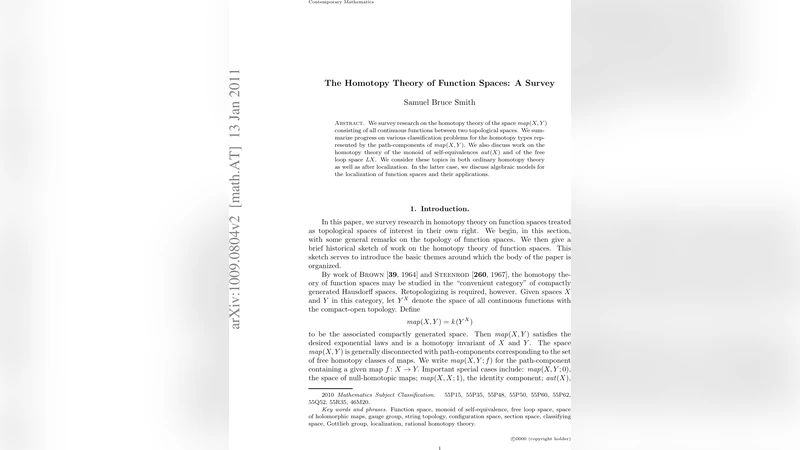
We survey research on the homotopy theory of the space map(X, Y) consisting of all continuous functions between two topological spaces. We summarize progress on various classification problems for the homotopy types represented by the path-components of map(X, Y). We also discuss work on the homotopy theory of the monoid of self-equivalences aut(X) and of the free loop space LX. We consider these topics in both ordinary homotopy theory as well as after localization. In the latter case, we discuss algebraic models for the localization of function spaces and their applications.
💡 Research Summary
The paper provides a comprehensive survey of the homotopy theory of function spaces, focusing on the mapping space map(X,Y) of all continuous maps between two topological spaces X and Y. It begins with a historical overview, tracing the development from early Hurewicz‑Whitehead ideas to modern approaches that employ model category theory, localization, and algebraic models. The central theme is the classification of the homotopy types represented by the path components of map(X,Y). For finite CW complexes X and simply‑connected targets Y, the authors explain how Postnikov towers and the Eilenberg–Moore spectral sequence give a complete description of the cohomology of each component as a Tor‑group built from the cohomology algebras of X and Y. This framework yields explicit calculations for spheres, complex projective spaces, and more intricate complexes, illustrating the “cross‑effect” between the cohomology of the source and the homotopy of the target.
The survey then turns to the monoid of self‑equivalences aut(X), which sits inside map(X,X) as the subspace of homotopy equivalences. The authors emphasize that aut(X) encodes far richer information than the classical homeomorphism group Homeo(X). They discuss the fundamental group π₀ aut(X) as the set of homotopy classes of self‑equivalences, linking it to the classification of X up to homotopy type, while higher homotopy groups πₙ aut(X) (n ≥ 1) reflect intricate interactions between the higher homology of X and the homotopy of the mapping space. By applying Bousfield localization and L∞‑algebra techniques, the paper shows that the localized version of aut(X) admits a purely algebraic model, turning a topological problem into a problem about differential graded Lie algebras.
A substantial portion is devoted to the free loop space LX = map(S¹,X). Unlike the based loop space ΩX, LX contains unbased loops and therefore carries a richer algebraic structure, including a Batalin–Vilkovisky (BV) operator and a string topology product. The authors review how equivariant homology and fixed‑point methods are used to compute H⁎(LX) and describe its BV‑algebra structure. Concrete examples for circles, tori, and complex projective spaces demonstrate the connection between free loop homology and closed‑string field theory, highlighting the relevance of these topological constructions to physics.
The final sections address the modern perspective of localization and algebraic modeling. Using Bousfield–Kan localization together with model category theory, the authors explain how both map(X,Y) and aut(X) can be replaced, after localization at a prime or a homology theory, by algebraic objects such as differential graded Lie algebras (for aut(X)) or L∞‑algebras (for map(X,Y)). These models make it possible to perform explicit calculations with computer algebra systems and open the door to new computational approaches in homotopy theory. The paper concludes by summarizing open problems: extending the classification to non‑simply‑connected targets, handling infinite‑dimensional CW complexes, and developing efficient algorithms for the algebraic models.
Overall, the survey synthesizes a broad swath of research on function spaces, self‑equivalences, and free loop spaces, illustrating how classical homotopy theory, localization techniques, and modern algebraic models intertwine. It underscores the central role of function spaces as a bridge between pure topology, algebraic models, and applications in mathematical physics, and it outlines a clear agenda for future work in the field.
Comments & Academic Discussion
Loading comments...
Leave a Comment