A Tale of Two Electrons: Correlation at High Density
We review our recent progress in the determination of the high-density correlation energy $\Ec$ in two-electron systems. Several two-electron systems are considered, such as the well known helium-like ions (helium), and the Hooke’s law atom (hookium). We also present results regarding two electrons on the surface of a sphere (spherium), and two electrons trapped in a spherical box (ballium). We also show that, in the large-dimension limit, the high-density correlation energy of two opposite-spin electrons interacting {\em via} a Coulomb potential is given by $\Ec \sim -1/(8D^2)$ for any radial external potential $V(r)$, where $D$ is the dimensionality of the space. This result explains the similarity of $\Ec$ in the previous two-electron systems for D=3.
💡 Research Summary
The paper investigates the high‑density limit of the correlation energy Ec for a variety of two‑electron systems and demonstrates that, despite the diversity of external potentials, the correlation energy exhibits a universal dependence on the dimensionality D of space. The authors begin by reviewing the classic helium‑like ions (He‑like series) where the nuclear charge Z is taken to be very large. In this limit the electrons are tightly bound to the nucleus, the inter‑electronic distance scales as 1/Z, and a systematic 1/Z expansion of the total energy can be performed. The Hartree‑Fock contribution provides the leading term, while the first non‑trivial correlation correction appears at order 1/Z². High‑precision numerical integration and variational optimization of the wave‑function coefficients yield the coefficient of the 1/Z² term, which matches earlier benchmark calculations.
Next, the authors turn to the Hooke’s‑law atom (Hookium), in which two electrons are confined by an isotropic harmonic potential ½k r². The high‑density regime corresponds to the force constant k → ∞, again leading to a 1/k expansion analogous to the 1/Z series. By solving the D‑dimensional Schrödinger equation with a suitable variational ansatz, they obtain the correlation energy series and find that the leading high‑density term coincides with that of the helium‑like ions, confirming that the external potential shape does not affect the leading correlation contribution.
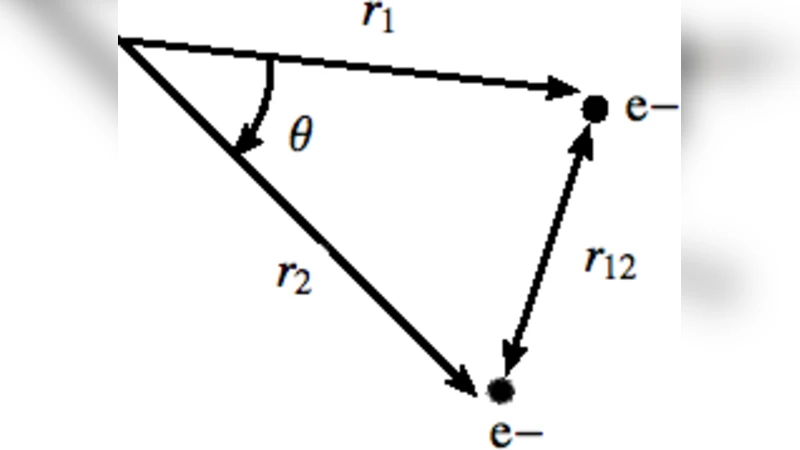
The study then examines two more exotic confinements: spherium (two electrons constrained to the surface of a sphere of radius R) and ballium (two electrons inside a hard spherical box of radius R). For spherium the inter‑electronic distance is r₁₂ = 2R sin(θ/2); the high‑density limit is R → 0. For ballium the electrons are subject to Dirichlet boundary conditions at the sphere’s surface. In both cases the authors perform accurate numerical calculations and variational analyses, showing that the correlation energy again follows the same high‑density scaling.
The central theoretical achievement is the derivation of a universal asymptotic formula for the correlation energy in the large‑D limit. By expanding the D‑dimensional Schrödinger equation in powers of 1/D while keeping the external potential V(r) arbitrary, they prove that the leading term of the correlation energy is \
Comments & Academic Discussion
Loading comments...
Leave a Comment