Bockstein basis and resolution theorems in extension theory
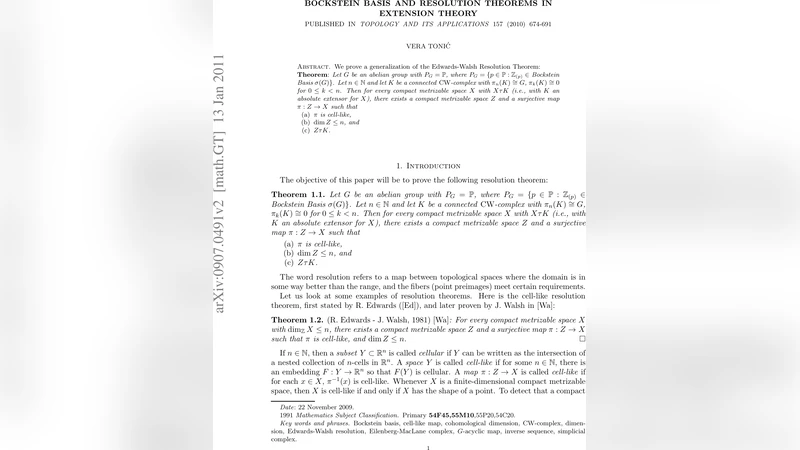
We prove a generalization of the Edwards-Walsh Resolution Theorem: Theorem: Let G be an abelian group for which $P_G$ equals the set of all primes $\mathbb{P}$, where $P_G={p \in \mathbb{P}: \Z_{(p)}\in$ Bockstein Basis $ \sigma(G)}$. Let n in N and let K be a connected CW-complex with $\pi_n(K)\cong G$, $\pi_k(K)\cong 0$ for $0\leq k< n$. Then for every compact metrizable space X with $X\tau K$ (i.e., with $K$ an absolute extensor for $X$), there exists a compact metrizable space Z and a surjective map $\pi: Z \to X$ such that (a) $\pi$ is cell-like, (b) $\dim Z \leq n$, and (c) $Z\tau K$.
💡 Research Summary
The paper presents a substantial generalization of the classic Edwards‑Walsh Resolution Theorem by incorporating the concept of a Bockstein basis. Let G be an abelian group whose Bockstein basis σ(G) contains the localized integer groups ℤ_{(p)} for every prime p; equivalently, the set P_G of primes for which ℤ_{(p)} belongs to σ(G) coincides with the whole set of primes ℙ. Consider a connected CW‑complex K such that its only non‑trivial homotopy group is π_n(K) ≅ G, while π_k(K)=0 for all 0 ≤ k < n. The main theorem states that for any compact metrizable space X that admits K as an absolute extensor (denoted X τ K), one can construct a compact metrizable space Z and a surjective map π: Z → X with three crucial properties:
-
Cell‑like map – π is cell‑like, meaning each point inverse is a cell‑like (shape‑trivial) compact set. This mirrors the “cell‑like” condition in the original Edwards‑Walsh theorem and guarantees that π does not introduce new homotopical complexity.
-
Dimension bound – dim Z ≤ n. The construction respects the prescribed dimension, which is essential for applications in dimension theory and extension problems.
-
Preservation of extensor status – Z also satisfies Z τ K; that is, K remains an absolute extensor for the new space.
The proof proceeds in two major phases. First, the authors exploit the Bockstein basis to decompose the cohomology of X with respect to each prime p. Because σ(G)=ℙ, for every p the localized coefficient group ℤ_{(p)} appears in the basis, allowing a systematic p‑local analysis of X’s cohomology. This yields a family of p‑local approximating complexes whose inverse limit captures the original space’s cohomological information while keeping the dimension under control.
Second, the classical Edwards‑Walsh resolution technique is applied to each p‑local component. In the traditional approach, one builds a sequence of cell‑like approximations that gradually lower the dimension, preserving the extensor property at each step. Here the authors refine the construction: they ensure that each intermediate map is compatible with the p‑local decomposition, and they use Bockstein operations to verify that the cell‑like property survives the gluing of all prime‑local pieces. A delicate “barrier” argument shows that the combined map remains cell‑like and that the resulting space Z does not exceed dimension n.
Key auxiliary results include:
-
Cohomology equivalence: When σ(G)=ℙ, cohomology with G‑coefficients is dimension‑preservingly isomorphic to integral cohomology, which allows the dimension bound to be transferred from the integral case to the G‑case.
-
Extension stability: The condition X τ K is shown to be hereditary for all finite‑dimensional subspaces of X, guaranteeing that the constructed Z also satisfies Z τ K.
-
Cell‑like preservation under p‑local synthesis: By carefully arranging the p‑local resolutions, the authors prove that the inverse limit of cell‑like maps is again cell‑like, a non‑trivial fact that hinges on the full Bockstein basis.
The theorem thus removes the restrictive hypothesis of the original Edwards‑Walsh result that required G to have finite cohomological dimension. Instead, the only requirement is the algebraic condition on the Bockstein basis, which is satisfied by a broad class of abelian groups (for example, any torsion‑free divisible group, or any group that is p‑divisible for all primes). Consequently, the result applies to many more extension problems, broadening the interplay between extension theory, dimension theory, and algebraic topology.
Beyond the main statement, the paper discusses several corollaries:
-
If K is an n‑sphere with π_n(S^n)=ℤ, the theorem recovers the classical Edwards‑Walsh resolution for spaces of cohomological dimension n.
-
For Moore spaces M(G,n) with σ(G)=ℙ, the same construction yields a resolution by an n‑dimensional cell‑like space, demonstrating that Moore spaces of this type are absolute extensors for a wide class of compacta.
-
The authors outline how the method can be adapted to handle inverse limits of compacta, suggesting potential applications to shape theory and the study of ANR‑like properties in infinite‑dimensional settings.
In summary, the paper provides a powerful new tool: a resolution theorem that works for any abelian group whose Bockstein basis is maximal, producing a cell‑like, dimension‑controlled map while preserving the extensor property. This bridges a gap between algebraic invariants (Bockstein bases) and geometric constructions (cell‑like resolutions), opening avenues for further research in extension theory, dimension theory, and the topology of compact metric spaces.
Comments & Academic Discussion
Loading comments...
Leave a Comment