Complexity of Existential Positive First-Order Logic
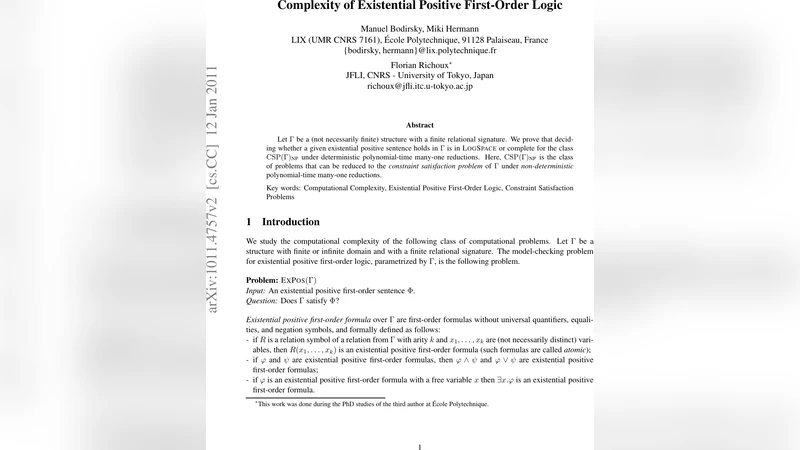
Let gamma be a (not necessarily finite) structure with a finite relational signature. We prove that deciding whether a given existential positive sentence holds in gamma is in Logspace or complete for the class CSP(gamma)_NP under deterministic polynomial-time many-one reductions. Here, CSP(gamma)_NP is the class of problems that can be reduced to the Constraint Satisfaction Problem of gamma under non-deterministic polynomial-time many-one reductions.
💡 Research Summary
The paper investigates the computational complexity of the model‑checking problem for existential positive first‑order sentences over a fixed relational structure γ, where γ may be infinite but its signature is finite. An existential positive sentence is built using only existential quantifiers, conjunction, disjunction, and atomic predicates; it contains no negation or universal quantifiers. Because of this syntactic restriction, each such sentence can be naturally translated into a set of constraints, establishing a close connection with the Constraint Satisfaction Problem (CSP) for the same structure.
The central contribution is a complete dichotomy theorem. The authors prove that, for any γ, the problem “given an existential positive sentence φ, does γ ⊨ φ?” falls into exactly one of two complexity classes. Either the problem is solvable in deterministic logarithmic space (L), or it is as hard as the class CSP(γ)_NP under deterministic polynomial‑time many‑one reductions. CSP(γ)_NP is defined as the class of decision problems that can be reduced to the CSP over γ by nondeterministic polynomial‑time many‑one reductions; in other words, it captures all problems that are at most as hard as CSP(γ) when reductions are allowed to be nondeterministic.
To establish the dichotomy, the authors combine algebraic methods (polymorphisms) with classic complexity‑theoretic reductions. The first step is a polynomial‑time transformation that converts any existential positive sentence into an equivalent CSP instance over γ. This transformation respects the size of the input, using variable duplication and constraint decomposition to handle disjunctions (∪) as a nondeterministic choice and conjunctions (∩) as simultaneous satisfaction.
The second step analyses the algebraic structure of γ. If γ admits a “simple” polymorphism—such as a global minimum, maximum, majority, or Maltsev operation—then the resulting CSP belongs to the logspace tractable fragment. The authors present a concrete logspace algorithm that scans the constraints sequentially, maintaining only a constant amount of information about variable assignments, thereby showing that the model‑checking problem lies in L.
Conversely, if γ lacks any of these tractable polymorphisms, the authors prove that the model‑checking problem is CSP(γ)_NP‑complete. They construct a nondeterministic polynomial‑time many‑one reduction from any problem in CSP(γ)_NP to the existential‑positive model‑checking problem. The reduction encodes the nondeterministic choices required by the NP‑many‑one framework into the disjunctions of the existential‑positive formula, while the conjunctions enforce the consistency of the chosen assignments. This shows that, under deterministic polynomial‑time many‑one reductions, the model‑checking problem is at least as hard as any problem reducible to CSP(γ) via nondeterministic reductions, establishing NP‑hardness in the refined sense of CSP(γ)_NP‑completeness.
The dichotomy aligns closely with the celebrated CSP Dichotomy Theorem (Bulatov‑Zhuk). When γ has a tractable polymorphism, CSP(γ) itself is in P (often even in L), and the existential‑positive model‑checking problem inherits this low complexity. When γ lacks such polymorphisms, CSP(γ) is NP‑complete, and the model‑checking problem becomes CSP(γ)_NP‑complete. Thus the paper lifts the CSP dichotomy from the level of plain constraint satisfaction to the richer logical level of existential positive first‑order logic.
In addition to the main theorem, the authors discuss several extensions and open directions. They suggest investigating infinite‑domain structures beyond the finite‑signature assumption, exploring fragments that allow limited negation or universal quantifiers, and applying the results to practical query evaluation in databases and knowledge‑representation systems. The work not only clarifies the exact boundary between tractable and intractable existential‑positive reasoning but also provides a framework for future studies of logical fragments that sit between pure CSPs and full first‑order logic.
Comments & Academic Discussion
Loading comments...
Leave a Comment