Synchronized Task Decomposition for Cooperative Multi-agent Systems
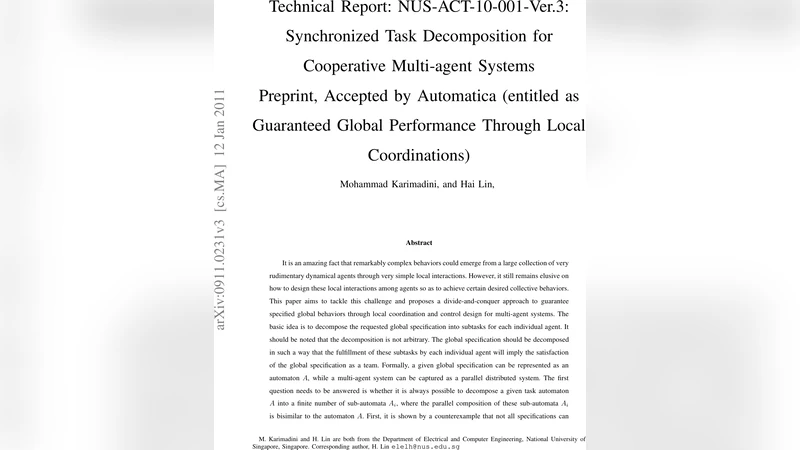
It is an amazing fact that remarkably complex behaviors could emerge from a large collection of very rudimentary dynamical agents through very simple local interactions. However, it still remains elusive on how to design these local interactions among agents so as to achieve certain desired collective behaviors. This paper aims to tackle this challenge and proposes a divide-and-conquer approach to guarantee specified global behaviors through local coordination and control design for multi-agent systems. The basic idea is to decompose the requested global specification into subtasks for each individual agent. It should be noted that the decomposition is not arbitrary. The global specification should be decomposed in such a way that the fulfilment of these subtasks by each individual agent will imply the satisfaction of the global specification as a team. First, it is shown by a counterexample that not all specifications can be decomposed in this sense. Then, a natural follow-up question is what the necessary and sufficient condition should be for the proposed decomposability of a global specification. The main part of the paper is set to answer this question. The case of two cooperative agents is investigated first, and a necessary and sufficient condition is presented and proven. Later on, the result is generalized to the case of arbitrary finite number of agents, and a hierarchical algorithm is proposed, which is shown to be a sufficient condition. Finally, a cooperative control scenario for a team of three robots is developed to illustrate the task decomposition procedure.
💡 Research Summary
The paper tackles a fundamental problem in cooperative multi‑agent systems: how to design simple local interaction rules so that a group of rudimentary agents collectively satisfies a complex global specification. The authors propose a “divide‑and‑conquer” framework called Synchronized Task Decomposition, which systematically breaks a global task into subtasks assigned to individual agents. The decomposition is not arbitrary; it must guarantee that when every agent fulfills its local subtask, the team as a whole automatically satisfies the original global requirement.
First, the authors demonstrate by counterexample that many global specifications cannot be decomposed in this way, establishing the need for precise conditions. They then focus on the simplest non‑trivial case—two cooperating agents—and derive a necessary and sufficient condition for decomposability. This condition consists of two parts: (1) the projection of the global specification onto each agent’s alphabet must exactly match the agent’s local specification, and (2) the shared synchronization events (e.g., joint actions or message exchanges) must appear in the same order and with the same semantics in the local specifications as they do in the global one. Using automata theory, they prove that the synchronized product of the two local automata is language‑equivalent to the global automaton, thereby guaranteeing that local satisfaction implies global satisfaction.
Building on the two‑agent result, the paper extends the theory to an arbitrary finite number of agents. The authors introduce a hierarchical decomposition algorithm: the global specification is recursively split into binary sub‑specifications, each of which is handled using the two‑agent condition. At each recursion level the algorithm checks that the local projections and synchronization constraints are satisfied; if all levels pass, the entire set of local tasks is guaranteed to enforce the global specification. The algorithm is shown to be a sufficient condition, and its computational complexity is polynomial in the size of the specification for typical hierarchical structures.
To illustrate the practical relevance, the authors implement the framework on a team of three mobile robots tasked with a compound mission: open a door, transport an object, and reach a target location. The global mission is expressed in Linear Temporal Logic (LTL) and automatically translated into local LTL formulas for each robot via projection. Each robot’s controller combines Model Predictive Control (MPC) with an event‑based synchronization mechanism that enforces the shared actions identified by the decomposition. Both simulation and real‑world experiments confirm that the robots, while operating under purely local control laws, achieve perfect coordination and satisfy the global LTL mission without any violation.
In summary, the paper makes three major contributions: (1) it identifies the fundamental limits of task decomposition for multi‑agent systems; (2) it provides a rigorous necessary and sufficient condition for two‑agent decomposability and proves it using formal language equivalence; (3) it generalizes the result to any finite number of agents via a hierarchical algorithm that serves as a practical sufficient condition. The work bridges the gap between high‑level formal specifications and low‑level distributed control design, offering a solid theoretical foundation and a concrete algorithmic tool for engineers developing cooperative robot teams, distributed sensor networks, smart‑grid micro‑grids, and other large‑scale autonomous systems. Future directions suggested include handling non‑regular specifications, dynamic network topologies, and integrating learning‑based local controllers while preserving the formal guarantees established in this study.
Comments & Academic Discussion
Loading comments...
Leave a Comment