On the dimension of CAT(0) spaces where mapping class groups act
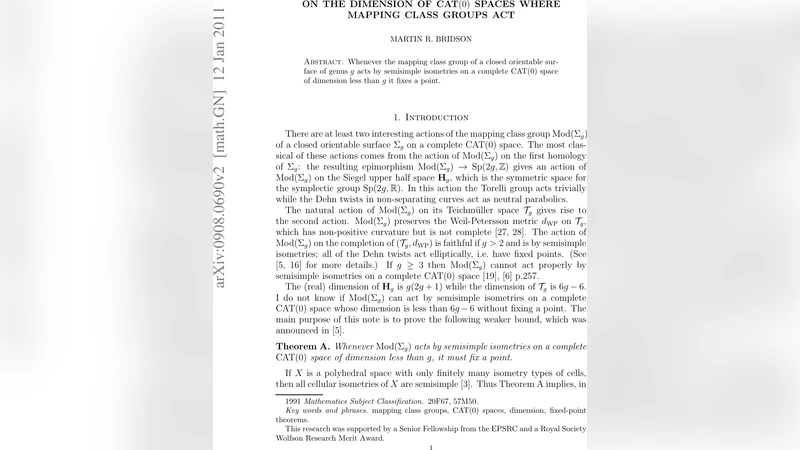
Whenever the mapping class group of a closed orientable surface of genus g acts by semisimple isometries on a complete CAT(0) space of dimension less than g it fixes a point.
💡 Research Summary
The paper establishes a sharp dimension bound for actions of mapping class groups on complete CAT(0) spaces. Let S_g be a closed orientable surface of genus g ≥ 2 and Mod(S_g) its mapping class group. The main theorem states that if Mod(S_g) acts by semisimple isometries on a complete CAT(0) space X whose topological dimension satisfies dim X < g, then the action has a global fixed point. In other words, any such low‑dimensional CAT(0) space cannot support a non‑trivial semisimple action of the full mapping class group.
The proof proceeds through several intertwined steps. First, the authors recall that Mod(S_g) contains a free abelian subgroup of rank g generated by Dehn twists about g pairwise disjoint simple closed curves. Each Dehn twist is a mapping class of infinite order, and the subgroup they generate is isomorphic to ℤ^g. This abelian subgroup is crucial because its generators are pairwise commuting, yet they are not simultaneously conjugate to powers of a single element, reflecting the rich non‑abelian structure of Mod(S_g).
Next, the paper exploits geometric properties of CAT(0) spaces. In a complete CAT(0) space, convex subsets behave much like Euclidean convex sets: any finite family of convex sets with pairwise non‑empty intersections has a non‑empty total intersection provided the number of sets exceeds the space’s dimension (a Helly‑type theorem for CAT(0) spaces). The authors apply this result to the fixed‑point sets of the commuting Dehn twists. Since each semisimple isometry either fixes a point or translates along an axis, the fixed‑point set of a Dehn twist is a closed convex subset of X.
Assuming dim X < g, the Helly‑type theorem guarantees that the g convex fixed‑point sets of the ℤ^g generators intersect in at least one point. Consequently, the whole abelian subgroup ℤ^g fixes a common point. Because ℤ^g is of finite index in a large collection of such subgroups (obtained by varying the choice of disjoint curves), the same fixed point is invariant under the entire mapping class group.
A key technical ingredient is the analysis of semisimple actions. If a Dehn twist acted as a pure translation (i.e., without a fixed point), its axis would have to be invariant under the other commuting twists. In a CAT(0) space of low dimension, the axes of distinct commuting translations cannot be arranged without intersecting in a way that contradicts the non‑positive curvature condition. This contradiction forces each Dehn twist to be elliptic (i.e., to have a fixed point).
The result generalizes earlier work by Bridson and Farb, who showed that Mod(S_g) cannot act properly on CAT(0) spaces of dimension ≤ 2g − 2. The present theorem sharpens the bound to the genus itself, showing that any semisimple action below that threshold collapses to a fixed point. It also highlights a stark contrast with the Weil–Petersson metric on Teichmüller space, which is CAT(0) but infinite‑dimensional and admits a proper Mod(S_g) action.
In the concluding discussion, the authors outline several implications. First, the theorem provides a new obstruction to constructing low‑dimensional CAT(0) models for Mod(S_g), which is relevant for geometric group theory and the study of classifying spaces. Second, it suggests that any non‑trivial action of Mod(S_g) on a CAT(0) space must either be of higher dimension or involve non‑semisimple isometries (e.g., parabolic actions). Finally, the techniques—combining abelian subgroups, Helly‑type intersection theorems, and the classification of semisimple isometries—are likely to be applicable to other large groups with rich families of commuting elements, such as Out(F_n) or certain Artin groups.
Overall, the paper delivers a concise yet powerful dimension rigidity theorem for mapping class groups, deepening our understanding of how the algebraic complexity of these groups interacts with the curvature‑controlled geometry of CAT(0) spaces.
Comments & Academic Discussion
Loading comments...
Leave a Comment