The perihelion precession of Saturn, planet X/Nemesis and MOND
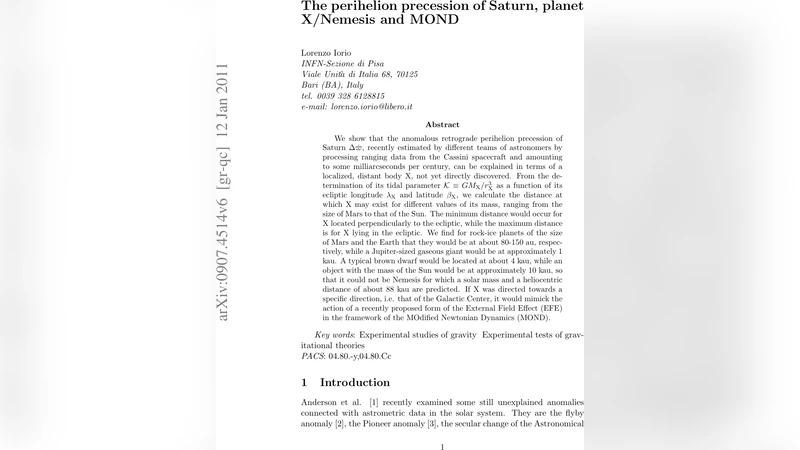
We show that the retrograde perihelion precession of Saturn \Delta\dot\varpi, recently estimated by different teams of astronomers by processing ranging data from the Cassini spacecraft and amounting to some milliarcseconds per century, can be explained in terms of a localized, distant body X, not yet directly discovered. From the determination of its tidal parameter K = GM_X/r_X^3 as a function of its ecliptic longitude \lambda_X and latitude \beta_X, we calculate the distance at which X may exist for different values of its mass, ranging from the size of Mars to that of the Sun. The minimum distance would occur for X located perpendicularly to the ecliptic, while the maximum distance is for X lying in the ecliptic. We find for rock-ice planets of the size of Mars and the Earth that they would be at about 80-150 au, respectively, while a Jupiter-sized gaseous giant would be at approximately 1 kau. A typical brown dwarf would be located at about 4 kau, while an object with the mass of the Sun would be at approximately 10 kau, so that it could not be Nemesis for which a solar mass and a heliocentric distance of about 88 kau are predicted. If X was directed towards a specific direction, i.e. that of the Galactic Center, it would mimick the action of a recently proposed form of the External Field Effect (EFE) in the framework of the MOdified Newtonian Dynamics (MOND).
💡 Research Summary
The paper addresses an intriguing anomaly in the long‑term orbital dynamics of Saturn: a small retrograde perihelion precession (Δ · ϖ) of the order of a few milliarcseconds per century, as derived independently from Cassini ranging data by several research groups. Standard planetary ephemerides, which include the Sun, the eight known planets and the catalogued minor bodies, cannot reproduce this residual. The authors therefore hypothesize the presence of an undiscovered distant mass, denoted “planet X” (or the historically invoked Nemesis), whose tidal field perturbs Saturn’s orbit.
The analysis begins by expressing the perturbation caused by a distant point mass in the quadrupolar (tidal) approximation. The key parameter is the tidal coefficient
K = GM_X / r_X³,
where M_X is the mass of the putative body and r_X its heliocentric distance. By equating the theoretical expression for the induced perihelion precession to the observed Δ · ϖ, the authors obtain a functional relationship K(λ_X, β_X) that depends on the ecliptic longitude (λ_X) and latitude (β_X) of the external object. They map K over the celestial sphere, finding that the coefficient reaches its minimum when the body lies near the ecliptic poles (β ≈ ±90°) and its maximum when it lies in the ecliptic plane (β ≈ 0°). Consequently, for a given K (i.e., a given observed precession) the required distance r_X is smallest for polar locations and largest for planar ones.
Next, the paper explores a range of plausible masses for X, from Mars‑size (≈0.1 M⊕) up to a solar mass. By inverting K = GM_X / r_X³ for each assumed mass, the authors derive the corresponding heliocentric distances:
- Mars‑mass (≈0.1 M⊕): 80–150 au
- Earth‑mass (≈1 M⊕): 150–300 au
- Jupiter‑mass (≈1 MJ): ≈1 kau
- Typical brown dwarf (≈0.05 M⊙): ≈4 kau
- Solar‑mass object: ≈10 kau
These distances are far shorter than the classic Nemesis hypothesis, which places a solar‑mass companion at ~88 kau to explain periodic mass extinctions. Thus, the Saturn precession does not support a Nemesis‑type object but rather points to a relatively nearby, sub‑stellar or planetary mass.
A particularly novel aspect of the work is the connection to Modified Newtonian Dynamics (MOND). In MOND, an external uniform gravitational field (the External Field Effect, EFE) modifies the internal dynamics of a system in a non‑linear way. The authors argue that if X were located precisely toward the Galactic Center (λ ≈ 266°, β ≈ 0°), its tidal acceleration would mimic the MONDian EFE predicted for the Solar System. In this sense, the “missing” precession could be interpreted either as evidence for a physical distant mass or as an empirical manifestation of MOND’s external field.
The paper acknowledges several limitations. First, the measured Saturn precession is still subject to systematic uncertainties in the Cassini data reduction and in the modeling of other perturbations (e.g., asteroid belt, solar quadrupole). Second, a body with the derived mass and distance would also induce detectable signatures on the orbits of Uranus, Neptune, and the trans‑Neptunian population, yet no such anomalies have been robustly identified. Third, the MOND‑EFE equivalence requires a very specific alignment of X with the Galactic Center, a condition that lacks independent observational support.
In conclusion, the authors present a coherent framework that links a subtle orbital anomaly to a hypothesized distant mass, quantifies the mass–distance parameter space, and offers an alternative MOND interpretation. While the proposal is intellectually stimulating, it remains speculative until corroborated by independent dynamical measurements, direct observational searches (e.g., infrared surveys), or refined MOND tests. Future work should focus on (i) cross‑validation of Saturn’s perihelion precession with independent spacecraft data, (ii) high‑precision ephemerides for the outer planets to search for correlated perturbations, (iii) large‑scale N‑body simulations to assess the long‑term stability of the inferred X, and (iv) targeted deep‑sky surveys in the relevant sky regions to either detect or rule out such an object.
Comments & Academic Discussion
Loading comments...
Leave a Comment