Not every pseudoalgebra is equivalent to a strict one
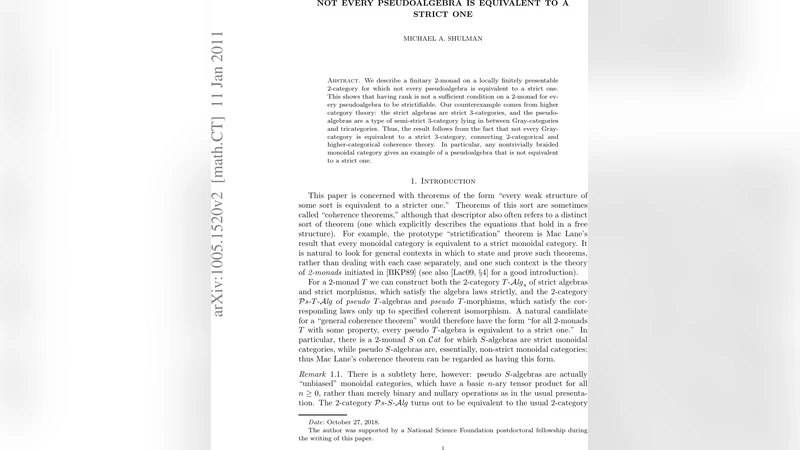
We describe a finitary 2-monad on a locally finitely presentable 2-category for which not every pseudoalgebra is equivalent to a strict one. This shows that having rank is not a sufficient condition on a 2-monad for every pseudoalgebra to be strictifiable. Our counterexample comes from higher category theory: the strict algebras are strict 3-categories, and the pseudoalgebras are a type of semi-strict 3-category lying in between Gray-categories and tricategories. Thus, the result follows from the fact that not every Gray-category is equivalent to a strict 3-category, connecting 2-categorical and higher-categorical coherence theory. In particular, any nontrivially braided monoidal category gives an example of a pseudoalgebra that is not equivalent to a strict one.
💡 Research Summary
The paper addresses a long‑standing expectation in 2‑category theory that every pseudo‑algebra for a finitary 2‑monad can be strictified, i.e., is equivalent to a strict algebra. The authors construct a concrete counterexample by exhibiting a finitary 2‑monad (T) on a locally finitely presentable 2‑category (\mathcal{K}) such that not all pseudo‑algebras for (T) are equivalent to strict ones.
First, the ambient 2‑category (\mathcal{K}) is chosen to be LFP, guaranteeing the existence of free algebras for finitary monads. The monad (T) is defined so that its strict algebras are precisely strict 3‑categories: objects equipped with 0‑, 1‑, 2‑, and 3‑cells satisfying all associativity, unit, and interchange laws on the nose. In contrast, a pseudo‑algebra for (T) relaxes the interchange law between 2‑ and 3‑cells: the coherence is witnessed only by invertible 3‑cells rather than strict equalities. Consequently, pseudo‑algebras are exactly the semi‑strict 3‑categories that sit between Gray‑categories (where the 1‑/2‑cell interchange is strict but the 2‑/3‑cell interchange is weak) and fully weak tricategories.
The crucial observation is that not every Gray‑category is equivalent to a strict 3‑category. This is a known result in higher‑category theory, often demonstrated by taking a non‑trivially braided monoidal category (\mathcal{B}) and forming the one‑object Gray‑category (\Sigma\mathcal{B}). The braiding provides a non‑trivial 3‑cell that cannot be strictified without collapsing the braiding, so (\Sigma\mathcal{B}) is not equivalent to any strict 3‑category. By interpreting (\Sigma\mathcal{B}) as a pseudo‑algebra for the monad (T), the authors obtain a concrete pseudo‑algebra that fails to be strictifiable.
The construction proceeds as follows. The monad (T) is shown to be finitary (it preserves filtered colimits) and to have rank, satisfying the usual hypotheses that guarantee the existence of free algebras. The authors then describe the pseudo‑algebra structure explicitly: a 2‑functor (a: T A \to A) together with coherent invertible modifications that encode the weakened interchange. They verify that any Gray‑category equipped with its canonical Gray‑tensor product gives rise to such a pseudo‑algebra. Next, they invoke the known non‑strictifiability of certain Gray‑categories (e.g., those arising from braided monoidal categories) to demonstrate that the corresponding pseudo‑algebra cannot be equivalent, in the 2‑monadic sense, to any strict algebra.
This counterexample shows that the presence of rank (or finitariness) for a 2‑monad is not sufficient to guarantee strictification of all pseudo‑algebras. The result thus separates two previously conflated conditions: (i) the existence of a rank‑preserving monad, which ensures good algebraic behaviour such as the existence of free algebras, and (ii) the higher‑dimensional coherence property that every pseudo‑algebra can be strictified. The paper highlights that the latter is a genuinely higher‑categorical phenomenon, sensitive to the specific nature of the coherence data at the 3‑cell level.
Beyond the abstract counterexample, the authors discuss implications for coherence theory. In dimension three, the failure of strictification reflects the impossibility of eliminating all non‑trivial braidings or associators without altering the underlying categorical structure. Consequently, any attempt to develop a general strictification theorem for finitary 2‑monads must incorporate additional hypotheses that control the interaction of higher cells, such as requiring the monad to be “cartesian” or to preserve certain limits, rather than merely having rank.
Finally, the paper presents the braided monoidal category example in detail. Given a non‑trivially braided monoidal category ((\mathcal{B},\otimes, I, \beta)), one forms the one‑object Gray‑category (\Sigma\mathcal{B}) whose 1‑cells are the objects of (\mathcal{B}), 2‑cells are the morphisms, and the braiding (\beta) supplies the non‑strict 3‑cell data. This Gray‑category is a pseudo‑algebra for (T) but cannot be equivalent to any strict 3‑category, because any strictification would force the braiding to be the identity, contradicting the non‑triviality of (\beta). Thus, the example provides an explicit, easily visualizable instance of a pseudo‑algebra that resists strictification.
In summary, the paper delivers a clear and robust counterexample to the conjecture that finitary 2‑monads with rank automatically strictify all pseudo‑algebras. It bridges the gap between 2‑categorical monad theory and higher‑dimensional coherence, showing that the subtleties of 3‑dimensional cell interactions can obstruct strictification even under seemingly strong algebraic conditions. This work invites further investigation into what additional structural constraints on a 2‑monad might guarantee strictification, and it underscores the richness of coherence phenomena in higher category theory.
Comments & Academic Discussion
Loading comments...
Leave a Comment