Single--crossover recombination in discrete time
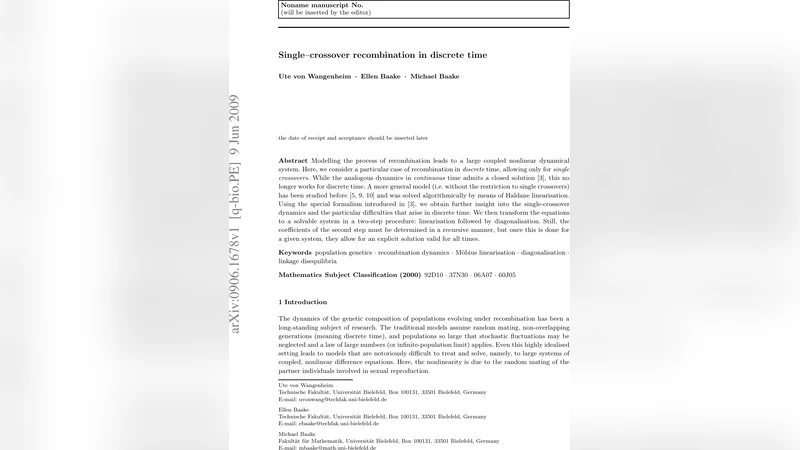
Modelling the process of recombination leads to a large coupled nonlinear dynamical system. Here, we consider a particular case of recombination in {\em discrete} time, allowing only for {\em single crossovers}. While the analogous dynamics in {\em continuous} time admits a closed solution, this no longer works for discrete time. A more general model (i.e. without the restriction to single crossovers) has been studied before and was solved algorithmically by means of Haldane linearisation. Using the special formalism introduced by Baake and Baake (2003), we obtain further insight into the single-crossover dynamics and the particular difficulties that arise in discrete time. We then transform the equations to a solvable system in a two-step procedure: linearisation followed by diagonalisation. Still, the coefficients of the second step must be determined in a recursive manner, but once this is done for a given system, they allow for an explicit solution valid for all times.
💡 Research Summary
The paper addresses the mathematical description of genetic recombination when time is treated as a discrete sequence of generations and only a single crossover per generation is allowed. In continuous‑time models the recombination dynamics can be expressed as a system of differential equations that become linear after the classic Haldane linearisation, yielding a closed‑form solution. In discrete time, however, the update rule remains a nonlinear map because each generation either experiences a crossover at one of the possible loci or none at all. This nonlinearity prevents a direct application of the continuous‑time solution technique.
To overcome this obstacle the authors adopt the formalism introduced by Baake and Baake (2003), which decomposes the genotype space into subsets corresponding to the possible crossover patterns. For a chromosome with (n) potential crossover sites there are (2^{n}) such subsets, each associated with a probability variable that records the frequency of genotypes exhibiting the corresponding pattern. By arranging these variables into a high‑dimensional vector, the recombination map can be written as a matrix transformation.
The analysis proceeds in two stages. First, a linearisation step rewrites the nonlinear update as a linear combination of the previous‑generation probabilities. The resulting matrix (A) is upper‑triangular: diagonal entries represent the probability that no crossover occurs (the “stay” probability), while the entries above the diagonal encode the transition probabilities when a single crossover takes place at a specific site. This step reduces the original coupled nonlinear system to a linear recurrence (p_{t+1}=A,p_{t}).
Second, the authors diagonalise (A). Because the matrix is not generically diagonalizable by a simple eigenvalue decomposition—eigenvalues can be degenerate and depend hierarchically on the positions of the crossover sites—they develop a recursive construction of eigenvectors. The eigenvalues (\lambda_{k}) are ordered according to the number of crossover sites involved; the leading eigenvalue (\lambda_{0}=1) corresponds to the invariant mode where no recombination occurs, while subsequent eigenvalues (\lambda_{1},\lambda_{2},\dots) are functions of the single‑crossover probability (p) (e.g., (\lambda_{1}=1-p), (\lambda_{2}=1-2p), etc.). For each eigenvalue the associated eigenvector is built from previously computed eigenvectors multiplied by appropriate transition‑probability factors. The coefficients needed for this construction are obtained recursively, but once they are determined for a given set of parameters they apply to all time steps.
With the eigen‑decomposition (A = V \Lambda V^{-1}) the solution of the original dynamics becomes \
Comments & Academic Discussion
Loading comments...
Leave a Comment