Effect of Rare Fluctuations on the Thermalization of Isolated Quantum Systems
We consider the question of thermalization for isolated quantum systems after a sudden parameter change, a so-called quantum quench. In part icular we investigate the pre-requisites for thermalization focusing on the statistical properties of the time-averaged density matrix and o f the expectation values of observables in the final eigenstates. We find that eigenstates, which are rare compared to the typical ones sampled by the micro-canonical distribution, are responsible for the absence of thermalization of some infinite integrable models and play an important role for some non-integrable systems of finite size, such as the Bose-Hubbard model. We stress the importance of finite size effects for the thermalization of isolated quantum systems and discuss two alternative scenarios for thermalization, as well as ways to prune down the correct one.
💡 Research Summary
The paper addresses the long‑standing question of whether and how an isolated quantum many‑body system thermalizes after a sudden change of a Hamiltonian parameter—a quantum quench. The authors focus on two statistical objects that encode the long‑time behavior: (i) the time‑averaged density matrix ρ̄, which determines the expectation values of all observables after dephasing, and (ii) the distribution of eigenstate expectation values ⟨ϕα|Ô|ϕα⟩ of a generic observable Ô in the final Hamiltonian’s eigenbasis. In the conventional picture of thermalization, ρ̄ is expected to coincide with the micro‑canonical ensemble, which implies that the eigenstates contributing significantly to ρ̄ are typical members of the micro‑canonical shell and that their expectation values cluster tightly around the micro‑canonical average (the eigenstate thermalization hypothesis, ETH).
The authors demonstrate that this picture can break down because of “rare” eigenstates—states that are statistically atypical within the micro‑canonical shell but have unusually large overlaps with the initial state. Even though the number of such states is exponentially small, their contribution to ρ̄ can dominate if the overlap coefficients |cα|² = |⟨ϕα|ψ₀⟩|² are anomalously large. Consequently, the long‑time averages of observables deviate from the micro‑canonical prediction, and the system fails to thermalize.
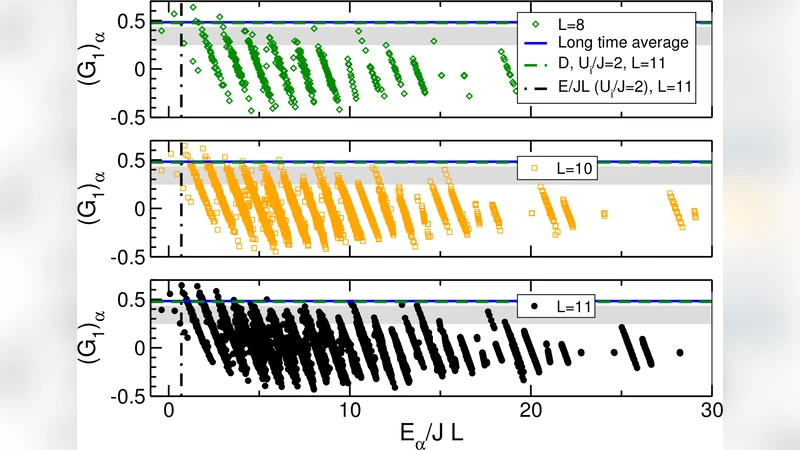
Two families of models are examined. First, integrable systems (e.g., the one‑dimensional free fermion chain and the quantum Ising model) are shown to possess a dense set of rare eigenstates that survive in the thermodynamic limit. In these models the ETH is violated, and the presence of rare states explains the well‑known lack of thermalization after a quench. Second, a non‑integrable but finite‑size model, the Bose‑Hubbard lattice with a small number of sites, is studied numerically. For modest system sizes (L≈6–10) the quench can populate a handful of rare eigenstates, leading to pronounced finite‑size effects: the time‑averaged density matrix is skewed, and observable averages differ markedly from micro‑canonical values. As the lattice size grows, the weight of rare states diminishes, and the system crosses over to a regime where ETH holds and thermalization occurs. This crossover is quantified by a “pruning” procedure that measures the fraction of the total weight carried by rare states and compares it to a threshold.
Based on these observations the authors propose two alternative scenarios for the ultimate fate of thermalization in isolated quantum systems. In the “rare‑state suppression” scenario, the weight of rare states vanishes in the thermodynamic limit, so ETH becomes exact and thermalization is guaranteed for generic non‑integrable models. In the “rare‑state persistence” scenario, symmetries or conserved quantities protect a set of atypical eigenstates, allowing them to retain a finite weight even as the system size grows; in this case thermalization can be permanently obstructed, as in integrable models. The paper outlines concrete diagnostics—spectral analysis of the initial state, finite‑size scaling of the rare‑state weight, and comparison with micro‑canonical predictions—to discriminate between the two scenarios in numerical simulations and experiments.
In summary, the work highlights that thermalization is not solely a matter of energy conservation and typicality; rare fluctuations in the eigenstate overlap distribution can dominate the long‑time state, especially in finite systems. Recognizing and quantifying these rare contributions is essential for interpreting quench experiments in cold‑atom platforms, for designing protocols that either avoid or exploit non‑thermal steady states, and for establishing a more nuanced understanding of when and why isolated quantum systems do—or do not—thermalize.
Comments & Academic Discussion
Loading comments...
Leave a Comment