We obtain an exact solution of the self-consistent relativistic magnetohydrodynamic equations for an anisotropic magnetoactive plasma in the background of a plane gravitational wave metric (PGW) with an arbitrary polarization. It is shown that, in the linear approximation in the gravitational wave amplitude, only the $\mathbf{e_+}$ polarization of the PGW interacts with a magnetoactive plasma.
Deep Dive into Exact solution of the relativistic magnetohydrodynamic equations in the background of a plane gravitational wave with combined polarization.
We obtain an exact solution of the self-consistent relativistic magnetohydrodynamic equations for an anisotropic magnetoactive plasma in the background of a plane gravitational wave metric (PGW) with an arbitrary polarization. It is shown that, in the linear approximation in the gravitational wave amplitude, only the $\mathbf{e_+}$ polarization of the PGW interacts with a magnetoactive plasma.
In a series of previous articles by one of the authors (see, e.g., [1][2][3] a theory of gravimagnetic shock waves in a homogeneous magnetoactive plasma has been developed. The essence of this phenomenon is that a magnetized plasma in anomalously strong magnetic fields drifts under the action of gravitational waves (GWs) in the GW propagation direction under the condition that the wave amplitude is large enough, and, on a certain wave front, the plasma velocity tends to the speed of light. Its energy density and the intensity of the frozen-in magnetic field then tend to infinity. In the subsequent papers this effect was proved on the basis of the kinetic theory, and the possibility of using this mechanism as an effective tool for detecting GWs from astrophysical sources was also shown. However, in all cited papers, a monopolarized gravitational wave was considered. In the present paper we consider the action of a GW with combined polarization on a magnetoactive plasma.
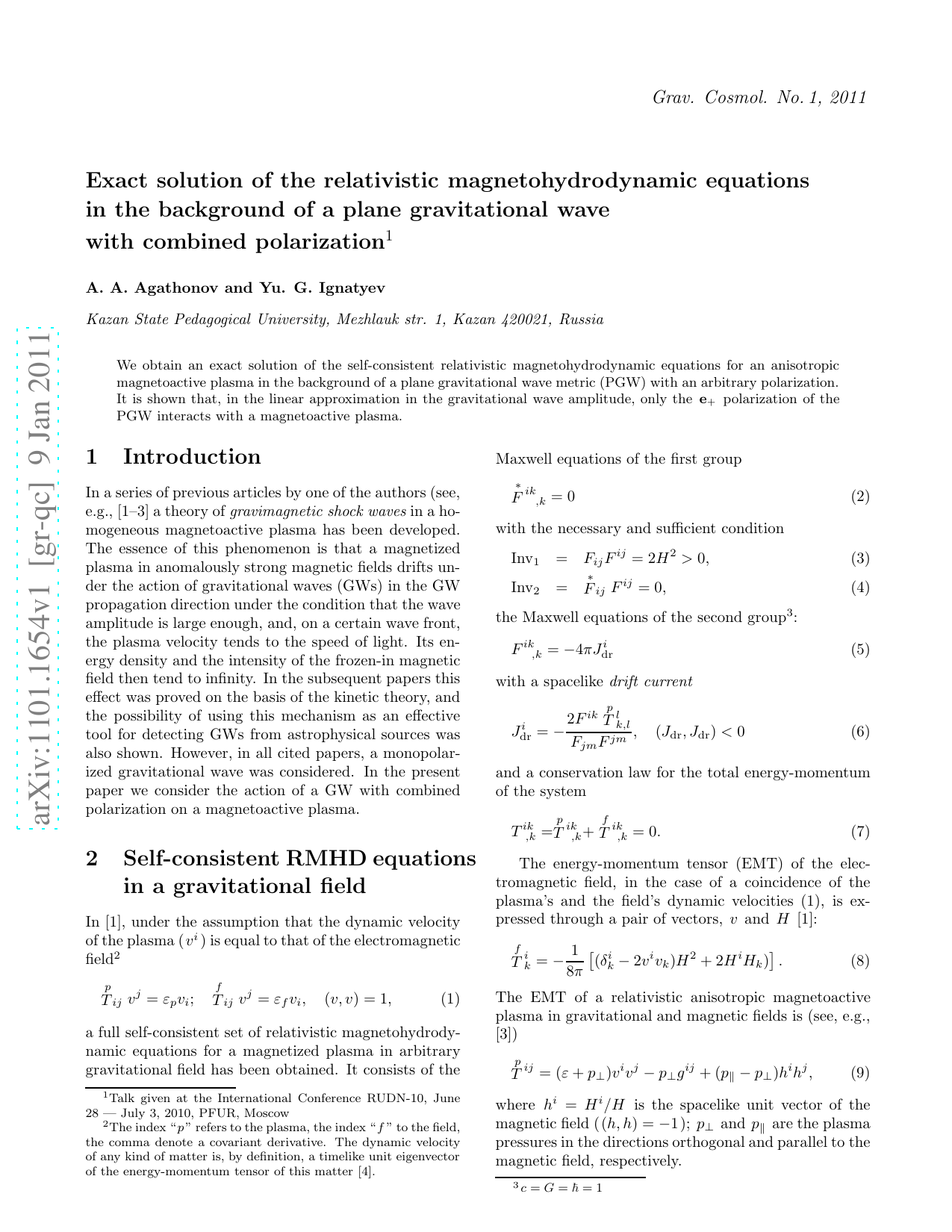
In [1], under the assumption that the dynamic velocity of the plasma (v i ) is equal to that of the electromagnetic field
a full self-consistent set of relativistic magnetohydrodynamic equations for a magnetized plasma in arbitrary gravitational field has been obtained. It consists of the
with the necessary and sufficient condition
the Maxwell equations of the second group 3 :
with a spacelike drift current
F jm F jm , (J dr , J dr ) < 0 (6) and a conservation law for the total energy-momentum of the system
The energy-momentum tensor (EMT) of the electromagnetic field, in the case of a coincidence of the plasma’s and the field’s dynamic velocities (1), is expressed through a pair of vectors, v and H [1]:
The EMT of a relativistic anisotropic magnetoactive plasma in gravitational and magnetic fields is (see, e.g., [3])
where h i = H i /H is the spacelike unit vector of the magnetic field ((h, h) = -1 ); p ⊥ and p are the plasma pressures in the directions orthogonal and parallel to the magnetic field, respectively.
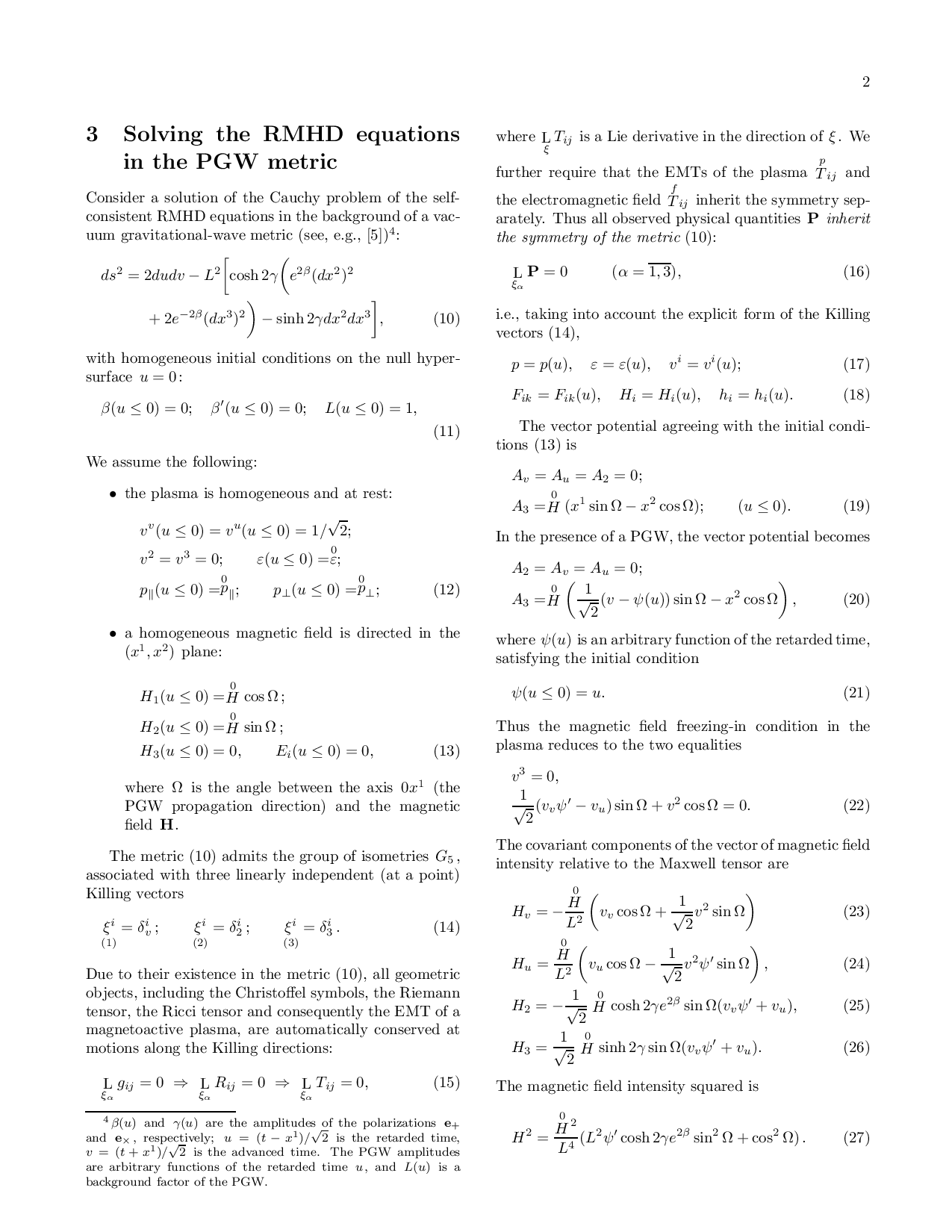
Consider a solution of the Cauchy problem of the selfconsistent RMHD equations in the background of a vacuum gravitational-wave metric (see, e.g., [5]) 4 :
with homogeneous initial conditions on the null hypersurface u = 0 :
We assume the following:
• the plasma is homogeneous and at rest:
• a homogeneous magnetic field is directed in the (x 1 , x 2 ) plane:
where Ω is the angle between the axis 0x 1 (the PGW propagation direction) and the magnetic field H.
The metric (10) admits the group of isometries G 5 , associated with three linearly independent (at a point) Killing vectors
Due to their existence in the metric (10), all geometric objects, including the Christoffel symbols, the Riemann tensor, the Ricci tensor and consequently the EMT of a magnetoactive plasma, are automatically conserved at motions along the Killing directions:
i.e., taking into account the explicit form of the Killing vectors ( 14),
The vector potential agreeing with the initial conditions (13) is
In the presence of a PGW, the vector potential becomes
where ψ(u) is an arbitrary function of the retarded time, satisfying the initial condition
Thus the magnetic field freezing-in condition in the plasma reduces to the two equalities
The covariant components of the vector of magnetic field intensity relative to the Maxwell tensor are
The magnetic field intensity squared is
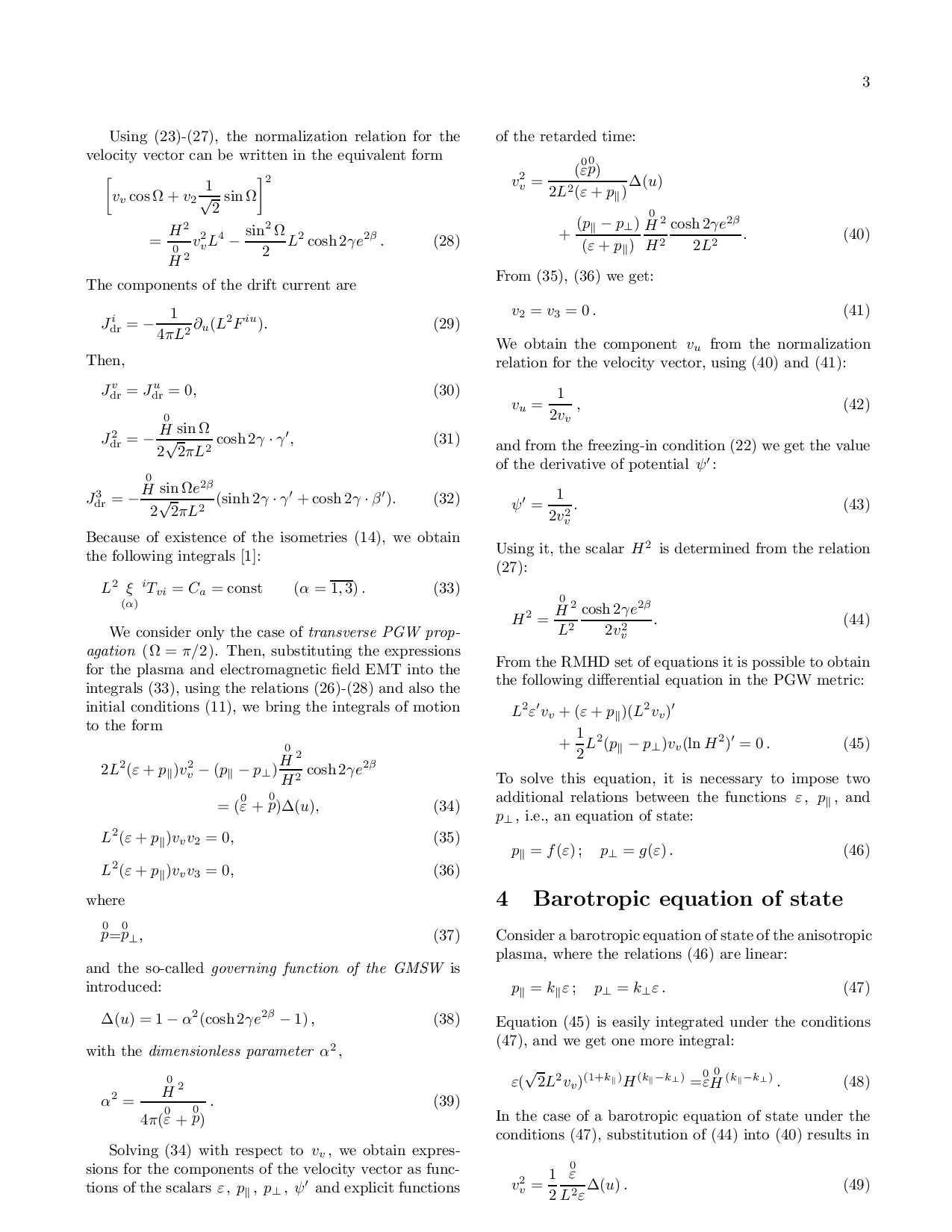
Using ( 23)-( 27), the normalization relation for the velocity vector can be written in the equivalent form
The components of the drift current are
Then,
Because of existence of the isometries (14), we obtain the following integrals [1]:
We consider only the case of transverse PGW propagation (Ω = π/2 ). Then, substituting the expressions for the plasma and electromagnetic field EMT into the integrals (33), using the relations (26)-(28) and also the initial conditions (11), we bring the integrals of motion to the form
where
and the so-called governing function of the GMSW is introduced:
with the dimensionless parameter α 2 ,
Solving (34) with respect to v v , we obtain expressions for the components of the velocity vector as functions of the scalars ε , p , p ⊥ , ψ ′ and explicit functions of the retarded time:
From ( 35), (36) we get:
We obtain the component v u from the normalization relation for the velocity vector, using (40) and (41):
and from the freezing-in condition (22) we get the value of the derivative of potential ψ ′ :
Using it, the scalar H 2 is determined from the relation ( 27):
From the RMHD set of equations it is possible to obtain the following differential equation in the PGW metric:
To solve this equation, it is necessary to impose two additional relations between the functions ε , p , and p ⊥ , i.e., an equation of state:
4 Barotropic equation of state
Consider a barotropic equation of state of the anisotropic plasma, where the relations (46) are linear:
Equation ( 45) is easily integrated under the conditions (47), and we get one m
…(Full text truncated)…
This content is AI-processed based on ArXiv data.