Iterative method for solution of radiation emission/transmission matrix equations

Reading time: 5 minute
...

📝 Original Info

  • Title: Iterative method for solution of radiation emission/transmission matrix equations
  • ArXiv ID: 1101.0819
  • Date: 2011-01-06
  • Authors: Clinton DeW. Van Siclen

📝 Abstract

An iterative method is derived for image reconstruction. Among other attributes, this method allows constraints unrelated to the radiation measurements to be incorporated into the reconstructed image. A comparison is made with the widely used Maximum-Likelihood Expectation-Maximization (MLEM) algorithm.

💡 Deep Analysis

Deep Dive into Iterative method for solution of radiation emission/transmission matrix equations.

An iterative method is derived for image reconstruction. Among other attributes, this method allows constraints unrelated to the radiation measurements to be incorporated into the reconstructed image. A comparison is made with the widely used Maximum-Likelihood Expectation-Maximization (MLEM) algorithm.

📄 Full Content

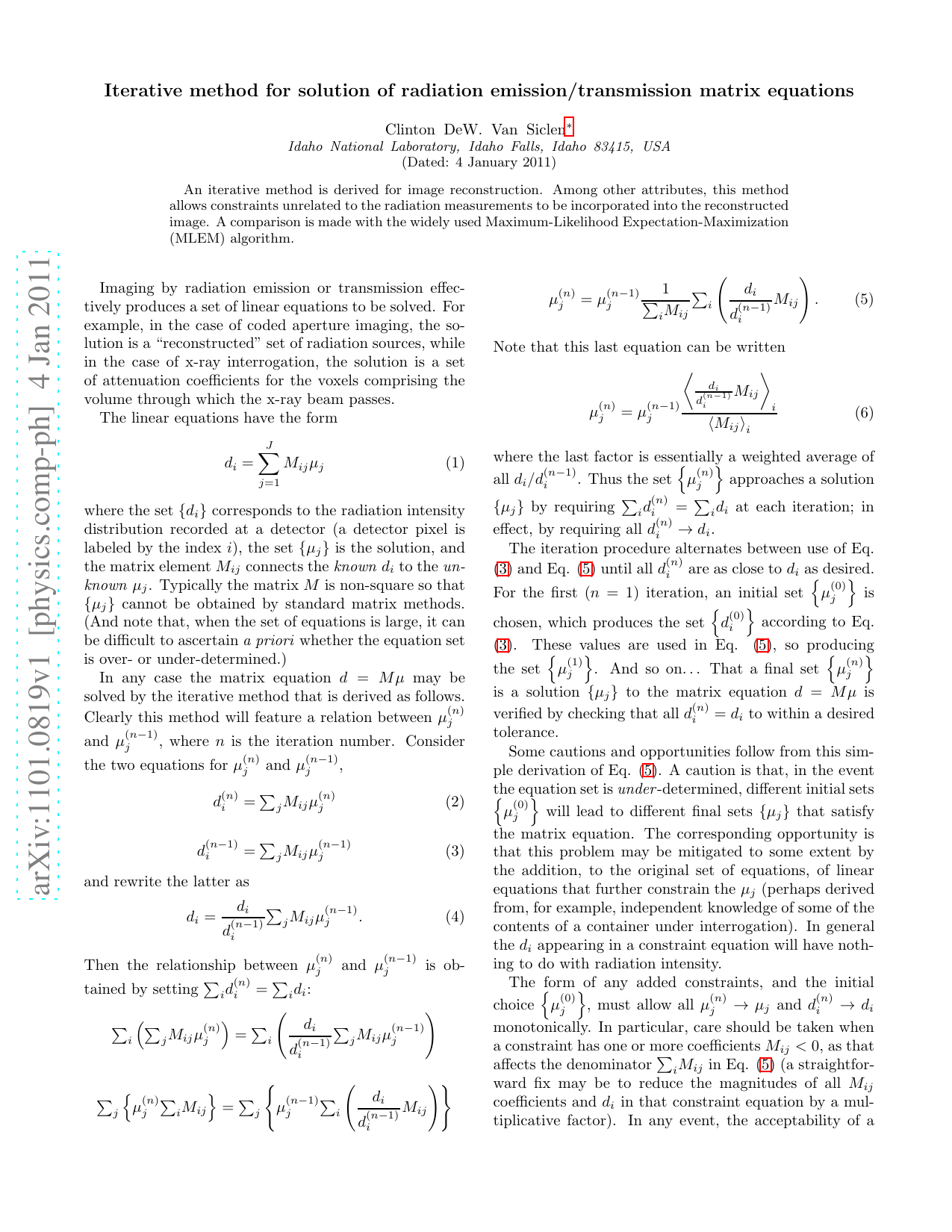
arXiv:1101.0819v1 [physics.comp-ph] 4 Jan 2011 Iterative method for solution of radiation emission/transmission matrix equations Clinton DeW. Van Siclen∗ Idaho National Laboratory, Idaho Falls, Idaho 83415, USA (Dated: 4 January 2011) An iterative method is derived for image reconstruction. Among other attributes, this method allows constraints unrelated to the radiation measurements to be incorporated into the reconstructed image. A comparison is made with the widely used Maximum-Likelihood Expectation-Maximization (MLEM) algorithm. Imaging by radiation emission or transmission effec- tively produces a set of linear equations to be solved. For example, in the case of coded aperture imaging, the so- lution is a “reconstructed” set of radiation sources, while in the case of x-ray interrogation, the solution is a set of attenuation coefficients for the voxels comprising the volume through which the x-ray beam passes. The linear equations have the form di = J X j=1 Mijµj (1) where the set {di} corresponds to the radiation intensity distribution recorded at a detector (a detector pixel is labeled by the index i), the set {µj} is the solution, and the matrix element Mij connects the known di to the un- known µj. Typically the matrix M is non-square so that {µj} cannot be obtained by standard matrix methods. (And note that, when the set of equations is large, it can be difficult to ascertain a priori whether the equation set is over- or under-determined.) In any case the matrix equation d = Mµ may be solved by the iterative method that is derived as follows. Clearly this method will feature a relation between µ(n) j and µ(n−1) j , where n is the iteration number. Consider the two equations for µ(n) j and µ(n−1) j , d(n) i = P jMijµ(n) j (2) d(n−1) i = P jMijµ(n−1) j (3) and rewrite the latter as di = di d(n−1) i P jMijµ(n−1) j . (4) Then the relationship between µ(n) j and µ(n−1) j is ob- tained by setting P id(n) i = P idi: P i P jMijµ(n) j  = P i

di d(n−1) i P jMijµ(n−1) j ! P j n µ(n) j P iMij o = P j ( µ(n−1) j P i

di d(n−1) i Mij !) µ(n) j = µ(n−1) j 1 P iMij P i

di d(n−1) i Mij ! . (5) Note that this last equation can be written µ(n) j = µ(n−1) j  di d(n−1) i Mij  i ⟨Mij⟩i (6) where the last factor is essentially a weighted average of all di/d(n−1) i . Thus the set n µ(n) j o approaches a solution {µj} by requiring P id(n) i = P idi at each iteration; in effect, by requiring all d(n) i →di. The iteration procedure alternates between use of Eq. (3) and Eq. (5) until all d(n) i are as close to di as desired. For the first (n = 1) iteration, an initial set n µ(0) j o is chosen, which produces the set n d(0) i o according to Eq. (3). These values are used in Eq. (5), so producing the set n µ(1) j o . And so on. . . That a final set n µ(n) j o is a solution {µj} to the matrix equation d = Mµ is verified by checking that all d(n) i = di to within a desired tolerance. Some cautions and opportunities follow from this sim- ple derivation of Eq. (5). A caution is that, in the event the equation set is under-determined, different initial sets n µ(0) j o will lead to different final sets {µj} that satisfy the matrix equation. The corresponding opportunity is that this problem may be mitigated to some extent by the addition, to the original set of equations, of linear equations that further constrain the µj (perhaps derived from, for example, independent knowledge of some of the contents of a container under interrogation). In general the di appearing in a constraint equation will have noth- ing to do with radiation intensity. The form of any added constraints, and the initial choice n µ(0) j o , must allow all µ(n) j →µj and d(n) i →di monotonically. In particular, care should be taken when a constraint has one or more coefficients Mij < 0, as that affects the denominator P iMij in Eq. (5) (a straightfor- ward fix may be to reduce the magnitudes of all Mij coefficients and di in that constraint equation by a mul- tiplicative factor). In any event, the acceptability of a 2 constraint equation is easily ascertained by monitoring the behavior d(n) i →di for that constraint. Note that all solutions {µj} to a set of equations that includes additional constraints with di > 0 and all Mij ≥0 are accessible from sets n µ(0) j o of initial values, and further that any set n µ(0) j o will produce a solution {µj}. This suggests that, for this implementation of con- straints, a superposition of many solutions may give a good “probabilistic” reconstruction. To achieve this, con- sider that the innumerable solutions to the set of equa- tions may be regarded as points in a J-dimensional space (J is the number of elements in a solution {µj}). These points must more-or-less cluster, producing a cluster cen- troid that is itself a solution. While the centroid solution n µ(c) j o has no intrinsic special status (as all cluster points represent equally likely reconstructions), it may be taken to represent the particular set of equations. The clu

…(Full text truncated)…

📸 Image Gallery

cover.png

Reference

This content is AI-processed based on ArXiv data.

Start searching

Enter keywords to search articles

↑↓
ESC
⌘K Shortcut