We show that two tensor permutation matrices permutate tensor product of rectangle matrices. Some examples, in the particular case of tensor commutation matrices, for studying some linear matrix equations are given.
Deep Dive into On the tensor Permutation Matrices.
We show that two tensor permutation matrices permutate tensor product of rectangle matrices. Some examples, in the particular case of tensor commutation matrices, for studying some linear matrix equations are given.
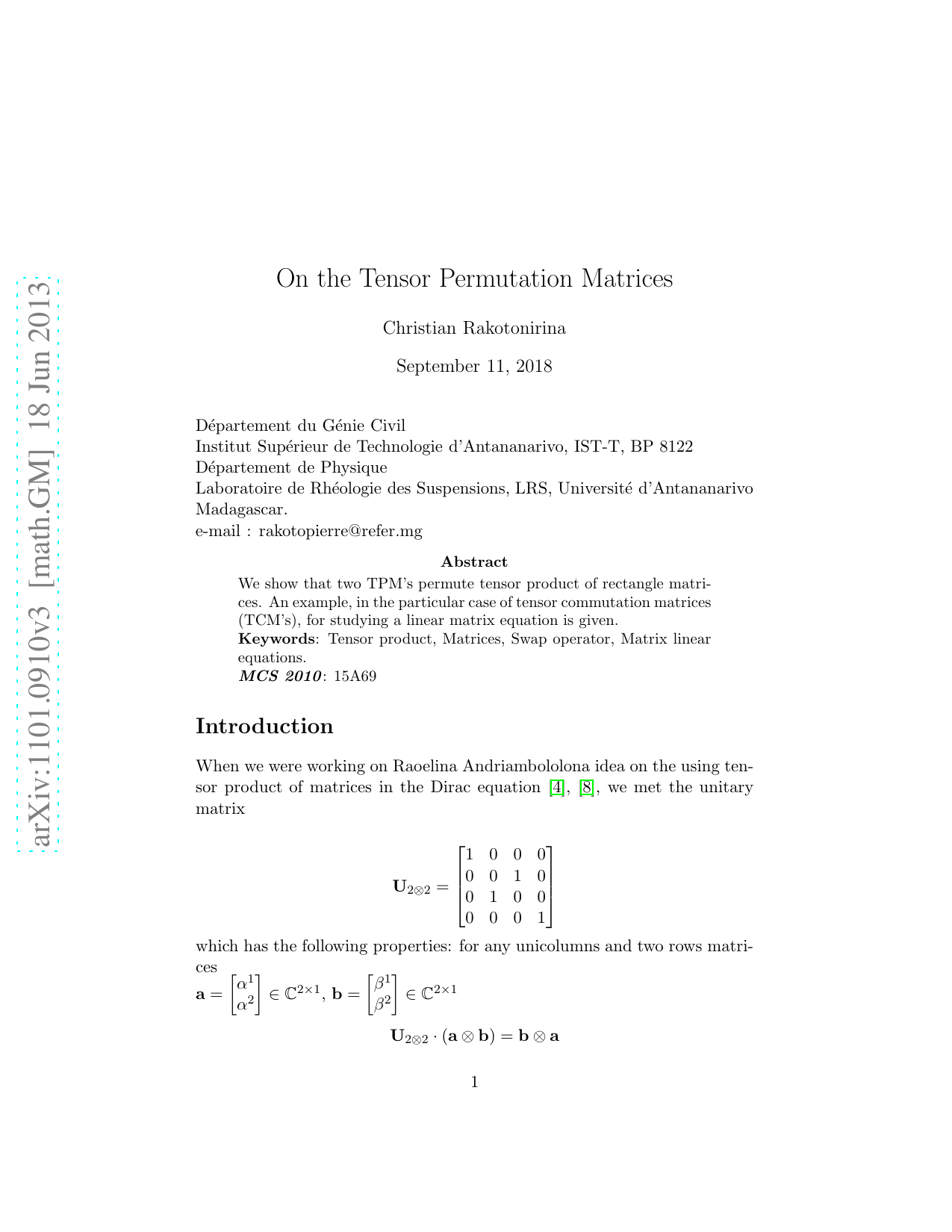
When we were working on Raoelina Andriambololona idea on the using tensor product of matrices in the Dirac equation [4], [8], we met the unitary matrix
which has the following properties: for any unicolumns and two rows matrices
and for any two 2 × 2-matrices, A, B ∈ C 2×2
This matrix is frequently found in quantum information theory [2], [1], [7].
We call this matrix a tensor commutation matrix (TCM) 2 ⊗ 2. The TCM 3 ⊗ 3 has been written by Kazuyuki Fujii [2] under the following form
in order to obtain a conjecture of the form of a TCM n ⊗ n, for any n ∈ N ⋆ . He calls these matrices “‘swap operator”’. U n⊗p , the TCM n ⊗ p, n, p ∈ N ⋆ , commutes the tensor product of n × n-matrix by p × p-matrix. In this paper we will show that two σ-TPM’s U σ , V σ permute tensor product of rectangle matrices, that is,
, where σ is a permutation of the set {1, 2, . . . , k}. U σ = V σ , if A 1 , A 2 , . . ., A k are square matrices (Cf. for example [5]). We will show this property, according to the Raoelina Andriambololona approach in linear and multilinear algebra [6]: in establishing at first, the propositions on linear operators in intrinsic way, that is independently of the bases, and then we demonstrate the analogous propositions for the matrices.
obtained after the multiplications by scalar, A i j B, is called the tensor product of the matrix A by the matrix B.
A ⊗ B ∈ C mp×nr Proposition 2. Tensor product of matrices is associative.
A is the matrix of A with respect to the couple of bases (e i ) 1 ≤i ≤n , (f j ) 1 ≤j ≤m , B the one of B in (g k ) 1 ≤k ≤r , (h l ) 1 ≤l ≤p . Then, A ⊗ B is the matrix of A ⊗ B with respect to the couple of bases (B, B 1 ), where B = (e 1 ⊗ g 1 , e 1 ⊗ g 2 , . . . , e 1 ⊗ g r , e 2 ⊗ g 1 , e 2 ⊗ g 2 , . . . , e 2 ⊗ g r , . . . , e n ⊗ g 1 , e n ⊗ g 2 , . . . , e n ⊗ g r ) Notation: we denote the set B and B 1 by
), defined by
with respect to the same couple of bases. According to the proposition 5, we have
Proof. " =⇒ " It is evident from the proposition 9. " ⇐= " Suppose that for all
. . , B k be some bases of E 1 , E 2 , . . . , E k where the components of a 1 , a 2 ,. . . , a k form the unicolumn matrices a 1 , a 2 ,. . . ,
The application of this proposition to any two unicolumn matrices leads us to the following remark.
or equivalently
The equation ( 2) can be obtained by multiplying the equation (1) by the m ⊗ q TCM U m⊗q and in using the proposition 9 and the remark 11. Mutually, the equation ( 1) can be obtained by multiplying the equation ( 2) by the q ⊗ m TCM U q⊗m .
We have generalized a property of TPM’s. Two TPM’s permutate tensor product of rectangle matrices. The example show the utility of the property. It suffices to transform a matrix linear equation to a matrix linear equation of the form AX = B. Another matrix linear equation of this form can be deduced by using a TCM and by applying the generalization.
This content is AI-processed based on ArXiv data.