Evolution of Chinese airport network
With the rapid development of economy and the accelerated globalization process, the aviation industry plays more and more critical role in today's world, in both developed and developing countries. As the infrastructure of aviation industry, the air…
Authors: Jun Zhang, Xian-Bin Cao, Wen-Bo Du
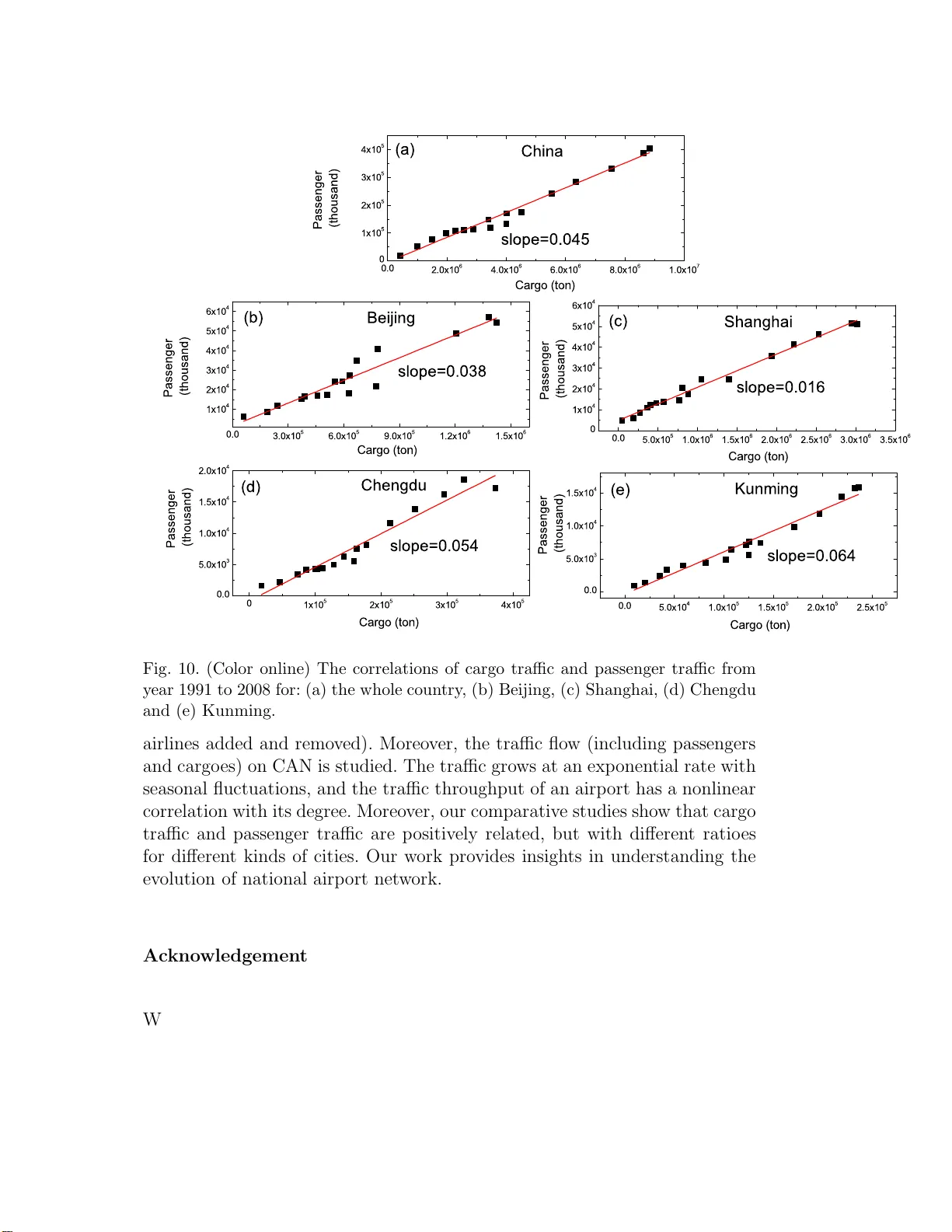
Ev olution of Chinese airp ort net w ork Jun Zhang a , Xian-Bin Cao a,b, ∗ , W en-Bo Du a,b , Kai-Qua n Cai a a Scho o l of Ele ctr o ni c and Informatio n Engine ering, Beihang University, Beijing, 10008 3, P.R.China b Scho o l of Computer Scienc e and T e chnolo gy, Unive rs i ty o f Scienc e and T e c hn olo gy of China, Hefei, A nhui, 23002 6, P . R. China Abstract With the rapid dev elopment of econom y and the accelerated globalization pro cess, the a viation in dustry pla ys more and more critical role in to da y’s w orld , in b oth dev elop ed and dev eloping coun tries. As the infr astru cture of a viation indu stry , th e airp ort net work is one of th e most imp ortan t ind ica tors of economic growth. In this pap er, w e inv estigate the ev olution of Chin ese airp ort netw ork (CAN) via complex net work theory . It is found that although the top ology of C AN remains steady du r- ing the past seve r al ye ars , there are many d ynamic switc h in gs inside the net w ork , whic h c hanges the relativ e r el ev ance of airp orts and airlines. Moreo v er, w e inv es- tigate the ev olution o f t r affic flow (passengers and cargo es) on CAN. It is found that the traffic k eeps gro wing in an exp onen tial form and it has eviden t seasonal fluctuations. W e a lso foun d that cargo traffic and p assenger traffic are p ositiv ely related b ut the correlations are quite different for different kinds of cities. Key wor ds: Complex n et work, Chinese Airp ort netw ork, T ransp ortation, Evolutio n P ACS: 89.75. -k, 89.75.Fb, 89.40.Da, 89.40.Dd 1 In tro duction Ranging from biological systems to economic and so cial systems, many real- w orld complex systems can b e represen ted b y net w orks, includin g c hemical- reaction net w orks, neuronal net w orks, fo o d w ebs, telephone netw or k, the W orld Wide W eb, railroa d and airline routes, so cial netw orks and scien tific-collab oration net w orks [1,2,3]. Obv io usly , the real net works are neither regular lattices nor ∗ Corresp onding author. E-mail: xb cao@ustc.edu.cn Preprint submitted to Elsevier S ci en ce 26 Octob er 2018 simple ra ndom net w o r ks. Since the small-w orld net w ork mo del [4 ] and the scale-free netw or k mo del [5] w ere brought fo r ward at the end of t he last cen- tury , p eople find that many real complex netw o rks are actually as so ciated with small-w orld prop ert y and a scale-free, p o w er- la w degree distribution. In the past ten y ears, the theory of complex netw orks has drawn con tin uous atten- tion fro m differen t scien t ific commun it ies, suc h as net w ork mo delling [6,7,8], sync hronization [9,10], information traffic [1 1 ,12,13,14], epidemic spreading [15,16], cascading failures [17,1 8,19,20], ev olutionary games [21,2 2 ,23,24,25] and social dynamics [26] etc.. One in teresting and imp ortant researc h direc- tion is understanding t he transp ortation infrastructures in the fr a mew ork of complex net w ork theory [27,28,29,30,31,32,33,34 ]. With the acceleration of globalization pro cess, the aviation industry pla ys a more and more critical role in the economy and man y scien tists pay sp ecial atten tion to the airw ay transp ortation infrastructure. Complex net w or k the- ory is na t ur a lly a useful to ol since the airp orts can b e denoted by v ertex and the flights can b e denoted with edges. In the past few y ears, some inte resting researc hes ha ve b een repo r t ed to study the airpo rt net works from the view of net w o rk theory . F or example, Amaral et a l. comprehensiv ely in v estigated the w orldwide air port net work (W AN). They found that W AN is a typical scale-free small-w orld netw o rk and the most connected no des in W AN are not necessarily t he most cen tral no des, whic h means critical lo cations might not coincide with highly-connected hubs in the inf r astructure s. This inte rest- ing phenomenon inspired them to prop ose a geographical- political- cons t r a ined net w ork mo del [35,36]. V espignani et al. further inv estigated the in tensit y of W AN’s connections via the view of w eighted netw orks a nd they found the correlations b et we en w eighted quan tities and the top ology . They pro posed a w eigh ted ev olving net w ork mo del to expand our understanding of we ig hted features o f real systems. Besides, t hey a lso prop osed a global epidemic mo del to study the role of W AN in the prediction and predictabilit y of global epi- demics [37,38]. Besides, sev eral empirical w orks on Chinese Airp ort Netw ork [39,40,41] and Indian Airp ort Net w ork [42] rev eal that the scale o f national airp ort net works can exhibit differen t properties from the global s cale of W AN, i.e., t he tw o-regime p o wer-la w degree distribution and t he disassortative mix- ing prop ert y . As the a viation industry is an imp ortant indicator of economic gro wth, it is necessary and more meaningful to inv estigate the ev olutio n of airp ort netw ork. Recen tly , Gautreau et al. studied t he US airpo rt netw ork in the time p erio d 1990 ∼ 2000 . They fo und that most statistical indicators are stationary and an intens e activity takes place at the microscopic lev el, with many disapp ear- ing/app earing links b et we en air ports [43]. Ro c ha studied the Brazilian airp ort net w ork (BAN) in the time p erio d 1 995 ∼ 2006. He also found the net w ork structure is dynamic with c hanges in the relev a nce of airp orts and airlines, and the traffic on BAN is doubled during the perio d while the top ology of BAN 2 shrinks [44]. Inspired by their in teresting w orks, w e in v estigate ev o lution of Chinese Airp ort Netw o rk (CAN) from the year 1950 to 2008 (1991 to 2008 for detailed traffic information and 200 2 to 2009 for detailed top ology infor- mation). It is found that the airw ay traffic v olume increases in a n exp onen tial form while t he to p ology has no significan t change. The pap er is organized as follows. In the next section, the description of CAN data is presen ted. The statistical analysis o f CAN top ology is given in Section 3. In Section 4, w e analyze ev olut io n of traffic flo w on CAN. The pap er is concluded b y the last section. 2 Dev elopmen t of CAN with Chinese GDP 1 9 5 0 1 9 6 0 1 9 7 0 1 9 8 0 1 9 9 0 2 0 0 0 2 0 1 0 0 2 0 0 4 0 0 6 0 0 8 0 0 1 0 0 0 1 2 0 0 1 9 5 0 1 9 6 0 1 9 7 0 1 9 8 0 1 9 9 0 2 0 0 0 2 0 1 0 0 2 0 4 0 6 0 8 0 1 0 0 1 2 0 1 4 0 1 6 0 1 9 5 0 1 9 6 0 1 9 7 0 1 9 8 0 1 9 9 0 2 0 0 0 2 0 1 0 0 . 0 5 . 0 x1 0 3 1 . 0 x1 0 4 1 . 5 x1 0 4 2 . 0 x1 0 4 2 . 5 x1 0 4 3 . 0 x1 0 4 2 0 0 0 2 0 0 4 2 0 0 8 1 0 4 2 x 1 0 4 3 x 1 0 4 ( b ) G D P ( b i l l i o n ) T h e n u m b e r o f a i r p o r t s T h e n u m b e r o f a i r l i n e s ( c) Y e a r ( a ) Fig. 1. (Color online.) The dev elopment of Ch in ese Gross Domestic Prod uct (a), n u m b er of airlines (b) and num b er of airp orts (c) from 1950 to 2008. Th e data are obtained from R ef.[45] Airp ort netw ork is the bac kb one of aviation industry . It inclu des air ports and direct flights linking airp ort pairs. Since av ia t ion industry is closely re- 3 1 9 5 0 1 9 6 0 1 9 7 0 1 9 8 0 1 9 9 0 2 0 0 0 2 0 1 0 0 2 0 4 0 6 0 8 0 1 0 0 1 2 0 1 4 0 1 6 0 1 8 0 2 0 0 1 9 5 0 1 9 6 0 1 9 7 0 1 9 8 0 1 9 9 0 2 0 0 0 2 0 1 0 0 5 0 0 1 0 0 0 1 5 0 0 2 0 0 0 2 5 0 0 3 0 0 0 3 5 0 0 4 0 0 0 4 5 0 0 0 5 0 0 0 1 0 0 0 0 1 5 0 0 0 2 0 0 0 0 2 5 0 0 0 3 0 0 0 0 0 2 0 4 0 6 0 8 0 1 0 0 1 2 0 1 4 0 1 6 0 1 8 0 2 0 0 0 5 0 0 0 1 0 0 0 0 1 5 0 0 0 2 0 0 0 0 2 5 0 0 0 3 0 0 0 0 0 5 0 0 1 0 0 0 1 5 0 0 2 0 0 0 2 5 0 0 3 0 0 0 3 5 0 0 4 0 0 0 4 5 0 0 C a r g o e s ( k i l o t o n ) ( a ) ( b ) Y e a r P a s s e n g e e r s ( m i l l i o n ) Y e a r P a s s e n g e r s ( m i l l i o n ) G D P ( b i l l i o n ) ( c) ( d ) sl o p e = 0 . 0 0 7 C a r g o e s ( k i l o t o n ) G D P ( b i l l i o n ) sl o p e = 0 . 1 5 3 Fig. 2. (Color online.) (a): The develo p men t of passengers,(b): Th e devel opm en t of cargoes, (c): Relation of p assen gers ov er GDP , (d): Relation of cargo es o ve r GDP . The d at a are obtained from Ref.[45] lated to econom y dev elopment and China ha s made a great economic mir- acle in the past decades, w e firstly inv estigate the dev elopmen t of Chines e econom y , airp orts and fligh ts. Figure 1(a) sho ws the dev elopmen t of Chinese GDP from 1950 to 20 0 8. One can see that it ha s great incremen t in the 58 y ears. Especially , the historic Third Plenary Session of the Elev enth Cen t r a l Committee w a s held in 1978, ushering in China’s new historical p erio d of re- form and op ening up. Sinc e then, Chinese GD P increases faster and b o osts in the b eginning of 21 st century (GD P increases as an exp onen tial f orm since y ear 200 0, see the inset o f Fig.1(a )). Ho wev er, the deve lopment of airlines (Fig.1(b)) and airp orts (Fig.1 ( c)) is not in consis t ent with that o f GD P . F or the dev elopment of airp orts (Fig.1(c)), one c a n see that the n um b er o f air- p orts gro ws in 1950 ∼ 1 975, 19 8 7 ∼ 1995 and 2005 ∼ 2008, but k eeps con- stan t in 1975 ∼ 1987 and 1995 ∼ 2005. The first increasing (1950 ∼ 1975) mainly mak es large prefecture-lev el cities connected, a nd the second increas- ing (1987 ∼ 1 995) mainly ma kes medium prefecture-lev el cities connected. The third increasing (2005 ∼ 2008) is due to the rapid deve lo pme nt of Chi- nese economy and China plans to build more airp orts b y 20 2 0. F rom Fig.1(b), 4 one can a lso see that the num b er of airlines remains constant since 1 995 and rises again in ye a r 2007 and 2008. The steadiness is mainly due to efficiency reason. Op ening new airlines means more op erating exp ense s and commercial airline companies prefer to ha v e a small n um b er of hub s where all airlines connect. They w o uld not lik e to a dd uneconomical airlines once a mature transp ortation net work is constructed. Th us the n um b er of airlines do es not increase con tin uo usly . In y ear 2007 and 2008, as man y new airp orts are put in to service, many new airlines are naturally launche d. Although the airline infrastructure (e.g., airp orts a nd airlines) do es not ke ep gro wing due to v arious constrain ts, the traffic o n CAN k eeps g ro wing with the GDP . As sho wn in Figure 2, the traffic (passengers and cargo es) grows almost linearly with G DP . By calculation, one can see that 1 million R MB o f G DP can supp ort ab out 7 passe ngers and 153 k g cargo es. Moreo v er, the Chinese a viation industry is also sho c k ed b y the 2008 g lobal financial crisis. The top 3 Chinese airline companies ha v e rep orted their op erating information of 2008 and most imp ortan t indicators are declining. This has b een demonstrated by the annual rep ort of Civil Aviation Administration of China (CAA C) and we can find in F ig.2 that t he traffic of 2008 is a lmost the same a s that o f 200 7. 3 T op ological prop erties of C A N The top ology dat a of CAN a re o btained f r om 14 timetables pro vided by Civil Aviation Administration of China (CAA C) from 2002 to 2009 (2 timetables for y ears 2003 ∼ 2008, and 1 t imetable for the second half of 200 2 and the first ha lf of 2 009). It should b e noted that: • The timetable con tains b oth domestic and in ternationa l airlines. As w e o nly fo cus on the domestic information, the in ternational airlines are excluded. • Since Ref.[45] is a statistical y earb o ok edited b y CAA C, it con tains not only the sc heduled fligh ts but also the temp orary flights, whereas the timetables only comprise the sc heduled flights. Thus the n um b er of airlines in t he timetable is smaller than the data in Ref.[45] by ab out 150. • Airpor ts in one cit y are view as one airp ort. F or instance, there are 3 airports in Shanghai and Chengdu, and 2 airp orts in Beijing. • The timetables are not p erfectly in consisten t with re a l flig hts due to w eather or emergencies. Figure 3 sho ws some basic top ological c haracteristics of CAN in the first ha lf y ear o f 2009. Fig.3(a) shows the degree distribution P ( k ) o f CAN, whic h f o l- lo ws a t wo-regime p o w er- law distribution with tw o differen t exp onen ts ( λ 1 = − 0 . 49 and λ 2 = − 2 . 63 ). W e also in ve stiga ted the directed CAN and it is found that P ( k in ) and P ( k out ) are almost the same as P ( k ), where k in is the 5 1 1 0 1 0 0 0 . 2 0 . 4 0 . 6 0 . 8 1 0 2 0 4 0 6 0 8 0 1 0 0 0 2 0 4 0 6 0 8 0 1 0 0 0 1 0 2 0 3 0 4 0 5 0 6 0 7 0 8 0 1 5 2 0 2 5 3 0 3 5 4 0 4 5 5 0 1 1 0 1 0 0 1 E - 3 0 . 0 1 0 . 1 1 C ( k) k sl o p e = - 1 . 0 ( a ) ( d ) ( b ) K i n K o u t sl o p e = 1 . 0 0 0 4 2 1 kn n k ( c) 2 = - 2 . 6 3 P ( k) k 1 = - 0 . 4 9 Fig. 3. (Color online.) (a) Degree d istribution of CAN;(b) C orrela tion b et wee n k in and k out of CAN; (c) The d eg r ee -degree correlation of CAN; (d) T he clustering-de- gree correlation of CAN in the first h alf y ear of 2009. ingoing degree and k out is the out g oing degree. F ig.1(b) show s the correlatio n b et w een k in and k out . One can see that the in-out degree correlation is v ery strong: the slop e is 1 . 000 4 21. This means that one can fly from one airp ort to another and return using the same airline. Another imp ortant top ological prop ert y is the degree-degree correlation. It is defined a s the mean degree of the neigh b ors ( k nn ) of a giv en airp ort as a f unction of the degree of the giv en airp ort. Fig.3 (c) show s the results of degree-degree correlation of undirected CAN and w e can find that the degrees of adjacen t airp orts ha v e significan t linear anti-correlation. Fig.3(d) exhibits the relationship of clustering c o effi- cien t C and degree k . As it sho ws, CAN has a p ow er- la w deca y of C ( k ) as a function of degree k ( C ( k ) ∼ k − 1 ), whic h means that CAN is a hierar chical net w ork a nd low er degree no des hav e larger clustering co efficien t. All the re- sults ab o v e are w ell in accordance with the r esults rep orted by Liu et.al. and Li et.al [39 ,4 0,41]. In netw o rks , a no de participating more shortest paths is usually more im- p ortan t. Th us the b et w eenness is prop osed to quan tify no de’s imp ortance in traffic [46]. Figure 4 sho ws the relation betw een degree and b et w eenness. One can see that b et we enness generally ob eys an exp onen tial function of de- gree but there exist three no des whose b et we enness is ob viously m uc h larger: U r umq i , X i ′ an and K unming . The three no des are all lo cated in w est China: 6 K unming is the cen tral cit y of south we st, X i ′ an is the cen tral cit y of north- w est and U r umq i is the cen tr a l cit y of far north wes t. The w estern p opulation needs t o b e connected to the p olitical cen ters (e.g., Beijing) and economical cen ters (e.g. Shang ha i and Shenzhen) in the east. Ho we ver, due to the long distance from we stern China to eastern China (o v er 3 , 000 kilometers), it is costly and unnecessary to make all w estern airp orts directly link to the east- ern air p orts. Th us s o me transit airpo r ts are naturally formed as the bridge b et w een east a nd w est China. 0 2 0 4 0 6 0 8 0 1 0 0 0 5 0 0 1 0 0 0 1 5 0 0 2 0 0 0 2 5 0 0 B e t w e e n n e s s k U r u m q i X i ' a n K u n m i n g Fig. 4. (Color online) The degree-b et w eenness correlation of CAN in the first half y ear of 2009. T he fitting fun ction is y = A ∗ e x/t 1 + y 0 with A = 42 . 0, t 1 = 22 . 6 and y 0 = − 53 . 9 No w w e study ev olutio n o f top ological prop erties of CAN. It can b e seen from T able 1 that top ological prop erties of CAN do not significan tly c hange f r o m 2002 to 2009. Similarly , top ological prop erties of Brazilian airp ort net w ork also do not significan tly change during a long perio d of time [44]. Next w e mak e a comparison b et w een the t w o net w orks. Fig.5(a) compares av erage shortest path length d of CAN and BAN. One can see that d of CAN is around 2 . 25 and is sligh tly smaller than that o f BAN. F ig .5(b) sho ws the diameter D , whic h is also sligh tly smaller in CAN. This means that CAN is more c o n v enien t for passengers. T able 2 giv es detailed results o f shortest paths of C AN in the first half y ear o f 2009. About 10% paths are direct connections and ov er 98% paths consist of no more than 2 fligh ts. Fig.5(c) sho ws that a verage clustering coefficien t C of C AN is apparently larger than that of BAN and Fig.5(d) sho ws tha t CAN is more recipro cal than BAN. 7 T ab le 1 Ev olution of topology parameters of CAN from ye ar 2002 to 2009 . h k i i s a verag e de- gree, k in is ingoing d egree , k out is outgo in g degree, d is a ve r ag e s hortest path length, D is netw ork d iame ter, C is clustering co efficien t, R is a recipro cit y parameter to measure the asymmetry of d irect ed netw orks and is defined as R = P N i 6 = j ( a ij − ¯ a )( a j i − ¯ a ) P N i 6 = j ( a ij − ¯ a ) 2 with ¯ a = P N i 6 = j a ij N ( N − 1) [44]. Here a ij = 1 if there is direct fligh t fr om airp ort i to j , oth- erwise a ij = 0. Y ear h k i λ 1 λ 2 k in k out R C d D 2002( 2) 13.90 -0.42 -2.66 13.78 13.78 0.990 0.75 2.21 5 2003( 1) 12.85 -0.44 -2.79 12.71 12.71 0.988 0.70 2.24 5 2003( 2) 11.81 -0.41 -2.63 11.69 11.69 0.989 0.71 2.26 5 2004( 1) 12.78 -0.43 -2.58 12.68 12.68 0.991 0.75 2.22 4 2004( 2) 11.70 -0.45 -2.53 11.61 11.61 0.991 0.77 2.23 4 2005( 1) 11.55 -0.45 -2.67 11.24 11.24 0.970 0.79 2.27 4 2005( 2) 12.03 -0.45 -2.52 11.90 11.90 0.988 0.79 2.25 4 2006( 1) 11.71 -0.47 -2.77 11.66 11.66 0.995 0.77 2.28 4 2006( 2) 12.55 -0.46 -2.81 11.94 11.94 0.944 0.81 2.22 4 2007( 1) 12.33 -0.45 -2.52 12.23 12.23 0.991 0.79 2.28 4 2007( 2) 12.85 -0.47 -2.96 12.88 12.88 0.994 0.79 2.25 4 2008( 1) 13.22 -0.47 -2.64 13.38 11.37 0.990 0.78 2.23 4 2008( 2) 12.06 -0.46 -2.70 11.96 11.96 0.991 0.76 2.29 4 2009( 1) 13.07 -0.49 -2.63 12.97 12.97 0.991 0.79 2.27 4 T ab le 2 Distribution of sh ortest paths in th e fi rst h al f yea r of 2009 Shortest Path Nu m b er of P aths P ercenta ge of Pa th s Nu mb er of Flights to b e changed 1 902 9.54 0 2 5561 58.83 1 3 2853 30.18 2 4 137 1.45 3 F r o m discussions ab o v e, w e kno w that CAN is an asymmetric small-w orld net w ork with a t w o- r egime p o w er-law degree distribution, a high c lustering co efficie nt, a short a verage path length, a negativ e degree-degree correlation, a negativ e clustering-degree correlation and a n exp onen tial b et w eenness-degree 8 1 9 9 6 2 0 0 0 2 0 0 4 2 0 0 8 2 . 0 2 . 2 2 . 4 2 . 6 2 . 8 3 . 0 1 9 9 6 2 0 0 0 2 0 0 4 2 0 0 8 3 4 5 6 7 1 9 9 6 2 0 0 0 2 0 0 4 2 0 0 8 0 . 4 0 . 6 0 . 8 1 . 0 1 9 9 6 2 0 0 0 2 0 0 4 2 0 0 8 0 . 7 0 . 8 0 . 9 1 . 0 y e a r A ve r a g e sh o r t e st p a t h l e n g t h y e a r ( a ) ( c) ( b ) D i a m e t e r y e a r C l u st e r i n g co e f f i ci e n t C A N B A N ( d ) y e a r R Fig. 5. (Color on lin e. ) (a ) T h e a verag e shortest path length d , (b) Th e diameter D , (c) Th e clustering coefficient C , (d) Th e r ecipr o cit y parameter R of CAN and BAN. Th e d at a of BAN is repro duced fr om Ref.[44]. correlation. Although the to polog y c hara cteris tics o f CAN is q uite steady from y ear 20 02 to 2009, a dynamic switc hing pro cess underlies the ev o lutio n o f CAN. Figure 6 show s the measured fluctuation of CAN from y ear 2002 to 2009. Fig.6(a) sho ws the fluctuation of air ports and w e can see that the fluctuation (including the added airp orts a nd remov ed airp orts) is usually b et w een 5 and 15. But for the second half y ear of 2007 and the first half y ear of 2008, the fluctuation is eviden tly more vigorous. Fig.6(b) shows that the p ercen tage o f c hanged air lines is usually smaller than 20% and the ma jo rit y of c hanges is mainly induced b y aO O a nd dO O . But for the second half y ear of 20 0 7 a nd the first y ear of 2 008, when man y airp orts w ere added and remov ed, aO N and dO R b ecomes the ma j orit y o f changes. 4 The t raffic of CA N This section inv estigat es ev o lution of traffic on CAN. As sho wn in Figure 7, the traffic (including cargo es and passengers) has eviden t seasonal fluctuations as in the United Stat es . If the seasonal fluctuations are a ve ra ged out, o ne finds that the traffic of CAN increases exp onen tially , m uch 9 2 0 0 3 2 0 0 4 2 0 0 5 2 0 0 6 2 0 0 7 2 0 0 8 2 0 0 9 - 0 .4 - 0 .2 0 .0 0 .2 0 .4 R a t i o o f c h a n g e d a i r l i n e s a O O a O N a N N d O O d O R d R R 2 0 0 3 2 0 0 4 2 0 0 5 2 0 0 6 2 0 0 7 2 0 0 8 2 0 0 9 - 2 0 - 1 0 0 1 0 2 0 y e a r ( b ) N u m b e r o f c h a n g e d a i r p o r t s a d d e d r e m o v e d ( a ) Fig. 6. (Color online.) (a) The fluctuation of airp orts: added indicates the new airp orts a n d r emov ed indicates the remo v ed airp orts; (b) the fluctuation of a ir lines: aO O indicates the added airlines b et ween old airp orts, aO N ind ica tes the add ed airlines b et w een old and n ew airp orts, aN N indicates the added airlines b et wee n new airp orts, dO O indicates th e d eleted airlines betw een old airp orts, dO R indicates the deleted a irlin es b et ween old and remov ed airp orts and dRR indicates the deleted airlines b et w een r emo ved airp orts. 1 9 9 1 1 9 9 5 1 9 9 9 2 0 0 3 2 0 0 7 1 0 4 1 0 5 1 9 9 1 1 9 9 5 1 9 9 9 2 0 0 3 2 0 0 7 1 0 3 1 0 4 ( a ) C a r g o e s ( t o n ) ( b ) P a s s e n g e r s ( t h o u s a n d ) Y e a r Fig. 7. (Color on lin e) Ev olution of total traffic on CAN: (a) cargo es; (b) passengers. 10 1 9 9 1 1 9 9 5 1 9 9 9 2 0 0 3 2 0 0 7 1 0 0 1 0 1 1 9 9 1 1 9 9 5 1 9 9 9 2 0 0 3 2 0 0 7 1 0 0 1 0 1 1 0 2 1 9 9 1 1 9 9 5 1 9 9 9 2 0 0 3 2 0 0 7 1 0 1 1 0 2 1 9 9 1 1 9 9 5 1 9 9 9 2 0 0 3 2 0 0 7 1 0 1 1 0 2 1 0 3 P a sse n g e r ( t h o u sa n d ) P a sse n g e r ( t h o u sa n d ) ( c ) C a r g o ( t o n ) Y e a r C a r g o ( t o n ) ( a ) ( d ) ( b ) ( a ) Fig. 8. (Color onlin e) Evolutio n of total traffic on CAN: (a) passengers p er-link; (b ) passengers p er-no de; (c) cargo es p er-link; (d) cargo es p er-no de. faster than that of the United States (a s sho wn in Ref.[43], the passenger data of the U.S. can b e linearly fitted). W e can a lso observ e similar gro wth (Figure 8) of the a v erage traffic p er-link and per-no de. It is found that the a verage traffic o f CAN has increased ab out 20 0 % during t he 1 7 y ears while the a v erag e passenger traffic of the U.S. has only increased ab out 20% ∼ 35% during the 10 y ears (1990 to 2000). It is w orth noting tha t there exists a sudden drop of passenger traffic in y ear 2 003 (see Fig.7(b), Fig.8(a) and Fig.8(b)). This is mainly induced b y the Sev ere Acute Respiratory Syndrome (SARS). Ho w eve r , the cargo traffic w as not kno c k ed b y SARS (see Fig.7(a), Fig.8(c) and Fig.8(d)). Figure 9 displa ys the cum ulative distribution of no des’ strength s , na me ly the throughput of eac h airp ort including passengers ( s passeng er , see Fig.9 (a)) and cargo es ( s car go , see Fig.9(b)). The dis tributio ns are quite broad: 5 orders of magnitude for passengers and 7 for carg oes. The correlations of k and s are also presen ted. Fig.9(c) show s the dep endence o f s passeng er on k , and Fig.9 (d) sho ws the dep endence of s car go on k in y ear 2008. One can find that there exists a clear non-linear b ehav ior denoting a strong correlat io n b et w een strength and top ology: s passeng er ∝ k 2 . 00 and s car go ∝ k 2 . 79 . W e also examined the data from y ear 2002 to 2007 and the results are similar. Figure 10 sho ws the correlations of cargo traffic and pass enger traffic from 11 1 0 0 1 0 1 1 0 2 1 0 3 1 0 4 1 0 5 0 . 0 1 0 . 1 1 1 0 - 1 1 0 0 1 0 1 1 0 2 1 0 3 1 0 4 1 0 5 1 0 6 0 . 0 1 0 . 1 1 1 1 0 1 0 0 1 0 0 1 0 1 1 0 2 1 0 3 1 0 4 1 1 0 1 0 0 1 0 - 1 1 0 1 1 0 3 1 0 5 1 9 9 2 1 9 9 6 2 0 0 0 2 0 0 4 2 0 0 8 P a sse n g e r p ( s) s p a s s e n g e r ( t h o u sa n d ) ( b ) s c a r g o ( t o n ) 1 9 9 2 1 9 9 6 2 0 0 0 2 0 0 4 2 0 0 8 C a r g o p ( s) ( d ) ( c ) s p a s s e n g e r ( t h o u sa n d ) k ( a ) sl o p e = 2 . 0 0 sl o p e = 2 . 7 9 s c a r g o ( t o n ) k Fig. 9. (Color online)(a) s passeng er : the passenger thr ou gh put of eac h airp ort, (b) s car go : th e cargo throughpu t of eac h airp ort of years 1992, 1996,2000 ,2004 and 2008; (c) the correlation b etw een k and s passeng er , (d) the correlation b et ween k and s car go in year 2008. y ear 2001 to 20 08. One can find a strong linear correlation b et we en c a rgo traffic and passenger traffic for b oth the total traffic of CAN and the tra ffic o f a single airp ort/cit y . How eve r, the ratio s of cargo traffic and passenger tr affic are quite differen t. As sho wn in Fig.10(a), the slop e is 0 . 045 for the total traffic of C AN. F or m unicipalities Beijing (Fig.10( b) ) and Shanghai (Fig.10 (c)), the slop es are obviously smaller. Because Beijing and Shanghai are the most imp ortan t cen tral cities of p olitics and economy and culture of China, they a r e aggregating cen ters and distributing cente r s for ov er 51% of Chinese go o ds flow (only 27% o f Chinese passenger flow ). F or tourism cities Chengdu (Fig.10 (d)) and Kunming (Fig .10(e)), the slop es are ob viously larger, indicating that the passenger traffic is mo r e a ctive in these t wo cities. 5 Conclusion In summery , we inv estigate the ev olution of Chinese airp ort net work (CAN), including the topolo g y , the traffic and the in t erplay b et w een them. W e find that, though the main top ological indicators are quite stationary , there exists a dynamic switc hing pro cess inside the netw ork (a ir ports added and remo v ed, 12 0 . 0 3 . 0 x 1 0 5 6 . 0 x 1 0 5 9 . 0 x 1 0 5 1 . 2 x 1 0 6 1 . 5 x 1 0 6 1 x 1 0 4 2 x 1 0 4 3 x 1 0 4 4 x 1 0 4 5 x 1 0 4 6 x 1 0 4 0 . 0 5 . 0 x 1 0 5 1 . 0 x 1 0 6 1 . 5 x 1 0 6 2 . 0 x 1 0 6 2 . 5 x 1 0 6 3 . 0 x 1 0 6 3 . 5 x 1 0 6 0 1 x 1 0 4 2 x 1 0 4 3 x 1 0 4 4 x 1 0 4 5 x 1 0 4 6 x 1 0 4 0 . 0 5 . 0 x 1 0 4 1 . 0 x 1 0 5 1 . 5 x 1 0 5 2 . 0 x 1 0 5 2 . 5 x 1 0 5 0 . 0 5 . 0 x 1 0 3 1 . 0 x 1 0 4 1 . 5 x 1 0 4 0 1 x 1 0 5 2 x 1 0 5 3 x 1 0 5 4 x 1 0 5 0 . 0 5 . 0 x 1 0 3 1 . 0 x 1 0 4 1 . 5 x 1 0 4 2 . 0 x 1 0 4 0 . 0 2 . 0 x 1 0 6 4 . 0 x 1 0 6 6 . 0 x 1 0 6 8 . 0 x 1 0 6 1 . 0 x 1 0 7 0 1 x 1 0 5 2 x 1 0 5 3 x 1 0 5 4 x 1 0 5 s l o p e = 0 . 0 3 8 C h e n g d u ( d ) ( c ) ( b ) P a s s e n g e r ( t h o u s a n d ) B e i j i n g s l o p e = 0 . 0 1 6 S h a n g h a i P a s s e n g e r ( t h o u s a n d ) C a r g o ( t o n ) P a s s e n g e r ( t h o u s a n d ) s l o p e = 0 . 0 6 4 K u n m i n g ( e ) C a r g o ( t o n ) s l o p e = 0 . 0 5 4 C a r g o ( t o n ) P a s s e n g e r ( t h o u s a n d ) C a r g o ( t o n ) P a s s e n g e r ( t h o u s a n d ) C a r g o ( t o n ) ( a ) C h i n a s l o p e = 0 . 0 4 5 Fig. 10. (Color onlin e) The correlatio n s of cargo tr affic and p assenge r traffic from y ear 1991 to 2008 for: (a) the whole country , (b) Beijing, (c) S hanghai, (d) Chengdu and (e) Ku nming. airlines added and remo v ed). Moreo ver, the traffic flow (including passengers and carg oes) on CAN is studied. The traffic grows at an exp onen tial ra te with seasonal fluctuatio ns, and the traffic throughput of a n airp ort has a nonlinear correlation with its degree. Moreo ve r, our comparativ e studies show t hat cargo traffic and passenger t r a ffic are p ositiv ely related, but with differen t ra tioes for differen t kinds of cities. Our work pro vides insigh ts in understanding the ev olution o f na tional airp ort netw or k. Ac knowledgem ent W e thank Gang Y an, Rui Jiang and Mao-Bin Hu fo r their useful discus - sions. This w ork is supp orted by the National Science F oundatio n for Dis- tinguished Y oung Sc holars of China (No.6062 5 102) and the F oundation for Inno v ativ e Researc h G roups of the National Natural Scie nce F oundation of China (No .60921001). 13 References [1] R. Alb ert and A.-L. Barab´ asi, Rev. Mo de. Phys. 74 (2002) 47. [2] S. Bo ccalett i, V. Latora, Y. Moreno, M. Chav ez and D.-U. Hw ang, Phys. Rep. 424 (2006) 175. [3] M.E.J. Newman, SIAM Review 45 (2003) 167. [4] D.J. W atts an d S.H. Strogatz, Nature 393 (1998) 440. [5] A.-L. Barab´ asi and R. Alb ert, S cie n ce 286 (1999) 509. [6] A. Barrat, M. Barth ´ elem y , and A. V espignani, Phys. Rev. Lett. 92 (2004) 228701 . [7] W.-X. W ang, B.-H . W ang, B. Hu, G. Y an, and Q. Ou, Ph ys. Rev. Lett. 94 (2005 ) 118702. [8] T. Zhou, G. Y an and B.-H. W ang, Phys. Rev. E 71 (2005) 046141. [9] A. Ar enas, A. Diaz-Guilera, J . Kur ths, Y. Moreno and C.-S. Zhou, Phys. Rep. 469 (2008) 93. [10] G. Y an, Z .-Q. F u, J. Ren and W.-X. W ang, Ph ys . Rev. E 75 (2007) 01610 8. [11] G. Y an, T . Zhou, B. Hu, Z.-Q. F u and B.-H. W ang, Phys. Rev. E 73 (200 6) 04610 8. [12] W.-X. W ang, C.-Y. Yin, G. Y an and B.-H. W ang, Ph ys. Rev. E 74 (20 06) 01610 1. [13] A. Arenas, A. D ´ ız-Guilera and R. Guimer` a, Phys. Rev. Lett. 86 (2001) 3196. [14] Z.-X. W u , W.-X. W ang and K.H. Y eung, New J. P h ys. 10 (2008) 023025. [15] G. Y an, T. Zhou, J. W ang, Z.-Q. F u and B.-H. W ang, Chin. Ph y s . Lett. 22 (2005 ) 510. [16] R. P astor-Satorras and A. V espignani, Phys. Rev. Lett. 86 (2001) 3200. [17] W.-X. W ang and G. Ch en, Ph ys . Rev. E 77 (2008) 02610 1. [18] L. Huang, K. Park, Y.-C. Lai, L. Y ang and K .-Q. Y ang, Ph ys. Rev. Lett. 97 (2006 ) 164101. [19] D. J. W atts, Pro c. Natl. Acad. S ci. U.S.A. 99 (2002) 5766. [20] J.-W. W ang and L.-L. Rong, Physica A 388 (2009) 1731. [21] G. Szab´ o and G. F´ ath, Phys. Rep . 446 (2007) 97. [22] A. Szolnoki and M. Perc, New J. Phys. 10 (2008) 043036. [23] A. Szolnoki, M. Perc and Z. Danku, Eur oph ys. Lett. 84 (2008) 50007. 14 [24] Z.-H. Rong, X. Li and X.-F. W ang, P hys. R ev. E 76 (2007) 027101. [25] Z.-X. W u , J.-Y. Guan, X.-J. Xu and Y.-H. W ang, Physica A 379 (2007) 672. [26] C. Castellano, S. F ortu n ato and V. Loreto, Rev. Mo d. P h ys. 81 (2009) 591. [27] W.-S. Jung, F.-Z. W ang and H.E. Stanley , Eur oph ys. Lett. 81 (2008) 48005. [28] V. Latora and M. Marc h iori, Physica A 314 (2002) 109. [29] K.A. Seaton and L.M. Hac k ett, Physica A 339 (2004) 635. [30] J. Sienkiewicz and J.A. Holyst, Ph ys . Rev. E 72 (2005) 04612 7. [31] D. Bro c kmann, L. Hufnagel and T. Geisel, Nature 439 (2006) 462. [32] Y.-Z. Chen, N. Li and D.-R. He, Physica A 376 (2007) 747. [33] L.-P . Chi and X. Cai, Int. J. Mo d. Phys. B 18 (2004) 2394. [34] W. Li and X. Cai, Physica A 382 (2007) 693. [35] L.A.N. Amaral, A. Scala, M. Barth´ elem y and H.E. S ta n ley , Pr oc. Natl. Acad. Sci. USA 97 (2003) 11149. [36] R. Guimer` a, S . Mossa, A. T urtschi and L . A. N. Amaral, Pro c. Natl. Acad. Sci. USA 102 (2005) 7794. [37] A. Barrat, M. Barth ´ elem y , R. Pasto r -Sato r ras and A. V espignani, Pro c. Natl. Acad. S ci . USA 101 (2004) 3747. [38] V. Colizza, A. Barrat, M. Ba r th ´ ele my a n d A. V espignani, Proc. Natl. Acad. Sci. USA 103 (2006) 2015. [39] W. Li and X. Cai, Phys. Rev. E 69 (2004) 046106. [40] H.-K. Liu and T. Zh ou, Acta Phys. Sin . 56 (2007) 106. [41] H.-K. Liu, X.-L. Zh ang, L . Cao, B.-H. W ang and T. Zhou, Sci. Chi. Ser. G 39 (2009 ) 935. [42] G. Bagler, Ph ys ic a A 387 (2008) 2972. [43] A. Gautreau, A. Barrat and M. Barth´ elem y , Pro c. Natl. Acad. Sci. USA 106 (2009 ) 8847. [44] L.E.C. da Ro c ha, J. Stat. Mec h. (2009) P04020. [45] Statistical Data on C ivil Aviation of Ch ina 1992-20 09 (Chin ese Civil Aviation Press). This b o ok of yea r 1994 is out of pr int. [46] L.C. F reeman, S ocial Net wo rk s 1 (1979) 215. 15
Original Paper
Loading high-quality paper...
Comments & Academic Discussion
Loading comments...
Leave a Comment