Relative categories: Another model for the homotopy theory of homotopy theories
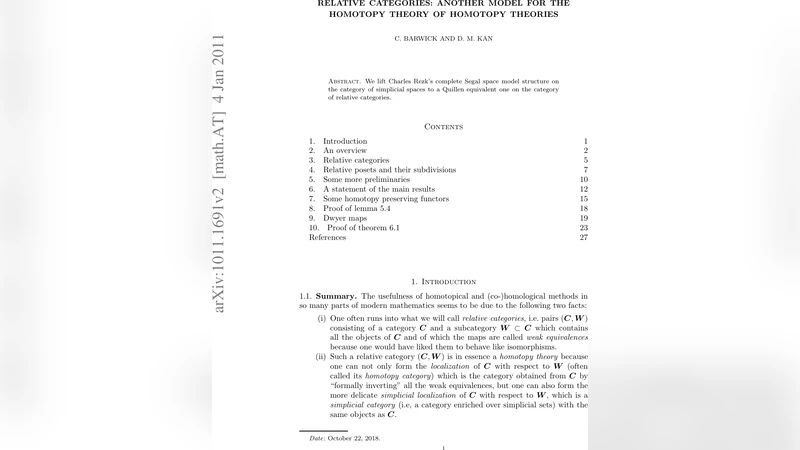
We lift Charles Rezk’s complete Segal space model structure on the category of simplicial spaces to a Quillen equivalent one on the category of relative categories.
💡 Research Summary
The paper establishes a model structure on the category of relative categories (RC) that is Quillen equivalent to Charles Rezk’s complete Segal space (CSS) model structure on simplicial spaces. A relative category is a pair (C,W) consisting of a small ordinary category C together with a subcategory W of “weak equivalences” satisfying the usual 2‑out‑of‑3 property. The authors’ goal is to lift the homotopy‑theoretic machinery that lives in the world of CSS to this more elementary categorical setting, thereby providing an alternative model for the homotopy theory of homotopy theories.
The authors begin by recalling Rezk’s CSS model: cofibrations are levelwise monomorphisms, weak equivalences are the so‑called complete Segal equivalences (maps that induce equivalences on the underlying Segal spaces and on the space of objects), and fibrant objects are precisely the complete Segal spaces, which model (∞,1)‑categories. They then define a model structure on RC. Cofibrations are taken to be all functors, which makes the model cofibrantly generated. Weak equivalences are defined to be Dwyer–Kan equivalences: a functor F:(C,W)→(D,V) is a weak equivalence if (i) it induces an equivalence after localising at the weak equivalences (i.e. C
Comments & Academic Discussion
Loading comments...
Leave a Comment