Noncommutative (generalized) sine-Gordon/massive Thirring correspondence, integrability and solitons
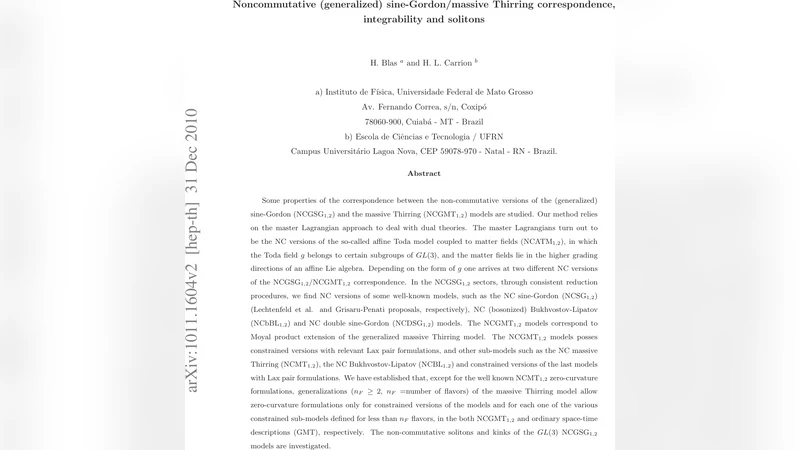
Some properties of the correspondence between the non-commutative versions of the (generalized) sine-Gordon (NCGSG${1,2}$) and the massive Thirring (NCGMT${1,2}$) models are studied. Our method relies on the master Lagrangian approach to deal with dual theories. The master Lagrangians turn out to be the NC versions of the so-called affine Toda model coupled to matter fields (NCATM${1,2}$), in which the Toda field $g$ belongs to certain subgroups of $ GL(3)$, and the matter fields lie in the higher grading directions of an affine Lie algebra. Depending on the form of $g$ one arrives at two different NC versions of the NCGSG${1,2}$/NCGMT${1,2}$ correspondence. In the NCGSG${1,2}$ sectors, through consistent reduction procedures, we find NC versions of some well-known models, such as the NC sine-Gordon (NCSG${1,2}$) (Lechtenfeld et al. and Grisaru-Penati proposals, respectively), NC (bosonized) Bukhvostov-Lipatov (NCbBL${1,2}$) and NC double sine-Gordon (NCDSG${1,2}$) models. The NCGMT${1,2}$ models correspond to Moyal product extension of the generalized massive Thirring model. The NCGMT${1,2}$ models posses constrained versions with relevant Lax pair formulations, and other sub-models such as the NC massive Thirring (NCMT${1,2}$), the NC Bukhvostov-Lipatov (NCBL${1,2}$) and constrained versions of the last models with Lax pair formulations. We have established that, except for the well known NCMT${1,2}$ zero-curvature formulations, generalizations ($n_{F} \ge 2$, $n_F=$number of flavors) of the massive Thirring model allow zero-curvature formulations only for constrained versions of the models and for each one of the various constrained sub-models defined for less than $n_F$ flavors, in the both NCGMT${1,2}$ and ordinary space-time descriptions (GMT), respectively. The non-commutative solitons and kinks of the $ GL(3)$ NCGSG${1,2}$ models are investigated.
💡 Research Summary
The paper investigates the duality between non‑commutative (NC) extensions of the (generalized) sine‑Gordon (SG) models and the massive Thirring (MT) models, focusing on integrability and soliton solutions. The authors adopt a master‑Lagrangian framework, constructing a non‑commutative affine Toda model coupled to matter fields (NCATM). In this construction the Toda field (g) takes values in specific sub‑groups of (GL(3)) while the matter fields occupy higher‑grade directions of an affine Lie algebra. By choosing different embeddings of (g) two distinct families of dual theories emerge, denoted NCGSG({1,2}) and NCGMT({1,2}).
In the NCGSG sector, systematic reductions of the master Lagrangian reproduce several well‑known NC integrable models. When (g) is restricted to a (U(1)) subgroup the resulting theory coincides with the Lechtenfeld‑et‑al. proposal for a NC sine‑Gordon model (NCSG(1)). A different reduction, where (g) belongs to an (SU(2))‑type subgroup, yields the Grisaru‑Penati version (NCSG(2)). Further reductions generate the NC double sine‑Gordon (NCDSG({1,2})) and the NC bosonized Bukhvostov‑Lipatov (NCbBL({1,2})) models. All these reductions preserve the Moyal star‑product structure and make explicit how the non‑commutativity parameter (\theta^{\mu\nu}) deforms the interaction terms.
The NCGMT side is obtained by extending the generalized massive Thirring model to the NC setting. The authors consider an arbitrary number of fermionic flavors (n_F). For (n_F\ge2) the naive NC Thirring Lagrangian does not admit a zero‑curvature (Lax‑pair) formulation, indicating a loss of classical integrability. However, by imposing suitable constraints on the currents—essentially projecting onto lower‑flavor sub‑sectors—one recovers a consistent Lax pair. The constrained models include the NC massive Thirring (NCMT({1,2})), the NC Bukhvostov‑Lipatov (NCBL({1,2})), and their further reductions. For each constrained sub‑model the authors construct explicit Lax operators and demonstrate the equivalence between the zero‑curvature condition and the equations of motion derived from the master Lagrangian. This mirrors the situation in the ordinary (commutative) generalized massive Thirring (GMT) theory, where only the flavor‑restricted sectors remain integrable.
A substantial part of the work is devoted to soliton and kink solutions of the GL(3) NCGSG models. Using the dressing method adapted to the Moyal product, the authors obtain one‑soliton, two‑soliton, and kink configurations for both the NC sine‑Gordon and NC double sine‑Gordon cases. The non‑commutativity parameter (\theta) enters the solutions through phase factors that shift the soliton position and modify the scattering phase shift. The authors compute the conserved quantities (energy, momentum, topological charge) and show that, despite the deformation, these quantities remain (\theta)-independent provided the constraints are satisfied. Moreover, they analyze soliton‑soliton collisions and find that the usual 180° phase exchange acquires an additional (\theta)-dependent contribution, a hallmark of NC integrable dynamics.
In summary, the paper establishes a comprehensive master‑Lagrangian picture that unifies various NC SG‑type models and their MT duals. It clarifies that integrability (zero‑curvature formulation) survives only in constrained flavor sectors, both in the NC and commutative descriptions. The explicit construction of NC solitons and the analysis of their scattering enrich the understanding of how non‑commutativity deforms classical integrable field theories while preserving essential conservation laws. This work thus provides a valuable framework for further studies of NC integrable models, their quantum extensions, and potential applications in string‑theoretic and condensed‑matter contexts.
Comments & Academic Discussion
Loading comments...
Leave a Comment