Productivity of sequences with respect to a given weight function
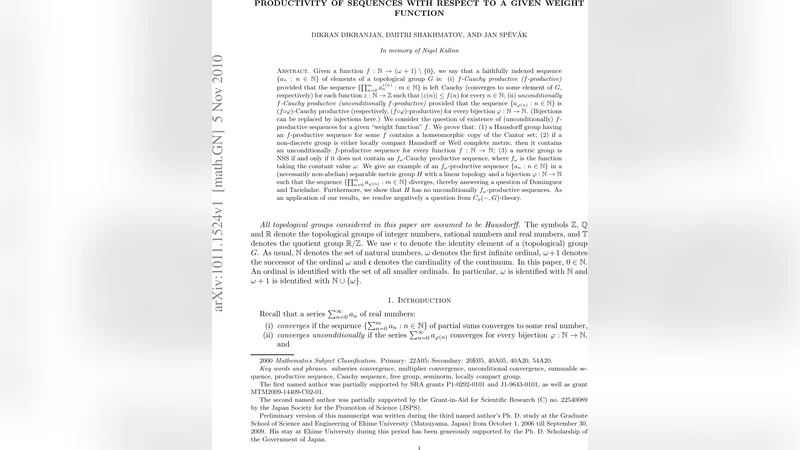
Given a function f: N –> (omega+1)-{0}, we say that a faithfully indexed sequence {a_n: n in N} of elements of a topological group G is: (i) f-Cauchy productive (f-productive) provided that the sequence {prod_{n=0}^m a_n^{z(n)}: m in N} is left Cauchy (converges to some element of G, respectively) for each function z: N –> Z such that |z(n)| <= f(n) for every n in N; (ii) unconditionally f-Cauchy productive (unconditionally f-productive) provided that the sequence {a_{s(n)}: n in N} is (f\circ s)-Cauchy productive (respectively, (f\circ s)-productive) for every bijection s: N –> N. (Bijections can be replaced by injections here.) We consider the question of existence of (unconditionally) f-productive sequences for a given “weight function” f. We prove that: (1) a Hausdorff group having an f-productive sequence for some f contains a homeomorphic copy of the Cantor set; (2) if a non-discrete group is either locally compact Hausdorff or Weil complete metric, then it contains an unconditionally f-productive sequence for every function f: N–> N; (3) a metric group is NSS if and only if it does not contain an f_omega-Cauchy productive sequence, where f_omega is the function taking the constant value omega. We give an example of an f_omega-productive sequence {a_n: n in N} in a (necessarily non-abelian) separable metric group H with a linear topology and a bijection s: N –> N such that the sequence {prod_{n=0}^m a_{s(n)}: m in N} diverges, thereby answering a question of Dominguez and Tarieladze. Furthermore, we show that H has no unconditionally f_omega-productive sequences. As an application of our results, we resolve negatively a question from C_p(-,G)-theory.
💡 Research Summary
The paper introduces a family of “productivity” notions for sequences in a topological group G that are parametrised by a weight function f : ℕ → (ω+1) \ {0}. For a faithfully indexed sequence {aₙ}ₙ∈ℕ, the authors say it is f‑Cauchy productive (or f‑productive) if for every integer‑valued function z with |z(n)| ≤ f(n) the partial products
\