B"acklund Transformations for the Kirchhoff Top
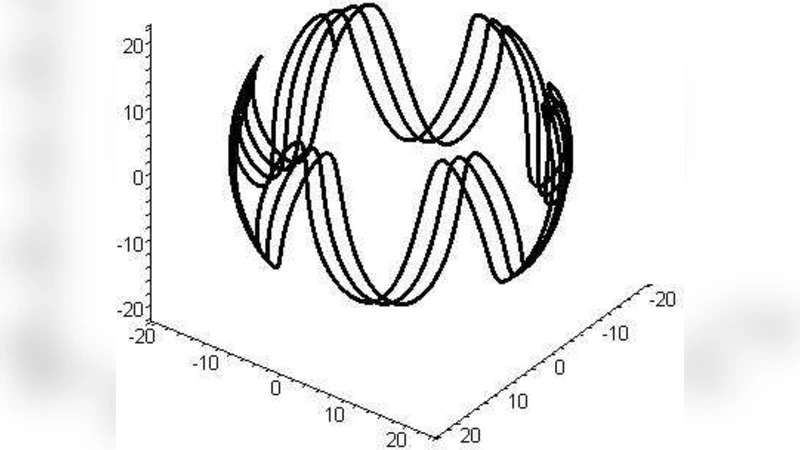
We construct B"acklund transformations (BTs) for the Kirchhoff top by taking advantage of the common algebraic Poisson structure between this system and the $sl(2)$ trigonometric Gaudin model. Our BTs are integrable maps providing an exact time-discretization of the system, inasmuch as they preserve both its Poisson structure and its invariants. Moreover, in some special cases we are able to show that these maps can be explicitly integrated in terms of the initial conditions and of the “iteration time” $n$. Encouraged by these partial results we make the conjecture that the maps are interpolated by a specific one-parameter family of hamiltonian flows, and present the corresponding solution. We enclose a few pictures where the orbits of the continuous and of the discrete flow are depicted.
💡 Research Summary
The paper presents a systematic construction of Bäcklund transformations (BTs) for the Kirchhoff top, a classical integrable rigid‑body system, by exploiting the fact that its underlying Poisson algebra coincides with that of the $sl(2)$ trigonometric Gaudin model. The authors begin by rewriting the Kirchhoff top in terms of $sl(2)$ generators $(S^+,S^-,S^3)$, whose Poisson brackets ${S^3,S^\pm}= \pm i S^\pm$, ${S^+,S^-}=2i S^3$ are identical to those appearing in the Gaudin Lax matrix $L(\lambda)$. This algebraic identification allows them to import the well‑developed BT machinery from the Gaudin context directly into the Kirchhoff setting.
A Bäcklund transformation is defined through a similarity relation $\tilde L(\lambda)=M(\lambda)L(\lambda)M^{-1}(\lambda)$, where $M(\lambda)$ is a $2\times2$ matrix depending on two auxiliary parameters: a “seed” $\mu$ and a “step” $\eta$. By solving the intertwining condition explicitly, the authors obtain closed‑form expressions for the transformed generators $(\tilde S^+, \tilde S^-, \tilde S^3)$ as rational functions of the original variables and the parameters $\mu,\eta$. Crucially, they verify that the transformation preserves the $sl(2)$ Poisson structure; the Poisson brackets among the tilded variables remain exactly the same as before. Moreover, all independent integrals of motion of the Kirchhoff top—namely the Hamiltonian (energy) and the two Casimir invariants—are shown to be invariant under the map. Consequently, the BT defines an integrable, symplectic discretization of the continuous flow.
The paper then focuses on special parameter regimes where the map can be iterated explicitly. When $\eta$ is taken to be a real (or purely imaginary) multiple of a basic step size, the $n$‑fold composition of the BT yields explicit formulas for $\tilde S^3(n)$ and $\tilde S^\pm(n)$ in terms of the initial data and the iteration index $n$. These formulas reveal that the discrete orbits coincide with the continuous trajectories sampled at equally spaced “times”, a fact illustrated by several phase‑space plots. This explicit integration demonstrates that the BT is not merely an approximation but an exact time‑discretization of the Kirchhoff dynamics.
Motivated by these observations, the authors conjecture that the discrete BT is interpolated by a one‑parameter family of continuous Hamiltonian flows $H_\tau$, with $\tau$ playing the role of an effective time step. By constructing $H_\tau$ from the generating function associated with the BT, they obtain a Hamiltonian that depends smoothly on $\tau$ and reduces to the original Kirchhoff Hamiltonian as $\tau\to0$. They solve the corresponding Hamilton equations using Laplace transform techniques, thereby providing an explicit expression for the interpolating flow. This result supports the conjecture that the BT can be viewed as the exact time‑$\tau$ map of a modified continuous system.
Overall, the work makes several significant contributions. First, it establishes a clear algebraic bridge between the Kirchhoff top and the trigonometric Gaudin model, enabling the transfer of integrable discretization tools. Second, the constructed BTs are shown to be Poisson‑preserving, symplectic, and to conserve all integrals of motion, guaranteeing that the discrete dynamics remain integrable. Third, the authors provide explicit iterated formulas for special choices of parameters, offering a rare example of a fully solvable discrete integrable map. Finally, the interpolation conjecture and its partial proof suggest a deeper geometric relationship between continuous and discrete integrable flows, opening avenues for similar constructions in other classical integrable systems and for applications in numerical integration, quantization, and the study of discrete geometry.
Comments & Academic Discussion
Loading comments...
Leave a Comment