Bivariant cyclic cohomology and Connes bilinear pairings in Non-commutative motives
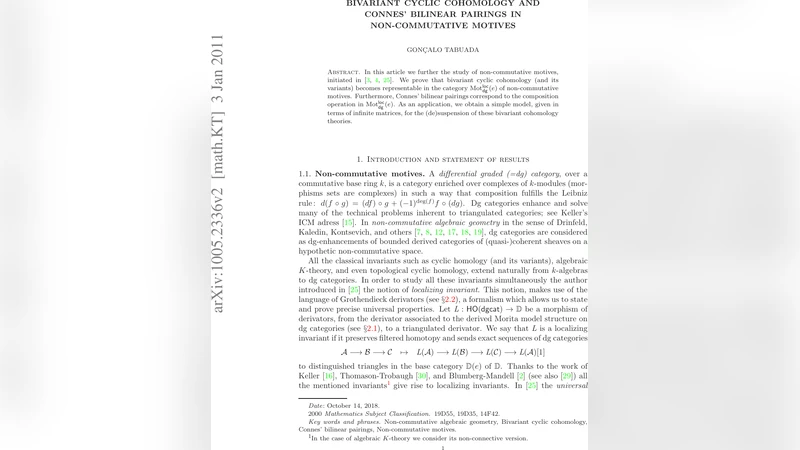
In this article we further the study of non-commutative motives. We prove that bivariant cyclic cohomology (and its variants) becomes representable in the category of non-commutative motives. Furthermore, Connes’ bilinear pairings correspond to the composition operation. As an application, we obtain a simple model, given in terms of infinite matrices, for the (de)suspension of these bivariant cohomology theories.
💡 Research Summary
This paper advances the theory of non‑commutative motives by showing that bivariant cyclic cohomology (BCC) and its standard variants (Hochschild, negative cyclic, periodic cyclic) are representable objects in the triangulated category of non‑commutative motives, Motₙc(k). The authors begin by recalling the construction of the dg‑category of complexes, Morita equivalences, and the universal additive invariant functor U: dgcat → Motₙc(k), which sends any dg‑category to its motive. Motₙc(k) is a compactly generated triangulated category equipped with a shift functor and a composition law that respects distinguished triangles.
The central result (Theorem 3.1) establishes a natural isomorphism \
Comments & Academic Discussion
Loading comments...
Leave a Comment