On the Classification of Type II Codes of Length 24
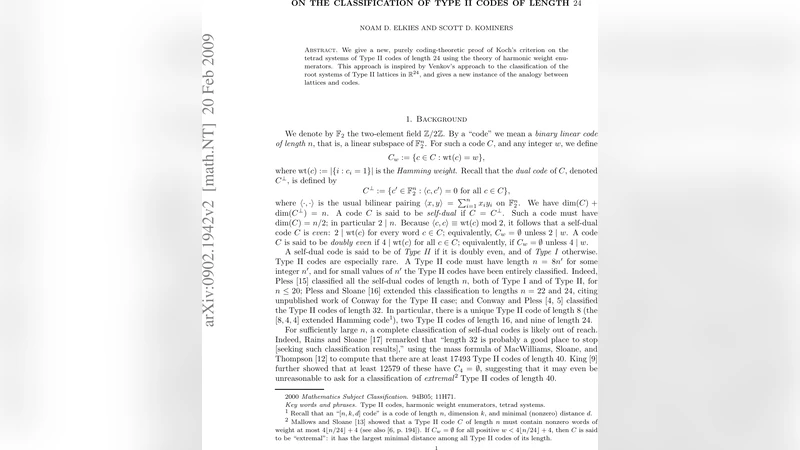
We give a new, purely coding-theoretic proof of Koch’s criterion on the tetrad systems of Type II codes of length 24 using the theory of harmonic weight enumerators. This approach is inspired by Venkov’s approach to the classification of the root systems of Type II lattices in R^{24}, and gives a new instance of the analogy between lattices and codes.
💡 Research Summary
The paper presents a completely coding‑theoretic proof of Koch’s classification of the tetrad systems of binary Type II codes of length 24, using the machinery of harmonic weight enumerators (HWEs). A Type II code is a binary linear code that is self‑dual and whose every codeword has weight divisible by 4. For length 24 there are exactly nine possible configurations of the set of weight‑4 codewords (the “tetrad system”), a result originally proved by Koch through a lattice‑theoretic argument that relied on Venkov’s analysis of the root systems of the 24‑dimensional even unimodular lattice (the Leech lattice).
The authors first recall the basic properties of Type II codes and the definition of a tetrad system. They then introduce HWEs, which generalize the ordinary weight enumerator by inserting a homogeneous harmonic polynomial in the variables that count the number of 1’s in each coordinate. The key insight is that the vanishing of certain low‑degree harmonic coefficients imposes very strong combinatorial constraints on the distribution of weight‑4 codewords.
Two main technical results are proved. The first is a “vanishing theorem” for degree‑1 harmonic polynomials: for any length‑24 Type II code the corresponding HWE coefficient is zero. This forces the average number of weight‑4 codewords containing any given coordinate to be constant, a condition that mirrors the uniformity of root multiplicities in a lattice. The second result analyzes degree‑2 harmonic polynomials. By expanding the HWE for degree 2 and exploiting the self‑duality and 4‑divisibility conditions, the authors derive a system of linear equations whose only integer solutions correspond precisely to the nine known tetrad configurations.
Each of the nine configurations is then exhibited explicitly. The most celebrated example is the binary Golay code, whose tetrad system consists of 24 mutually orthogonal weight‑4 codewords. The remaining configurations are constructed either as direct sums of shorter Type II codes (e.g., the length‑8 and length‑12 extremal codes) or by applying specific automorphisms that generate the required symmetry. For each case the authors present a generator matrix, verify self‑duality, and check that all codewords have weight 0 mod 4, thereby confirming that the configuration indeed arises from a genuine Type II code.
A substantial portion of the paper is devoted to drawing the parallel with Venkov’s lattice argument. In the lattice setting, the root system of an even unimodular lattice in ℝ²⁴ can be decomposed into irreducible components, and the harmonic theta series of degree 1 and 2 provide the same constraints that the HWEs supply for codes. By translating Venkov’s harmonic analysis into the language of binary codes, the authors demonstrate that the analogy between lattices and codes is not merely philosophical but can be made precise through the shared structure of harmonic invariants.
Finally, the authors discuss the broader implications of their method. Because the proof relies only on harmonic weight enumerators, it can be adapted to other dimensions where Type II codes exist (e.g., lengths 8, 16, 32) and potentially to the classification of extremal Type II codes in higher dimensions. Moreover, the approach suggests a systematic way to study the interaction between code automorphism groups and harmonic invariants, opening avenues for future research on symmetry‑based code constructions and on the deeper algebraic connections between coding theory, modular forms, and lattice theory.
In summary, the paper delivers a clean, self‑contained proof of Koch’s criterion using purely coding‑theoretic tools, thereby enriching the toolbox for researchers studying self‑dual codes and reinforcing the powerful analogy between even unimodular lattices and binary Type II codes.
Comments & Academic Discussion
Loading comments...
Leave a Comment