Giant Gamma-ray Bubbles from Fermi-LAT: AGN Activity or Bipolar Galactic Wind?
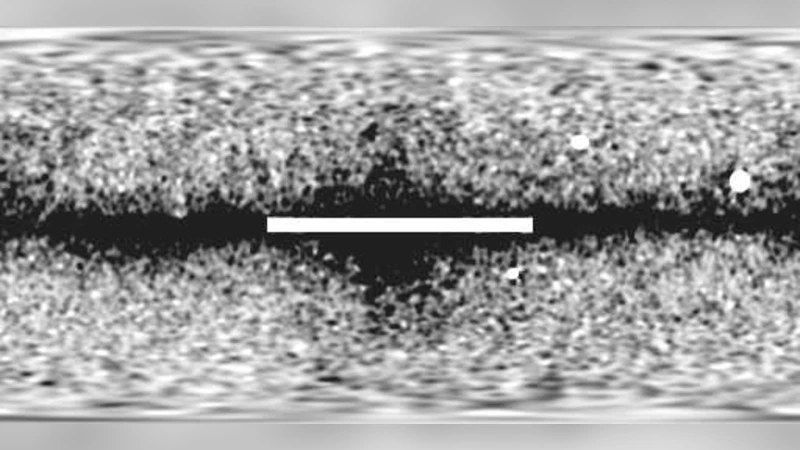
Data from the Fermi-LAT reveal two large gamma-ray bubbles, extending 50 degrees above and below the Galactic center, with a width of about 40 degrees in longitude. The gamma-ray emission associated with these bubbles has a significantly harder spectrum (dN/dE ~ E^-2) than the IC emission from electrons in the Galactic disk, or the gamma-rays produced by decay of pions from proton-ISM collisions. There is no significant spatial variation in the spectrum or gamma-ray intensity within the bubbles, or between the north and south bubbles. The bubbles are spatially correlated with the hard-spectrum microwave excess known as the WMAP haze; the edges of the bubbles also line up with features in the ROSAT X-ray maps at 1.5-2 keV. We argue that these Galactic gamma-ray bubbles were most likely created by some large episode of energy injection in the Galactic center, such as past accretion events onto the central massive black hole, or a nuclear starburst in the last ~10 Myr. Dark matter annihilation/decay seems unlikely to generate all the features of the bubbles and the associated signals in WMAP and ROSAT; the bubbles must be understood in order to use measurements of the diffuse gamma-ray emission in the inner Galaxy as a probe of dark matter physics. Study of the origin and evolution of the bubbles also has the potential to improve our understanding of recent energetic events in the inner Galaxy and the high-latitude cosmic ray population.
💡 Research Summary
The authors present a comprehensive analysis of the Fermi‑Large Area Telescope (Fermi‑LAT) data that reveals two enormous gamma‑ray structures—dubbed the “Fermi bubbles”—extending roughly 50° above and below the Galactic Center (GC) and spanning about 40° in longitude. By subtracting state‑of‑the‑art GALPROP foreground models from the all‑sky gamma‑ray maps, they isolate a residual component that is spatially coherent, sharply bounded, and remarkably uniform in intensity and spectral shape. Spectral fitting shows that the bubbles emit with a hard power‑law spectrum dN/dE ∝ E⁻² across the 1–100 GeV band, significantly harder than the inverse‑Compton (IC) emission from disk electrons (∼E⁻²·⁷) or the pion‑decay gamma rays produced by cosmic‑ray protons interacting with interstellar gas. No statistically significant variation is found between the northern and southern bubbles or within each bubble, indicating a single, well‑mixed population of high‑energy particles.
Multi‑wavelength comparisons reveal that the bubble edges line up with features in the ROSAT 1.5–2 keV X‑ray maps, and the interior correlates with the hard‑spectrum microwave excess known as the WMAP haze. This spatial coincidence strongly suggests that the same population of relativistic electrons is responsible for both the IC gamma rays and the synchrotron microwave emission. Assuming typical magnetic fields of a few μG, the required electron energy density is ≈10⁻⁹ erg cm⁻³, implying a total energy content of order 10⁵⁵–10⁵⁶ erg for the entire bubble system.
The authors evaluate three broad classes of origin: (1) a past episode of active galactic nucleus (AGN)‑like activity from the central supermassive black hole (Sgr A*), (2) a nuclear starburst driving a powerful galactic wind, and (3) exotic dark‑matter annihilation or decay. They argue that dark‑matter scenarios cannot simultaneously reproduce the hard gamma‑ray spectrum, the sharp edges, and the multi‑wavelength correlations, making them unlikely as the primary cause. In contrast, both AGN jet/outflow and starburst wind models naturally generate strong shocks that can accelerate electrons to the required energies, produce a uniform interior, and create the observed sharp boundaries through contact discontinuities with the surrounding halo gas. The estimated energy budget and the inferred timescale (≤ 10 Myr) favor a relatively brief, high‑power injection event rather than a long‑term steady process.
In summary, the paper establishes the Fermi bubbles as a distinct, large‑scale Galactic phenomenon that records a recent, energetic episode in the GC—most plausibly a bout of accretion‑driven outflow from Sgr A* or a vigorous nuclear starburst. Understanding these bubbles is essential not only for reconstructing the recent energetic history of the Milky Way but also for correctly modeling the diffuse gamma‑ray background, which is a critical foreground for indirect dark‑matter searches. The work opens new avenues for studying high‑latitude cosmic‑ray populations, halo gas dynamics, and the interplay between central engine activity and the Galactic environment.
Comments & Academic Discussion
Loading comments...
Leave a Comment