Edge Coloring of Triangle-Free 1-Planar Graphs
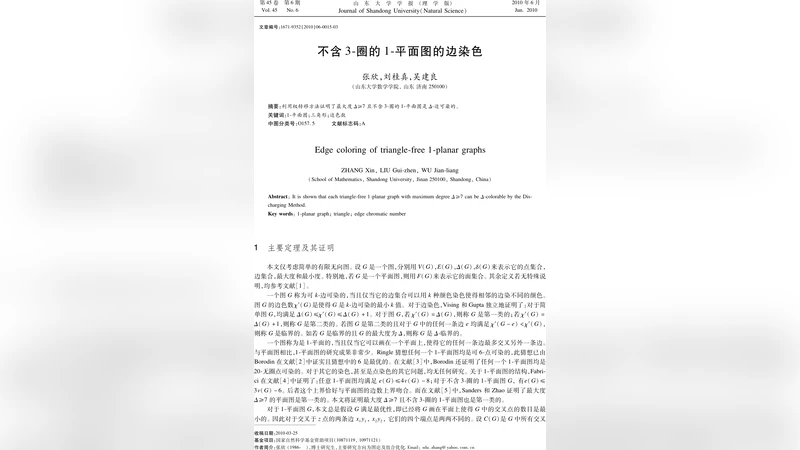
it is shown that each triangle-free 1-planar graph with maximum degree $\Delta\geq7$ can be $\Delta$-colorable by Discharging Method.
💡 Research Summary
The paper investigates the edge‑coloring problem for a special class of non‑planar graphs known as 1‑planar graphs, under the additional restriction that the graphs contain no triangles. A graph is 1‑planar if it can be drawn in the plane so that each edge is crossed at most once. The authors focus on graphs whose maximum degree Δ is at least seven and prove that such graphs are Δ‑edge‑colorable, i.e., the chromatic index χ′(G) equals Δ. The result extends the classical Vizing theorem and the well‑known fact that planar graphs with Δ ≥ 7 belong to Class I (Δ‑colorable) to a broader family that permits a limited amount of edge crossing.
The proof proceeds by contradiction. Assume that there exists a minimal counterexample G: a triangle‑free 1‑planar graph with Δ ≥ 7 that is not Δ‑edge‑colorable, yet every proper subgraph of G is Δ‑colorable. Minimality forces G to be Δ‑regular or to have vertices of degree Δ − 1 only, and any vertex of degree Δ − 1 must be adjacent to a specific configuration of Δ‑vertices. The authors first establish a series of structural lemmas that describe how vertices of degree Δ − 1 can be embedded in a 1‑planar drawing without creating triangles. In particular, they show that each Δ − 1 vertex must be incident with at least three Δ‑vertices, and that the surrounding faces have length at least four, a consequence of the triangle‑free condition.
Having fixed the structural groundwork, the authors apply the discharging method, a technique traditionally used in the proof of the Four‑Color Theorem and many results on planar graphs. They assign an initial “charge” to each vertex v equal to μ(v) = d(v) − 4, where d(v) is the degree of v. Because Δ ≥ 7, vertices of degree Δ start with a positive charge of at least three, while Δ − 1 vertices start with a negative charge of –3. The discharging rules are designed to transfer charge from high‑degree vertices to low‑degree ones while respecting the 1‑planar embedding and the absence of triangles:
- Rule R1 – Each Δ‑vertex gives one unit of charge to each adjacent Δ − 1 vertex.
- Rule R2 – If a Δ − 1 vertex is adjacent to fewer than three Δ‑vertices, it receives additional charge from neighboring Δ‑vertices through a secondary redistribution that exploits the fact that any two Δ‑vertices sharing a Δ − 1 neighbor cannot be adjacent themselves (otherwise a triangle would appear).
- Rule R3 – No charge is transferred across crossing edges; the crossing structure of a 1‑planar drawing limits the adjacency relations, ensuring that the redistribution does not create contradictions.
After applying these rules, every vertex ends with a non‑negative final charge μ′(v) ≥ 0. This outcome contradicts the assumption that a minimal counterexample exists, because the total sum of initial charges is negative (the sum over all vertices of d(v) − 4 equals 2|E| − 4|V|, which is negative for a triangle‑free 1‑planar graph with Δ ≥ 7). The contradiction forces the conclusion that no such counterexample can exist, and therefore every triangle‑free 1‑planar graph with maximum degree at least seven is Δ‑edge‑colorable.
The paper also situates its contribution within the broader literature. For planar graphs, the result that Δ ≥ 7 implies Class I status is classical; for 1‑planar graphs, the presence of edge crossings generally raises the chromatic index, and examples are known where Δ‑colorability fails for smaller Δ. By imposing the triangle‑free condition, the authors effectively limit the local density of the graph, which in turn controls the possible configurations of crossing edges. This restriction makes the discharging argument viable and yields a clean Δ‑colorability theorem.
In the concluding section, the authors outline several directions for future research. One natural extension is to lower the bound on Δ and investigate whether Δ‑colorability holds for Δ = 6 under the same triangle‑free hypothesis. Another avenue is to relax the triangle‑free condition while imposing alternative constraints, such as a lower bound on face length or restrictions on the number of crossings per edge. Finally, the authors suggest that the discharging framework developed here could be adapted to other coloring problems on 1‑planar graphs, including vertex coloring and face coloring, potentially leading to new results that parallel those known for planar graphs. The paper thus not only resolves a specific edge‑coloring question but also provides methodological tools that may be valuable for tackling a wider class of problems in topological graph theory.
Comments & Academic Discussion
Loading comments...
Leave a Comment