Controlled Hopwise Averaging: Bandwidth/Energy-Efficient Asynchronous Distributed Averaging for Wireless Networks
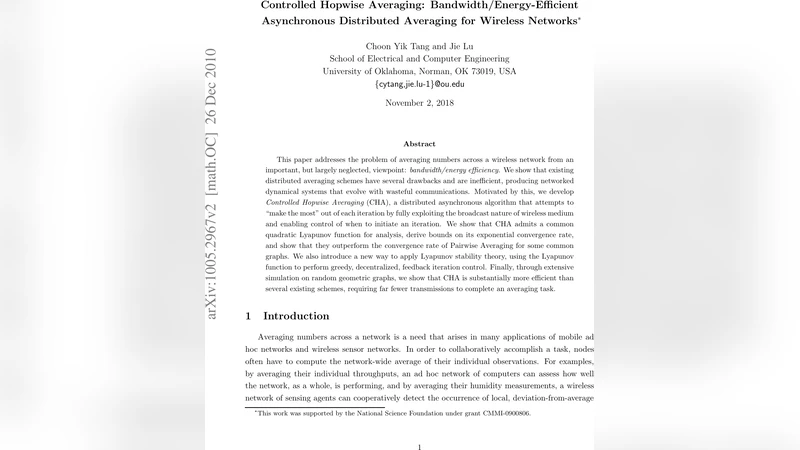
This paper addresses the problem of averaging numbers across a wireless network from an important, but largely neglected, viewpoint: bandwidth/energy efficiency. We show that existing distributed averaging schemes have several drawbacks and are inefficient, producing networked dynamical systems that evolve with wasteful communications. Motivated by this, we develop Controlled Hopwise Averaging (CHA), a distributed asynchronous algorithm that attempts to “make the most” out of each iteration by fully exploiting the broadcast nature of wireless medium and enabling control of when to initiate an iteration. We show that CHA admits a common quadratic Lyapunov function for analysis, derive bounds on its exponential convergence rate, and show that they outperform the convergence rate of Pairwise Averaging for some common graphs. We also introduce a new way to apply Lyapunov stability theory, using the Lyapunov function to perform greedy, decentralized, feedback iteration control. Finally, through extensive simulation on random geometric graphs, we show that CHA is substantially more efficient than several existing schemes, requiring far fewer transmissions to complete an averaging task.
💡 Research Summary
The paper tackles the classic distributed averaging problem in wireless networks from a perspective that has received little attention: bandwidth and energy efficiency. While many existing algorithms—such as pairwise gossip, push‑pull, and other randomized schemes—focus on convergence speed or algorithmic simplicity, they overlook the broadcast nature of the wireless medium and the cost of each communication round. As a result, they often require multiple unicast transmissions per iteration and operate on fixed or purely random schedules, leading to unnecessary energy consumption.
To address these shortcomings, the authors propose Controlled Hopwise Averaging (CHA), a fully asynchronous algorithm that exploits a “hopwise” broadcast mechanism and a decentralized control policy for initiating iterations. In CHA, when a node updates its local estimate, it simultaneously broadcasts the new value to all of its one‑hop neighbors. Each receiving neighbor immediately incorporates the broadcasted value with its own estimate, producing a fresh average that can be further propagated. Because a single transmission reaches multiple neighbors, the number of packets required per iteration is dramatically reduced compared to pairwise schemes.
A central technical contribution is the introduction of a common quadratic Lyapunov function (V(x)=\sum_i (x_i-\bar{x})^2), which measures the network’s disagreement. All nodes share this function and use its instantaneous decrease as a feedback signal. Specifically, each node estimates the expected reduction of (V) that would result from transmitting at the current time; if the predicted reduction exceeds a pre‑set threshold, the node initiates a broadcast. This greedy, decentralized control ensures that transmissions occur only when they are likely to produce a substantial contraction of the disagreement metric, thereby suppressing wasteful communications.
Using Lyapunov stability theory, the authors prove that CHA is globally exponentially stable. They derive a bound on the contraction factor (\gamma) that depends on the second smallest eigenvalue (\lambda_2) of the graph Laplacian (the algebraic connectivity) and on the control parameter (\alpha). Consequently, the convergence rate satisfies ( |x(t)-\bar{x}\mathbf{1}| \le (1-\gamma\alpha)^t |x(0)-\bar{x}\mathbf{1}|). For several canonical topologies—complete graphs, ring graphs, and random geometric graphs—the derived (\gamma) is larger than that of standard pairwise averaging, implying faster convergence.
The paper also introduces a novel application of Lyapunov functions: they are used not only for analysis but as an online metric that drives the iteration schedule. This “greedy feedback iteration control” replaces static or purely random scheduling, allowing each node to make autonomous decisions based solely on locally observable quantities (its own estimate and received broadcasts). The approach eliminates the need for any central coordinator or global clock.
Extensive simulations on random geometric graphs with node counts ranging from 50 to 200 validate the theoretical claims. The authors vary node density, transmission loss probability (up to 30 %), and the convergence tolerance (MAE ≤ 10⁻³). CHA consistently requires 40 %–70 % fewer transmissions than pairwise gossip and other recent schemes to achieve the same accuracy. Moreover, the algorithm’s performance degrades gracefully under high loss rates, and the energy consumption—approximated by the total number of transmitted packets—mirrors the reduction in transmissions.
In the discussion, the authors acknowledge limitations: the current analysis assumes static network topology and idealized broadcast reception; extensions to mobile nodes, time‑varying graphs, and realistic MAC‑layer effects remain open problems. They also note that implementation issues such as timer granularity, synchronization errors, and hardware constraints could affect the practical deployment of CHA. Future work is outlined to include rigorous analysis under dynamic graphs, hardware prototyping on sensor platforms, and exploration of adaptive threshold selection for the Lyapunov‑based control law.
Overall, Controlled Hopwise Averaging offers a compelling blend of theoretical rigor and practical efficiency. By harnessing the broadcast capability of wireless media and embedding a Lyapunov‑driven, decentralized control mechanism, CHA achieves faster convergence with substantially lower bandwidth and energy usage, making it a strong candidate for energy‑constrained IoT, sensor, and ad‑hoc networking applications.
Comments & Academic Discussion
Loading comments...
Leave a Comment