Fredholm realizations of elliptic symbols on manifolds with boundary II: fibered boundary
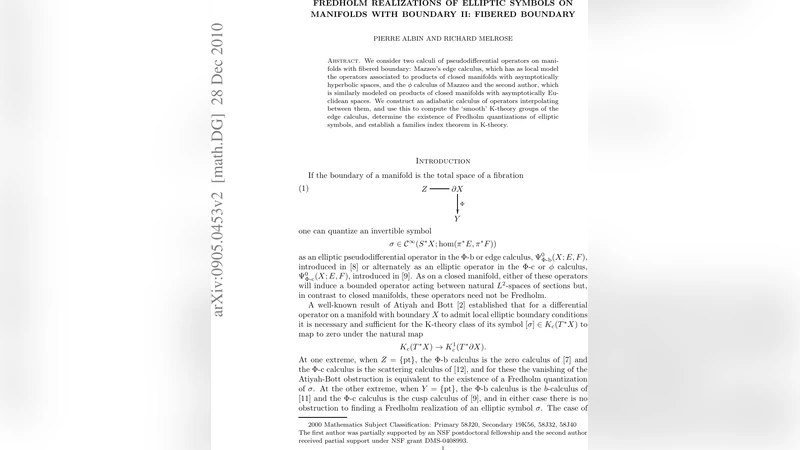
We consider two calculi of pseudodifferential operators on manifolds with fibered boundary: Mazzeo’s edge calculus, which has as local model the operators associated to products of closed manifolds with asymptotically hyperbolic spaces, and the phi calculus of Mazzeo and the second author, which is similarly modeled on products of closed manifolds with asymptotically Euclidean spaces. We construct an adiabatic calculus of operators interpolating between them, and use this to compute the `smooth’ K-theory groups of the edge calculus, determine the existence of Fredholm quantizations of elliptic symbols, and establish a families index theorem in K-theory.
💡 Research Summary
The paper studies two calculi of pseudodifferential operators on manifolds whose boundaries are equipped with a fibration structure: Mazzeo’s edge calculus and the φ‑calculus introduced by Mazzeo and the second author. The edge calculus models operators on products of closed manifolds with asymptotically hyperbolic spaces, while the φ‑calculus models products with asymptotically Euclidean spaces. Because the asymptotic geometries differ, the associated symbol algebras and K‑theoretic invariants behave differently, making it difficult to transfer results from one setting to the other.
To bridge this gap the authors construct an “adiabatic” calculus depending on a parameter ε. As ε → 0 the adiabatic calculus collapses to the φ‑calculus; as ε → ∞ it converges to the edge calculus. This interpolation is achieved by a careful blow‑up construction on the double space and by defining a global symbol map that respects both asymptotic regimes. The adiabatic calculus provides a continuous family of operator algebras linking the two previously unrelated calculi.
Using this bridge the authors compute the “smooth” K‑theory groups of the edge calculus, denoted K_e^(M). They prove that K_e^(M) is naturally isomorphic to the K‑theory of the φ‑calculus, K_φ^*(M). The isomorphism is realized by sending an edge‑symbol class to its adiabatic limit in the φ‑setting. Consequently, all K‑theoretic information known for the φ‑calculus (including index pairings and characteristic class formulas) transfers verbatim to the edge calculus.
A major application concerns the Fredholm quantization problem: given an elliptic symbol σ on a fibered‑boundary manifold, when does there exist a fully elliptic operator in the edge calculus whose principal symbol is σ? The authors show that σ admits a Fredholm quantization precisely when its class in K_e^*(M) maps to a non‑trivial element under the adiabatic isomorphism and satisfies a certain obstruction vanishing condition related to the boundary fibration. This provides a complete necessary and sufficient criterion, extending earlier partial results that only covered special cases.
Finally, the paper establishes a families index theorem in K‑theory for the edge calculus. For a smooth family {P_b}_b∈B of fully elliptic edge operators parametrized by a compact base B, the analytic index defines an element Ind(P) ∈ K^0(B). By passing to the adiabatic limit, the authors identify Ind(P) with the index class of the corresponding φ‑family, for which a topological formula is already known. Thus the families index theorem for edge operators follows from the φ‑calculus version, yielding an explicit K‑theoretic formula involving the Chern character of the symbol and the Todd class of the vertical tangent bundle of the boundary fibration.
In summary, the work introduces a powerful adiabatic interpolation that unifies two previously distinct pseudodifferential calculi on fibered‑boundary manifolds. It resolves the K‑theoretic structure of the edge calculus, gives a full answer to the Fredholm quantization problem for elliptic symbols, and proves a families index theorem in this setting. The methods combine microlocal analysis, blow‑up geometry, and modern K‑theory, and they open the way for further applications to geometric analysis on manifolds with more intricate asymptotic structures.
Comments & Academic Discussion
Loading comments...
Leave a Comment