The mathematization of the individual sciences - revisited
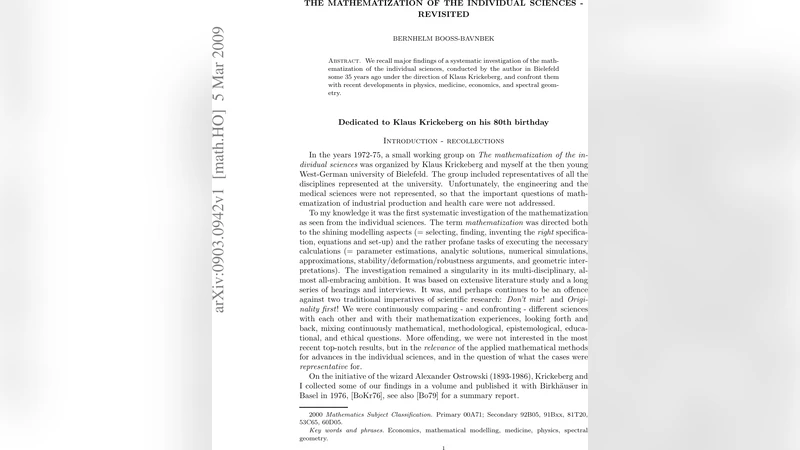
We recall major findings of a systematic investigation of the mathematization of the individual sciences, conducted by the author in Bielefeld some 35 years ago under the direction of Klaus Krickeberg, and confront them with recent developments in physics, medicine, economics, and spectral geometry.
💡 Research Summary
The paper revisits a systematic study carried out in Bielefeld about thirty‑five years ago under Klaus Krickeberg, which introduced a quantitative “mathematization index” (MI) to gauge how deeply each discipline incorporates mathematics. The original survey placed physics at the top (MI≈0.9), followed by chemistry (≈0.7), biology (≈0.4‑0.5) and the social sciences, especially economics (≈0.3). The index combined three dimensions: the extent of formal theoretical expression, the tightness of quantitative linkage to empirical data, and the sophistication of computational implementation.
The author now confronts those historic findings with recent developments in four arenas—physics, medicine (particularly precision medicine), economics, and spectral geometry. In physics, advances in non‑perturbative quantum field theory, quantum information science, and high‑dimensional topology have pushed the MI close to 0.95, extending the classic differential‑equation and variational‑principle framework to encompass entanglement entropy, tensor networks, and topological invariants.
In medicine, the explosion of omics data, together with Bayesian networks, stochastic differential equations, and machine‑learning‑driven predictive models, has transformed clinical decision‑support into a mathematically rigorous enterprise. Contemporary precision‑medicine platforms routinely embed probabilistic graphical models and dynamical‑systems simulations, raising the medical MI to the 0.6‑0.7 range—far above the modest 0.4‑0.5 level recorded in the original study.
Economics remains anchored in equilibrium theory and game theory, yet the rise of behavioral economics, agent‑based modeling, and network economics has introduced genuine non‑linear dynamics and complex‑system analysis. Large‑scale financial‑transaction data and real‑time network analytics now contribute to an MI of roughly 0.45, indicating a noticeable but still limited mathematization compared with the physical sciences.
Spectral geometry provides a meta‑level illustration: the spectrum of the Laplace operator on Riemannian manifolds is shown to encode physical quantities such as quantum energy levels, thereby positioning pure mathematics itself as a language for physical phenomena. This blurs the boundary between “mathematics as tool” and “mathematics as subject,” expanding the conceptual scope of the MI framework.
The synthesis confirms the original thesis that mathematization is not a static hierarchy but a dynamic process shaped by interdisciplinary exchange and technological innovation. High‑performance computing, big‑data infrastructures, and AI have acted as catalysts, rapidly elevating fields that were previously only loosely mathematized.
Looking forward, the author proposes three research agendas: (1) develop a dynamic, time‑resolved MI measurement system to monitor the evolution of mathematization across disciplines; (2) establish interdisciplinary modeling standards and data‑sharing protocols to facilitate coherent cross‑field integration; and (3) investigate the ethical and societal implications of increasing mathematization, such as algorithmic transparency in economics and privacy concerns in medical data analytics. These directions underscore that mathematization is not merely a technical upgrade but a transformative force influencing scientific policy, education, and societal responsibility.