Relative Chern character, boundaries and index formulae
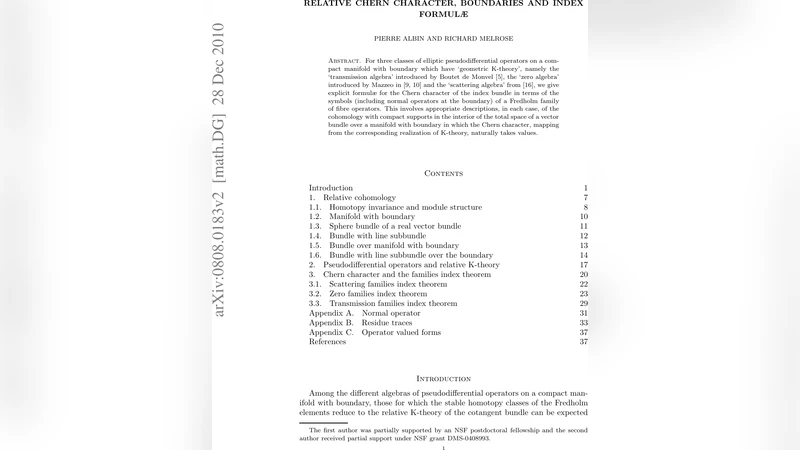
For three classes of elliptic pseudodifferential operators on a compact manifold with boundary which have geometric K-theory', namely the transmission algebra’ introduced by Boutet de Monvel, the zero algebra' introduced by Mazzeo and the scattering algebra’ from [MR95k:58168] we give explicit formulae for the Chern character of the index bundle in terms of the symbols (including normal operators at the boundary) of a Fredholm family of fibre operators. This involves appropriate descriptions, in each case, of the cohomology with compact supports in the interior of the total space of a vector bundle over a manifold with boundary in which the Chern character, mapping from the corresponding realization of K-theory, naturally takes values.
💡 Research Summary
The paper investigates three families of elliptic pseudodifferential operators on a compact manifold with boundary that admit a geometric K‑theory description: Boutet de Monvel’s transmission algebra, Mazzeo’s zero algebra, and Melrose’s scattering algebra. For each algebra the authors construct an explicit Chern character formula for the index bundle of a Fredholm family of fibre operators, expressed solely in terms of the interior symbols and the normal operators that live on the boundary (or at infinity in the scattering case).
The authors begin by recalling that the classical Atiyah–Singer index theorem identifies the K‑theoretic class of an elliptic operator with a cohomology class obtained via the Chern character. When a boundary is present, the operator’s symbol data splits into an interior symbol and a boundary symbol (the normal operator). The transmission algebra precisely packages these two pieces into a single K‑theory element. The paper defines a “relative Chern character” ch_rel : K_rel → H_c^{even} that maps this pair to a compact‑support cohomology class on the total space of the underlying vector bundle, after removing the boundary. The resulting formula separates the contribution of the interior symbol (integrated over the interior) from the contribution of the boundary symbol (integrated over the boundary), with the Todd class of the tangent bundles appearing as usual.
For the zero algebra, the geometry near the boundary is altered by a 0‑blow‑up construction. The normal operator now lives on a “zero‑section” that is not a genuine submanifold, and the symbol calculus is adapted accordingly. The authors show that the K‑theory of the zero algebra can be identified with a group of “transferable” K‑classes. By developing a compact‑support cohomology theory on the blown‑up total space, they obtain a Chern character formula that again splits into an interior term and a boundary term, the latter involving the normal operator of the zero algebra. The key technical point is the removal of the zero‑section from the interior, which guarantees that the cohomology class has compact support.
The scattering algebra treats operators that are asymptotically translation‑invariant at infinity. Its normal operator is defined on the “sphere at infinity” and carries a non‑homogeneous symbol. The authors introduce a reduced cohomology theory that accommodates the non‑compactness of the scattering cotangent bundle. Within this framework they construct a Chern character that includes an additional term coming from the symbol at infinity. The resulting index formula contains three pieces: an interior integral, a boundary integral (if a physical boundary is present), and an “infinity” integral that captures the scattering contribution.
All three cases share a common structure: the Chern character takes values in the compact‑support cohomology of the interior of the total space of a vector bundle over a manifold with boundary. By carefully describing this cohomology—using relative cohomology for the transmission case, blown‑up compact‑support cohomology for the zero case, and reduced cohomology for the scattering case—the authors provide a unified perspective on how boundary and asymptotic data enter the index. The final formulas can be schematically written as
- Transmission: ch(Index P) = ∫X ch(σ_int)·Td(TX) − ∫{∂X} ch(σ_bdy)·Td(T∂X)
- Zero: ch(Index P) = ∫{X\setminus 0‑section} ch(σ_int)·Td(TX) − ∫{∂X} ch(Norm P)·Td(T∂X)
- Scattering: ch(Index P) = ∫X ch(σ_sc)·Td(TX) − ∫{∞} ch(σ_sc,∞)·Td(T∞).
These expressions generalize the Atiyah–Singer theorem by adding explicit “relative” correction terms that encode the effect of the boundary or of infinity. The paper also discusses potential applications: boundary value problems with non‑local transmission conditions, analysis on manifolds with conical or edge singularities, and physical models where boundary or scattering phenomena play a central role (e.g., quantum field theory on manifolds with edge states). By establishing a clear bridge between geometric K‑theory and explicit cohomological representatives, the work opens the way for further extensions to non‑commutative geometry, families index theory, and equivariant settings where similar relative Chern characters may be defined.
Comments & Academic Discussion
Loading comments...
Leave a Comment